Tortuga Island, Costa Rica: The Complete Travel Guide
Isla Tortuga is a car-free, uninhabited island in the Gulf of Nicoya that you can only reach by boat and only visit for the day. Here is how the whole thing works, from departure point to return crossing.
Booking Choice: An island lunch, snorkeling equipment and a Negritos wildlife stop. Explore Puntarenas Island Day: Shared Or Private
Start: Puntarenas. Confirm age rules and extras before booking.
Price note: fixed dollar amounts and totals in the editorial examples below are planning illustrations, not current quotes. Prices, child rates and private/shared options must be checked for your date and full party. The provider calendars and booking pages carry current offers.
A Tortuga Island day, hour by hour
The bars break a standard ten-hour Jaco departure into its real segments, using the published tour timeline from pickup at 7:30am to marina return at 5:30pm.
Where is Tortuga Island, and what exactly are you visiting?
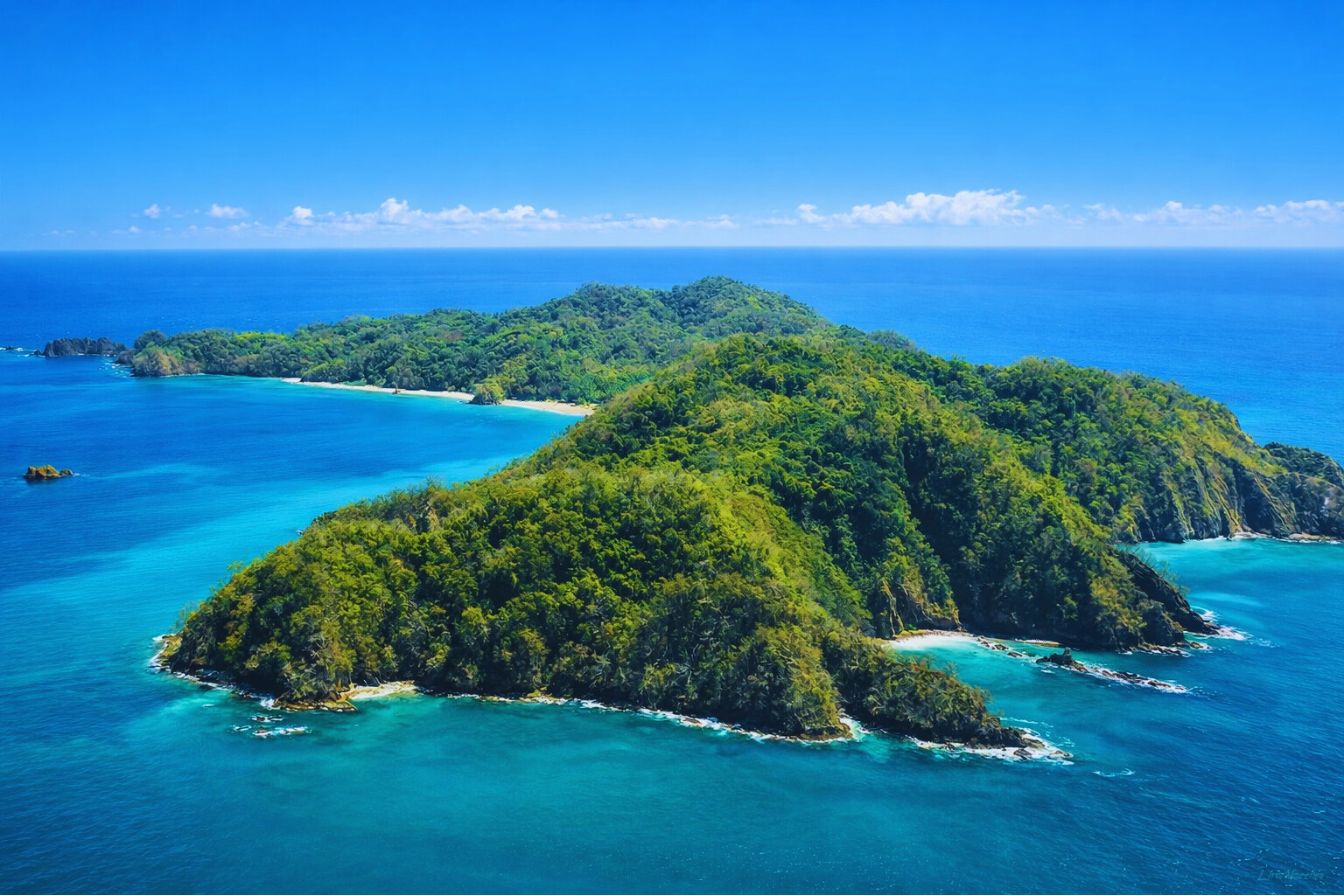
Tortuga Island sits in the Gulf of Nicoya on Costa Rica's Pacific coast, roughly 12 kilometres off the southeastern tip of the Nicoya Peninsula. It is uninhabited, car-free, and reachable only by boat. Every visit is a day trip, because there is no accommodation on the island and overnight stays are not permitted.
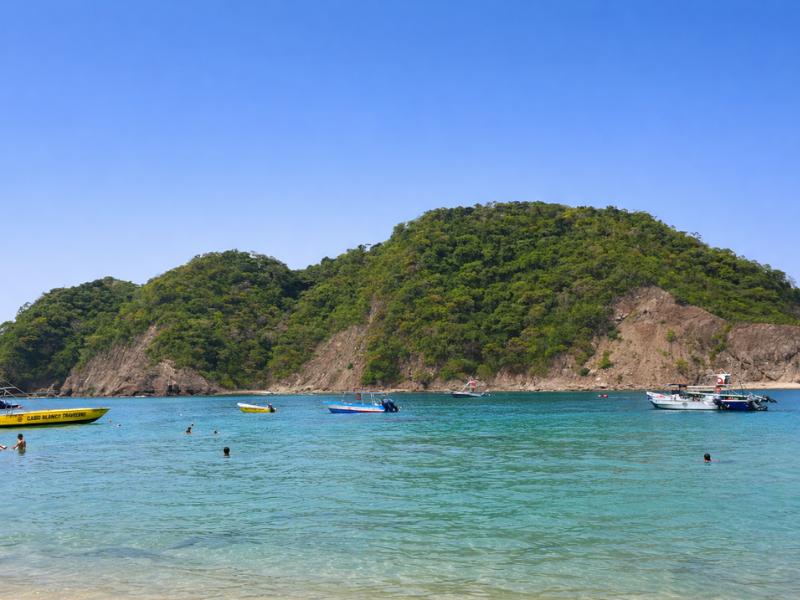
The first thing to fix in your head is the geography, because two different Costa Rican places share a similar name and travellers book the wrong one every season. Isla Tortuga is Pacific. It faces the Nicoya Peninsula across a warm, mostly sheltered gulf, and the water around it is the flat turquoise that shows up in every photograph. Tortuguero, by contrast, is a Caribbean national park of canals and turtle nesting beaches, several hours away on the opposite side of the country, with no road access at all. The two have nothing in common beyond the Spanish word for turtle.
What you are actually visiting is a beach, a reef, and a fringe of dry tropical forest. Playa Tortuga curves in a long pale arc, the sand is powdery rather than coarse, and palms lean over the top of it. Offshore, a shallow volcanic reef sits within easy swimming range. Behind the sand, the forest climbs quickly and stays mostly out of bounds. There is no village, no road, no shop of any consequence, no hotel and no cash machine. There are hammocks, a kitchen setup that the boat crews run, a stone arch viewpoint, and a small paid restroom block.
That absence is the point. The island is quiet because nobody lives there, and it stays clean because nobody stays overnight. The soundtrack on a good morning is waves, seabirds, and the occasional howler monkey chorus rolling out of the jungle edge. For context on the wider body of water you are crossing, the Gulf of Nicoya is one of the most productive estuarine systems on the Pacific coast of Central America, which is a large part of why the marine life around the island is as busy as it is.
| Detail | The fact | What it means for your day |
|---|---|---|
| Location | Gulf of Nicoya, Pacific coast, off the southeastern tip of the Nicoya Peninsula | Warm, mostly sheltered water rather than open ocean swell |
| Distance from mainland | About 12 km, roughly 7 miles | Short enough for a day trip, far enough that you need a real boat |
| Structure | Two uninhabited islands, Alcatraz and Tolinga | Boats land on one beach; the other is scenery, not a stop |
| Protection | Part of the Islas Negritos Biological Reserve | Limited landings, no development, no overnight stays |
| Access | Boat only, on an organised day tour | No road and no scheduled public service, so almost everyone arrives on a day tour |
| Facilities | Beach kitchen, hammocks, paid restrooms, no accommodation | Bring cash and everything you need for the day |
| Nearest international airport | Juan Santamaria, SJO, San Jose | About 1.5 hours by road to Puntarenas, the main departure port |
Why is Tortuga actually two islands, and does the reserve status matter?
Check the departure and cancellation terms for your actual travel date before arranging connecting transport. The product listings do not establish a guaranteed early landing, a fixed island-wide boat cap or how often a departure sells out.
Isla Tortuga and the Negritos islands are separate places in the Gulf of Nicoya. Some tours pass Negritos for wildlife viewing before visiting Tortuga. The excursions recommended here return the same day and do not include accommodation. Related reading: Sistema Nacional de Areas de Conservacion
Check the departure and cancellation terms for your actual travel date before arranging connecting transport. The product listings do not establish a guaranteed early landing, a fixed island-wide boat cap or how often a departure sells out.
Near the islands, the reserve extends to the Negritos group, and this is where several tours make a short stop before reaching the beach. From the Puntarenas side the Negritos stop comes up about 25 minutes in. Boats slow along the shoreline while guides scan the canopy for spider monkeys, which live on the reserve islands and are visible often enough that operators build the stop into the itinerary rather than treating it as a bonus. Dolphins turn up on the same stretch with some regularity.
None of this is presented to you with signage or a ranger station. The reserve is not a park you walk into. It is a boundary drawn on the water that determines how many boats arrive, how long they stay, and what is left standing on the sand at the end of the day.
Why is Tortuga Island a day trip and nothing else?
Isla Tortuga and the Negritos islands are separate places in the Gulf of Nicoya. Some tours pass Negritos for wildlife viewing before visiting Tortuga. The excursions recommended here return the same day and do not include accommodation.
Plenty of travellers arrive in Costa Rica hoping to build an island night into the itinerary, and it is worth killing that idea early so it does not distort your planning. You cannot camp. You cannot rent a cabin. There is no ranger hut that takes bookings and no informal arrangement with a boat captain that gets around it. The last boat leaves and the beach empties.
What this produces is a day with a hard shape at both ends. The boat departs at a fixed hour, and it returns at a fixed hour, and you are working inside that window whether or not the snorkelling is good and whether or not the light is perfect at four in the afternoon. It also means the return crossing is non-negotiable, which is a real consideration if anyone in your group is prone to seasickness and would rather not repeat the trip after a long day in the sun.
The second consequence is arrival timing. Because everyone is on a day schedule, the boats converge. First departures leave around 8 to 9am from Paquera, Montezuma or Tambor. Crowds peak between 11am and 2pm, when boats from every departure point are on the sand at once. Arriving at 11am can mean four other tour boats have already landed. Arriving at 9am means the first hour is close to yours alone. Same island, same price, materially different day.
The third consequence is that the island rewards a certain kind of pacing. There is no ferry to catch onward and nothing to see beyond the beach, the reef, the short trails and the stone arch viewpoint. Once you accept the day is a beach day, it works. Once you have decided how to get to Tortuga Island, the departure point you choose is what determines how much of that day survives the transfer.
Which departure point should you actually choose?
Six departure points serve Isla Tortuga, and the choice changes your day far more than the island does. Santa Teresa and Montezuma give the shortest crossing at 45 minutes. Puntarenas is the cheapest and most direct. San Jose is the most convenient if you have no car, and the longest by a wide margin.
The honest framing is this: the island is identical from every boat. Same sand, same reef, same lunch on the beach. What varies is how much travel you wrap around it, what you see along the way, and what you pay. Work backwards from where you are sleeping the night before, not from which tour photograph looks best.
| Departure point | Crossing time | Listed day length | Price from | Best for |
|---|---|---|---|---|
| Puntarenas, Las Playitas private dock | About 60 to 90 minutes | 12 hours door to door | $80 | Best value, showers and changing rooms at the dock on return |
| Puntarenas, Guima Frost marina, private charter | About 60 to 90 minutes | 7 hours | $125 | Families and groups who want the whole boat and a Negritos stop |
| Jaco and Herradura | About 90 minutes | 10 hours | $115 | Adding the Tarcoles River crocodile bridge stop to the day |
| Santa Teresa and Montezuma | 45 minutes | 7 hours | $152 | Shortest crossing, best whale corridor between July and November |
| San Jose, road plus boat | About 60 to 90 minutes on water | 18 hours door to door | $115 | Capital-based travellers with no rental car |
| Curu Wildlife Refuge, evening | 15 minutes | about 2½ hours for the evening tour | $60 | Sunset and the bioluminescence night swim, not a beach day |
Two entries on that table need a caveat. The 18-hour figure on the San Jose tour and the 12-hour figure on the Puntarenas speedboat are total door-to-door times including road transfer, not time on the water and certainly not time on the sand. The San Jose day starts with a pickup somewhere between 4am and 6am and includes roughly two hours of road each way. If that reads as a lot, it is, and whether it is worth visiting from the capital deserves its own honest answer.
The Santa Teresa and Montezuma route is the geographic winner and the price reflects it. Forty-five minutes of coastline instead of ninety minutes of open gulf, a route that runs through good marine wildlife water, and a boat that lands before the mid-morning convergence. If you are already on the southern Nicoya Peninsula, it is the obvious pick. If you are not, getting there involves the Puntarenas to Paquera ferry and a long drive, and the maths stops working.
What does a day on Tortuga Island look like, hour by hour?
A standard full-day tour runs about ten hours door to door from the Central Pacific coast: pickup around 7:30am, a mid-morning crossing, a snorkel session before noon, lunch on the sand, a free afternoon, and a return boat around 4pm. You get roughly four to five hours on the island itself.
The timings below follow the Jaco and Herradura pattern, which is the most feature-rich version of the day because it includes the crocodile bridge and the Negritos stop. Departures from Puntarenas skip the crocodiles and gain beach time. Departures from Montezuma compress the whole thing.
| Time | What happens | What to do with it |
|---|---|---|
| 7:30am | Hotel pickup in Jaco or Herradura | Sunscreen on before you leave, not on the boat |
| 8:00am | Tarcoles River bridge, crocodile viewing | Fifteen to twenty minutes, phone out, hold onto it over the rail |
| 8:30am | Boarding at the marina, safety brief, departure | Claim a shaded seat if you burn easily |
| 9:30am | Negritos Island stop, spider monkeys in the canopy | Scan the treeline, not the water; the guides point |
| 10:30am | Arrival at Isla Tortuga, snorkel gear handed out | Test your mask seal on the boat, not at the reef |
| 10:45am | Guided snorkel session on the shallow reef | Best visibility of the day, go now rather than after lunch |
| 12:00pm | Beach time, swimming, hammocks, kayaks | Hammocks are first come; claim one early |
| 12:30pm | Grilled lunch served on the sand | Grilled fish or chicken, rice, salad, fruit, soft drinks |
| 2:00pm | Free afternoon: banana boat, paddleboard, shade, arch walk | The stone arch viewpoint takes a short walk and is worth it |
| 4:00pm | Boarding for the return crossing | Rinse the salt off if your operator has facilities |
| 5:30pm | Back at the marina, hotel transfer | Budget an extra hour for traffic on Fridays |
Two things about that shape. The snorkel comes first for a reason: morning water is calmer and clearer, and by early afternoon several groups have been in and out of the same shallows stirring up the sand. If your operator offers a choice, take the morning slot. And the free afternoon is genuinely free. Nobody herds you. The kayaks and paddleboards are usually on the beach without extra charge, the banana boat runs for whoever wants it, and if your version of a good afternoon is a hammock and a book, that is fully supported.
What is included in a Tortuga Island tour, and what still costs money?
Standard full-day tours include round-trip boat transfer, snorkel gear, a grilled lunch on the beach, fruit and soft drinks, and a bilingual guide. What is not included is alcohol, gratuities, travel insurance, and a set of small on-island charges including a restroom fee of about one dollar per use.
The small charges catch people out, less because of the money and more because nobody expects to need cash on an uninhabited island. Bring small notes. Colones or US dollars both work, and the crew will not have change for a large bill.
| Item | Usually included? | Typical cost if not |
|---|---|---|
| Round-trip boat transfer | Yes, on every tour | Included |
| Snorkel mask, snorkel and fins | Yes, on all snorkel tours | Included |
| Beach lunch, grilled fish or chicken | Yes on full-day tours | Included; the evening Curu tour serves fruit and snacks instead |
| Fruit, soft drinks, iced tea, coffee | Yes | Included |
| Bilingual guide and captain | Yes | Included |
| Island restrooms | No | Around $1 per use on some tours |
| WiFi password on the island | No | Around $5 |
| Device charging | No | Around $5 |
| Beach chair or umbrella rental | No | Payable on the beach, varies |
| Alcohol | No | Sold on board or at the beach on most tours |
| Gratuities for crew | No | Cash, small notes, at your discretion |
| Ground transport to the dock | Varies | The Jaco tour lists a Jaco to Puntarenas transfer at $20 extra |
| Travel insurance | No | Arrange before you travel |
Read the exclusions on your specific listing rather than assuming. The private Puntarenas charter, for example, includes a ceviche appetiser and afternoon coffee that the group boats do not, and swaps the buffet format for a gourmet barbecue. The Curu evening tour includes refuge entry and snorkel gear but no full dinner, because it is a sunset and night-swim product rather than a beach day.
What does a Tortuga Island day trip cost?
Listed prices for Isla Tortuga day tours run from $60 for the evening bioluminescence trip out of Curu to $152 for the Santa Teresa full-day boat adventure. The mainstream full-day beach and snorkel tours cluster between $80 and $125, and the differences track departure logistics almost entirely.
Here is the full ladder, with the ratings and booking volumes that come with each listing. The site's average across the tours it lists sits at 4.8.
| Tour | Departs from | Listed length | Price from | Rating | Bookings |
|---|---|---|---|---|---|
| Bioluminescence evening tour | Curu Wildlife Refuge | 2 hours on the water | $60 | 4.3 | 434 |
| Full-day speedboat tour with lunch | Puntarenas, Las Playitas | 12 hours door to door | $80 | 4.5 | 1,669 |
| Full-day tour with beach lunch | San Jose | 18 hours door to door | $115 | 4.5 | 6,090 |
| Isla Tortuga adventure full-day tour | Jaco | 10 hours | $115 | 4.5 | 1,462 |
| Private all-inclusive escape | Puntarenas, Guima Frost marina | 7 hours | $125 | 4.8 | 1,179 |
| Full-day boat adventure and snorkel | Santa Teresa and Montezuma | 7 hours | $152 | 4.6 | 985 |
Prices move with season and availability, so treat these as the floor and check the live listing before you commit. Two patterns are worth reading off the table. First, the cheapest option is not the shortest: the $80 Puntarenas speedboat carries a 12-hour door-to-door label because it assumes you are getting yourself to the dock. Second, the highest-rated listing on the ladder is the private charter at 4.8, which is what you would expect from a product where the boat is not shared.
Budget beyond the ticket. Allow a few dollars for restrooms and small purchases, something for the crew, and transport to the dock if your tour does not collect you. A realistic all-in figure for a mainstream full-day tour, ticket plus incidentals plus a tip, lands somewhere above the headline price rather than at it.
When is the best time of year to visit Tortuga Island?
December to April is the dry season and the best window: calmest gulf, clearest water, most reliable departures, and the highest demand. May to June and September to October are the value months, with more availability, lower prices and a quieter beach. Humpback whales pass through between July and November.
The gulf is the variable that matters. In dry season it goes flat, which does two things at once: the crossing stops being a factor for anyone prone to motion sickness, and the underwater visibility around the reef rises because less sediment is in suspension. In the wet months the water can carry more sediment after heavy rain, and choppier days do occur. Tours still run. The island is still beautiful. The dependable version of what it does best belongs to the dry months. Costa Rica's Instituto Meteorologico Nacional publishes the national forecasts if you want to check conditions close to your date.
| Period | Sea and visibility | Crowds | Availability and price | Verdict |
|---|---|---|---|---|
| December to April | Calmest gulf, best visibility of the year | Moderate to busy at midday | Peak demand, book ahead | The classic version of the island |
| January to March | Flat water, reliably clear skies | Busiest of the dry season | Check the departure and cancellation terms for your actual travel date before arranging connecting transport. The product listings do not establish a guaranteed early landing, a fixed island-wide boat cap or how often a departure sells out. | Best conditions, least flexibility |
| May to June | Still mostly settled, occasional afternoon showers | Noticeably lighter | Good availability, lower prices | Strongest value window |
| July to November | More rain, more variable crossings | Light outside holiday weeks | Widest availability | Humpback whale season on the crossing |
| September to October | Wettest stretch, sediment after heavy rain | Lightest of the year | Lowest prices, easiest booking | Quietest beach, least reliable weather |
If your dates are fixed and they land in the wet season, go anyway and book a morning departure. Rain in Costa Rica's Pacific wet season tends to arrive in the afternoon, and a boat that leaves at eight is usually back across the gulf before the sky changes its mind. If your dates are flexible and you want the postcard, aim for the dry months and reserve early, because that is exactly when the good boats close out.
What wildlife will you realistically see?
Reef fish are close to guaranteed: parrotfish, angelfish and sergeant majors appear on almost every snorkel. Rays and sea turtles are common but not certain. Dolphins turn up on the crossing often enough that captains slow the boat. Spider monkeys are a reliable sighting at the Negritos stop. Humpbacks are seasonal, July to November.
Be careful with the wildlife lists that operators publish, not because they are dishonest but because they compress a whole season of sightings into one paragraph. The realistic framing is in the table below, split by where the encounter actually happens.
| Species | Where you see it | Realistic likelihood |
|---|---|---|
| Parrotfish, angelfish, sergeant majors, butterflyfish | Shallow reef off the beach | Very high on any snorkel session |
| Moray eels | Reef crevices, guide usually finds them | Moderate to high with a guide pointing |
| Eagle rays and manta rays | Reef edge and deeper water | Moderate, better in clear dry-season water |
| Sea turtles | Reef and open water near the island | Moderate, weather dependent |
| Dolphins | Gulf crossing, both directions | Common; captains scan and slow the boat |
| Humpback whales | Gulf crossing, especially the Montezuma route | Genuinely possible July to November, never promised |
| Spider monkeys | Negritos Island stop, canopy | High; built into several itineraries as a stop |
| Howler monkeys | Heard from the jungle edge behind the beach | Often heard, less often seen |
| Iguanas and seabirds | Rocks and treeline around the beach | Very high |
| Monkeys, deer, coatis, iguanas | Curu Wildlife Refuge, on the evening tour | Routine sightings on the guided walk |
The whale window deserves a note. Between July and November humpbacks move through the gulf, and the Santa Teresa and Montezuma crossing passes through good water for it. Crews scan and will divert within reason. Nobody sells it as a guarantee, and the operators who are straight about that are the ones you want, because a whale on the crossing should feel like a gift rather than a box ticked.
American crocodiles are a different story and a reliable one. The Tarcoles River bridge stop on the Jaco departure looks down on one of the highest concentrations of the species in Central America, with animals visible on the banks below. It takes fifteen minutes and it sets the tone for the day before anyone has touched a boat.
How do the crowds work, and how do you get ahead of them?
The island fills and empties on a predictable clock. First boats land around 9 to 9:30am and the beach is close to empty. Between 11am and 2pm boats from every departure point are on the sand at once. After 3pm the morning groups leave and it thins out again.
This is the single most useful piece of planning on the whole trip, and it costs nothing. The early slot is the same price as the late one. The difference is whether your first hour on Playa Tortuga is quiet sand and undisturbed water, or a beach already carrying four boats worth of towels with the snorkel zone stirred up.
- Book the earliest departure your operator offers. From Paquera, Montezuma or Tambor that means an 8 to 9am boat. From Puntarenas and Jaco it means the first sailing of the day.
- Snorkel before lunch, not after. Clearer water, more active fish, fewer bodies in the shallows.
- Walk away from the landing point. The beach is long enough that a few minutes on foot puts real distance between you and the lunch tables.
- Consider the private charter if your group is four or more. The 8:30am departure from Guima Frost marina exists partly to sidestep the convergence, and it includes the stone arch viewpoint that the group boats often skip.
- Go in the shoulder months if you can. May to June and September to October cut the boat count substantially.
The failure mode is the one most first-timers walk into: a midday departure, arrival around 11am or noon, and the best snorkelling hours spent in the heat with other groups in the water. The morning slot is available, it costs the same, and it produces a meaningfully better day. The island at 9am and the island at noon are not the same place.
Who is Tortuga Island right for, and who should skip it?
Tortuga suits travellers who want a calm beach and snorkel day with the logistics handled: families, first-time snorkellers, couples, cruise passengers with a full day in port, and anyone based on the Central Pacific coast. It suits adventure-seekers and experienced divers considerably less well.
The honest characterisation is that this is a beach and ocean day rather than an adventure day, and the pacing reflects that. There is a snorkel, there is lunch, and then there are several hours in which the intended activity is doing very little. Travellers who need to be constantly occupied tend to run out of island around 2pm.
It works well for
- Families with children. Calm shallow water, sand, life jackets on board, child rates on most listings, and a lunch that suits fussy eaters.
- Snorkeling conditions and entry points vary. Boat-based reef stops involve open water; a life jacket does not replace swimming ability or individual supervision. Tell the operator about swimming confidence before booking, and choose beach time if the water activity is unsuitable.
- Travellers without a rental car. The San Jose departure handles the entire chain from hotel pickup to return.
- Anyone already on the southern Nicoya Peninsula. A 45-minute crossing from Montezuma is the best version of this trip.
- Groups of four or more. A private charter stops being an extravagance once you divide it.
Think twice if
- You get seriously seasick. Two crossings in one day, and the return happens whether or not you feel like it.
- You are a certified diver chasing walls and big pelagics. The reef here is shallow, pretty and beginner-friendly rather than technical.
- You only have one free day in San Jose. Eighteen hours door to door is a heavy allocation for one beach.
- You want an island town. There is no village, no bar strip, no shops, no nightlife.
- You wanted turtle nesting and canal safaris. That is Tortuguero on the Caribbean side, a completely different trip.
If you are still weighing it up, the full argument on both sides lives in our honest assessment of whether Tortuga Island is worth visiting, which goes further into the trade-offs than a general guide should.
What should you pack and settle before you board?
Pack for six to ten hours of sun, salt and boat: swimwear worn under your clothes, high-SPF waterproof sunscreen applied before departure, a hat, polarised sunglasses, a quick-dry towel, a dry bag for your phone, and small cash notes for the restroom fee and crew tips.
Sunscreen before you board rather than on the boat is the one people get wrong most. Reflection off the water at this latitude burns faster than almost anyone expects, especially during the period when you are in the sea and feel cool. Reapply after the snorkel session.
- Worn, not packed: swimwear, a rash guard or light long sleeve, sandals with grip for a wet boat deck.
- In the bag: microfiber towel, dry bag or waterproof phone case, refillable water bottle, lip balm with SPF, a light cover-up for the return.
- Small cash: the island restroom runs about a dollar a use, WiFi and charging around five dollars each on some tours, and crew tips are cash only.
- Optional but sensible: motion sickness tablets taken before departure rather than after symptoms start, insect repellent for the shaded areas, your own mask if you dislike rental fit.
- Leave behind: anything valuable you would rather not have on a beach, and hard luggage of any kind. Boat space is limited.
Two admin items to settle before the day. Confirm your pickup point and time in writing, because the earliest departures from San Jose start somewhere between 4am and 6am and hotels do not always relay this accurately. And check the cancellation terms on your listing: most options carry free cancellation up to 24 hours ahead, which is the safety valve you want if the forecast turns during the wet season. For the finer detail on getting yourself to the right dock in the first place, our route-by-route breakdown of how to get to Tortuga Island covers every departure point and its crossing.