Is Tambor, Costa Rica Worth Visiting?
Tambor is the quietest of the southern Nicoya beach towns: a wide grey-sand bay with almost no waves, a grass airstrip, and boats to Isla Tortuga leaving before the day heats up. That combination suits some travellers perfectly and bores others.
Booking Choice: A boat itinerary combining the island, lunch and bioluminescence. Explore Tambor Island And Bioluminescence Trip
Start: Tambor. Confirm age rules and extras before booking.
Minutes on the water, by departure point
Crossing times are the approximate one-way boat durations published for the departure points this site covers, rounded to the nearest five minutes; actual times shift with sea state and boat type.
Is Tambor worth going out of your way for?
Tambor earns a stop if you want calm swimming water, an early boat to Isla Tortuga, and a village that goes quiet after dark. It is not a destination the way Montezuma or Santa Teresa are. Think of it as a comfortable, low-drama base on the southern Nicoya Peninsula rather than a place with a scene.
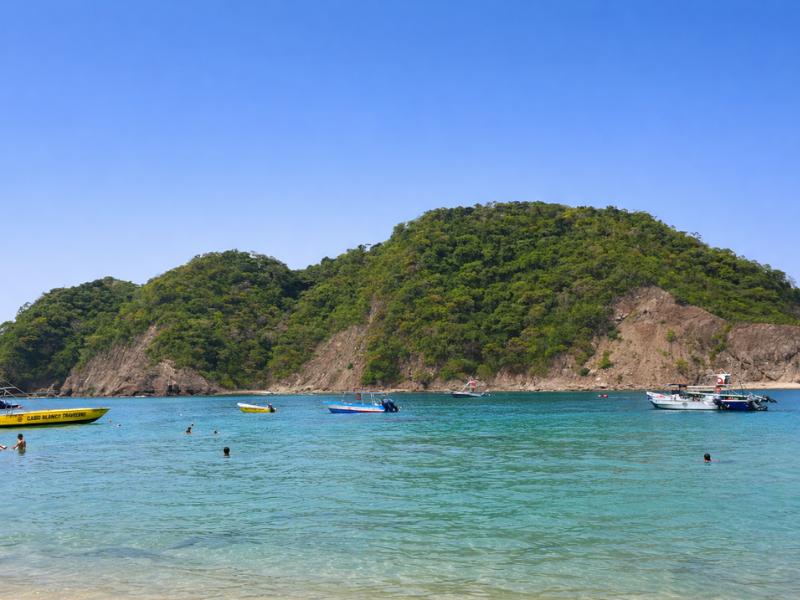
The bay is the whole argument. Tambor sits inside a broad horseshoe that opens onto the Gulf of Nicoya, and the headlands on either side take the energy out of the swell before it reaches the sand. On most mornings the water inside the bay is close to flat. You can walk out a long way and still be standing. For a family with small children, or anyone who has spent a week getting knocked around by Pacific beach break further south, that is not a small thing.
The sand is grey-brown rather than white, coarser than the powder on Isla Tortuga, and it darkens where the tide has just pulled back. Photographs of Tambor rarely do it justice, because the appeal is not the colour of the sand. It is that you can swim without thinking about it, at almost any hour, with the forested ridges of the Nicoya Peninsula standing behind you.
What Tambor does not have is nightlife, a restaurant strip worth planning around, or a surf culture. Nothing here demands your attention. If your idea of a good beach town includes deciding between eight dinner options and hearing music until midnight, you will be restless by the second evening.
How calm is the swimming water compared with the peninsula's surf beaches?
Tambor's bay faces inward, into the sheltered Gulf of Nicoya, while Santa Teresa, Mal País and Playa Grande face the open Pacific. The practical difference is large: gentle lapping water and a gradual sand shelf at Tambor, versus shore break, rips and a steep drop at the surf beaches an hour south.
Geography is doing the work. The Gulf of Nicoya is a large protected inlet between the peninsula and the mainland, and Tambor sits on its inner shore. Swell that arrives from the southwest wraps around the tip of the peninsula and loses most of its power on the way in. The surf towns on the outer coast get the same swell undiluted, which is exactly why surfers go there.
That has knock-on effects most people do not think about until they are in the water:
- Entry and exit are undramatic. No timing a gap between sets, no wading out with a toddler on your hip while a wave stands up.
- Visibility inside the bay is moderate rather than excellent. Sheltered water near a river mouth carries more sediment than an offshore reef does, which is one reason snorkelling happens out at the islands, not off the town beach.
- Afternoon wind matters more than swell. The gulf can get a chop on it by early afternoon, which affects boat comfort more than swimming comfort.
- Sunset swimming is realistic. On the outer coast the water often gets messier late in the day. Inside the bay it usually does not.
None of that makes Tambor a snorkelling destination. The reef life people come to Costa Rica's Pacific side for sits around the islands offshore, and that is a boat trip, not a wade from the beach.
How does Tambor compare with Montezuma and Santa Teresa?
The three towns split cleanly. Tambor is calm-water and quiet, Montezuma is small, walkable and bohemian with waterfalls and a good boat position, Santa Teresa is a long surf and wellness strip with the best food and the worst roads. Most people who love one are lukewarm about at least one other.
| Factor | Tambor | Montezuma | Santa Teresa |
|---|---|---|---|
| Water character | Sheltered bay, near flat most mornings | Small coves, mixed, some rocky entries | Open Pacific beach break, strong at times |
| Swimming with young kids | Easiest of the three | Workable in the right cove | Needs constant supervision |
| Evening atmosphere | Very quiet, early nights | Lively for its size, bars and music | Busiest, restaurants and beach clubs |
| Food choice | Limited, mostly sodas and hotel dining | Good variety for a small town | The strongest on the peninsula |
| Road access | Paved for most of the approach | Mixed, some rough sections | Rough dirt for the final stretch |
| Isla Tortuga boat position | Very good, close departure | Very good, roughly a 45 minute crossing | Good, usually via a road transfer to the boat |
| Best for | Families, calm swimmers, early boats | Backpackers, couples, waterfall walkers | Surfers, longer stays, food and yoga |
Distances between them are short on paper and longer in practice. Tambor sits between Paquera in the north and the Montezuma and Santa Teresa cluster in the south, so you pass through it whichever way you are travelling. Allow more driving time than the map suggests, especially in the wet months when the unpaved sections deteriorate.
Does the Tambor airstrip actually save you time?
Yes, if your alternative is the full road and ferry chain from San José. The small domestic airstrip near Tambor turns a half-day of driving, queueing and crossing into a short hop, which is the single strongest practical reason to base yourself here rather than further along the peninsula.
The overland route to the southern Nicoya Peninsula involves a drive out of the Central Valley, then the Puntarenas to Paquera ferry, then more road on the far side. It works, it is cheap, and plenty of travellers do it. It also eats a large slice of a travel day, and the ferry runs to its own timetable rather than yours.
Flying into the Tambor airstrip removes almost all of that. Schedules, aircraft and carriers change from season to season, so check current timetables directly rather than trusting anything written months earlier, and note that small aircraft carry tight baggage limits. The airstrip is also a genuine shortcut on the way out: if you have an evening international departure from San José, flying back removes the risk of a missed ferry turning into a missed flight.
| Route into the southern peninsula | Rough time budget | Main drawback |
|---|---|---|
| Domestic flight to the Tambor airstrip | Under an hour in the air, plus airport time | Higher cost, strict baggage limits, weather cancellations |
| Drive plus Puntarenas to Paquera ferry | Most of a travel day | Ferry timetable and queues, especially at weekends |
| Public bus plus ferry from San José | Longer again, with connections | Cheapest option, least flexible, luggage handling |
| Private shuttle plus ferry | Similar to driving yourself | Comfortable but priced per vehicle |
Treat the times above as planning allowances rather than promises. Ferry frequency and road conditions both change, and the official tourism board site at visitcostarica.com is a reasonable starting point for current regional access information.
Is Tambor a good base for an Isla Tortuga day trip?
It is one of the better ones. Boats leaving from this side of the gulf reach Isla Tortuga far faster than boats coming across from the mainland, and the first departures leave around 8 to 9am, which puts you on the beach before the midday convergence of tour boats.
Check the departure and cancellation terms for your actual travel date before arranging connecting transport. The product listings do not establish a guaranteed early landing, a fixed island-wide boat cap or how often a departure sells out.
Being based near the southern peninsula also shortens the crossing itself. From Montezuma the run is roughly 45 minutes, and from Curú it is about 15. Compare that with a crossing of around 90 minutes from the mainland side, and the case for staying on this side of the water becomes obvious for anyone who does not love long boat rides.
Check the departure and cancellation terms for your actual travel date before arranging connecting transport. The product listings do not establish a guaranteed early landing, a fixed island-wide boat cap or how often a departure sells out.
What else is near Tambor worth a day?
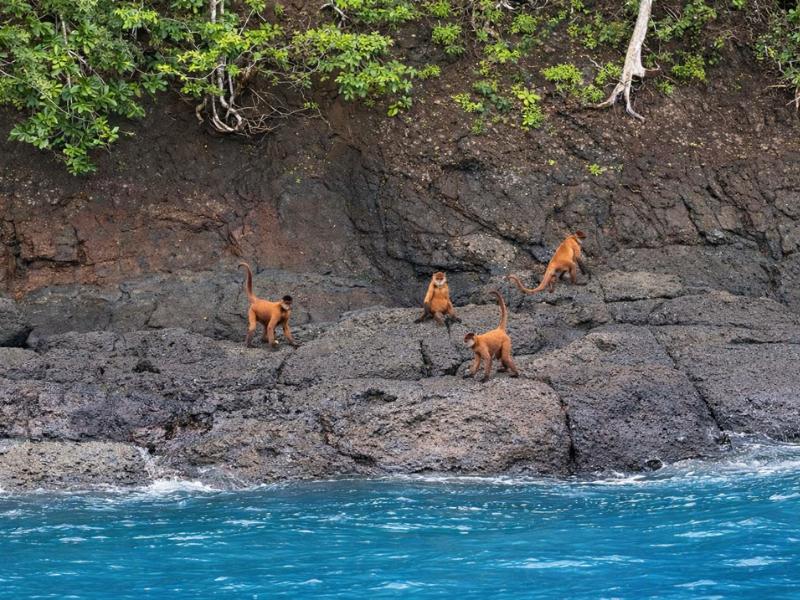
Curú Wildlife Refuge sits just up the coast toward Paquera, and it is the best reason to stay an extra day. Monkeys, deer, coatis and iguanas are routine sightings there, and it doubles as the departure point for the bioluminescence night tour, which is the most memorable thing you can do here after dark.
Curú Wildlife Refuge
Curú is a private refuge with mangrove, dry forest and beach habitats packed into a small area, and the animal density is high enough that you do not need to be a patient wildlife watcher to see something. Early afternoon walks are productive. Costa Rica's protected-area authority, SINAC, oversees the broader conservation framework these coastal reserves sit within, including the Islas Negritos reserve out in the gulf.
The bioluminescence night tour
This one is genuinely different from the daytime island run. It starts in the afternoon with the refuge walk, moves to a short boat ride out to a white-sand beach for sunset, then finishes with a swim in water that lights up around every movement once it is properly dark. Bioluminescence comes from plankton reacting to disturbance, so the effect is strongest on dark nights and in small groups where the water is not constantly churned. Moon phase matters more than most people expect.
The rest of the peninsula
Montezuma's waterfall walk, the beaches south of it, and the surf and food strip at Santa Teresa are all reachable as day trips from Tambor if you have a vehicle. The reverse is also true, which is part of why some travellers use Tambor purely as a first or last night rather than a full stay.
Who should stay in Tambor, and who should skip it?
Stay if you want flat swimming water, an early Isla Tortuga departure, easy air access, or a quiet last night before a flight. Skip it if you came to surf, if you want restaurant choice, or if you are travelling for two weeks and need each stop to earn its place.
| Traveller | Verdict | Why |
|---|---|---|
| Family with children under ten | Strong yes | The calmest swimming water on this stretch of coast |
| Couple after quiet and early nights | Yes | Very little noise, easy access to the island tours |
| Anyone flying in or out domestically | Yes | The airstrip removes the ferry from your travel day |
| Surfers | No | The sheltered bay is the opposite of what you want |
| Food and nightlife travellers | No | Santa Teresa does both far better |
| Backpackers on a tight budget | Probably not | Montezuma has more hostels, cheap food and company |
| Short trip, one peninsula stop only | Depends | Montezuma is the more interesting single base |
How long should you stay, and what does a day here look like?
Two nights is the sweet spot for most people. That gives you one full day for the Isla Tortuga boat trip and one slower day split between the bay, Curú and the bioluminescence tour, without the flat feeling that sets in by day three when you realise there is nothing new to find.
A workable two-day shape looks like this. Day one: an early breakfast, a boat departure between 8 and 9am, snorkelling before the other groups land, lunch on the sand, and back by mid afternoon with enough of the day left for a swim in the bay. Day two: a slow morning, an afternoon wildlife walk at Curú, sunset from a beach reached by boat, and the night swim after dark.
Three or four nights works if you have a car and treat Tambor as a hub, driving out to Montezuma's waterfall or down to Santa Teresa for a long lunch. Without a vehicle, three nights starts to feel like a lot of bay.
Seasonally, December through April brings the calmest gulf water, the best underwater visibility and the highest demand. May to June and September to October are quieter and cheaper, with a real chance of afternoon rain and the occasional cancelled crossing. Costa Rica's national weather service, the Instituto Meteorológico Nacional, publishes current forecasts if you want to check conditions before committing to a boat day.