Tortuga Island Tours from Puntarenas: Docks, Boats and the Real Timings
Puntarenas is the closest working port to Isla Tortuga, and two very different boats leave from it. One is a low-cost speedboat day for thirty people. The other is a private charter with your own captain. Here is how each one runs.
Booking Choice: An island lunch, snorkeling equipment and a Negritos wildlife stop. Explore Puntarenas Island Day: Shared Or Private
Start: Puntarenas. Confirm age rules and extras before booking.
Price note: fixed dollar amounts and totals in the editorial examples below are planning illustrations, not current quotes. Prices, child rates and private/shared options must be checked for your date and full party. The provider calendars and booking pages carry current offers.
Puntarenas departures at a glance
The bars compare the published door-to-door duration of the three departures closest to San José, with price, rating and booking volume taken from the live tour listings.
Why does Puntarenas send more boats to Isla Tortuga than anywhere else?
Puntarenas sits on a long sand spit that pushes into the Gulf of Nicoya, which puts its docks closer to Isla Tortuga than any other mainland town with real infrastructure. You get a crossing of roughly 90 minutes, paved road access from San José in about an hour and a half, and docks with parking, showers and changing rooms.
The port has been moving people and cargo across the gulf for well over a century, and the tour boats simply inherited a working waterfront. That matters more than it sounds. A boat leaving from a proper dock loads thirty people in ten minutes without a wet beach landing, and the same dock hands you a hot shower when you come back salted and sunburned.
Distance is the other half of the answer. Isla Tortuga lies roughly 12 km off the Nicoya Peninsula, and the run from Puntarenas crosses open gulf water rather than hugging a coastline. Boats from the peninsula side do reach the island faster. Almost nobody flies into the peninsula, though. Nearly every international visitor lands at Juan Santamaría outside San José, and Puntarenas is the first stretch of Pacific coast they can reach on a single tank of fuel.
The result is a town that functions as the island's default staging area. Two products leave from it, and they are aimed at completely different travellers: a large-group speedboat day at the lowest price on the whole island, and a private charter that costs more and gives you the entire vessel.
Which of the two Puntarenas departures should you book?
Book the $80 speedboat if you want the cheapest full day on Isla Tortuga and do not mind a large group and a long door-to-door window. Book the $125 private charter if you want an 8:30 AM start, your own boat, a spider monkey stop at Negritos and a seven-hour day instead of a twelve-hour one.
The price gap between the two is $45 per person, which is smaller than most people expect for the jump from shared to private. What you are really buying with the charter is time and control. Seven hours door to door against twelve is five hours of your holiday handed back, and it is the single biggest practical difference between the two.
Ratings tell a consistent story too. The shared speedboat holds 4.5 across more than 1,669 bookings. The private escape sits at 4.8 across more than 1,179 bookings, which is the highest rating of any tour on this site. That gap is not about the island, since both boats land on the same sand. It reflects group size, pace and how much attention one captain can give.
| Factor | Puntarenas speedboat | Private all-inclusive charter |
|---|---|---|
| Price per person | $80 | $125 |
| Rating and volume | 4.5, 1,669+ booked | 4.8, 1,179+ booked |
| Door-to-door window | Around 12 hours including road transfer | Around 7 hours |
| Departure point | Private dock, Las Playitas neighbourhood | Guima Frost marina |
| Stated departure time | Morning, confirmed on booking | 8:30 AM |
| Boat sharing | Shared speedboat | Your group only |
| Negritos Island stop | Not a fixed part of the run | Yes, around 25 minutes |
| Lunch | Full lunch, fruit, iced tea, coffee and cookies | Gourmet BBQ fish or chicken plus ceviche starter |
| Best for | Budget travellers, solo visitors, first-timers | Families, groups of friends, anyone short on days |
One thing worth saying plainly: the private charter is not a luxury yacht product. It is a normal Costa Rican tour boat that has been committed to your group for the day, with a guide who is not splitting attention across four other parties. For a family of four the maths is straightforward, and for a couple the shared boat usually wins on value.
What is the Las Playitas private dock like on the morning of your tour?
Las Playitas is a residential neighbourhood on the Puntarenas spit with a small private dock used by the speedboat operator. There is no terminal building and no departure board. You arrive at a marked gate, check in with the crew at a folding table, hand over anything you do not want wet, and walk straight onto the boat.
The informality catches people out. Visitors expecting the big ferry terminal on the other side of town sometimes drive to the wrong dock entirely, lose twenty minutes and arrive flustered. The ferry pier and the tour dock are different places with different purposes: the ferry moves cars and foot passengers to Paquera, while the tour boats use small private landings scattered along the spit.
Practical points that repeat across every morning at Las Playitas:
- Arrive with the address saved offline. Mobile signal on the spit is fine, but a screenshot removes the risk.
- Give yourself fifteen minutes of slack. Boats push off close to their stated time because the crossing schedule is built around getting to the island before the midday boats.
- Wear your swimsuit under your clothes. Changing space at the dock is for the return, not the departure.
- Bring small notes. Beach chairs, the island restroom and any drinks beyond the included ones are cash transactions.
The dock itself is not scenic. It is a functional strip of concrete with boats tied alongside and a crew that has done this several thousand times. The scenery starts about four minutes after you leave it, when the town drops behind the stern and the gulf opens up.
How does the speedboat day actually run, hour by hour?
The twelve-hour figure on the speedboat tour is the full door-to-door day including road transfer from wherever you are staying, not twelve hours on the water. The boat portion is a crossing of roughly an hour, then about five hours of free time on Isla Tortuga, then the crossing back.
That distinction changes how you should read the listing. Twelve hours sounds punishing until you realise five of them are spent lying on white sand. Here is the shape of a typical day, with the caveat that exact times shift with tide, weather and how many people the crew is loading.
| Stage | Rough timing | What is happening |
|---|---|---|
| Road transfer to Puntarenas | Early morning | Self-drive or transfer from San José, Jacó or a coastal hotel. Not included in the $80. |
| Check in at Las Playitas dock | Around 15 minutes | Name check, safety brief, life jackets issued, bags stowed. |
| Gulf of Nicoya crossing | About 1 hour | Open-water run past the gulf's volcanic islets. Crew scan for dolphins and slow the boat when a pod appears. |
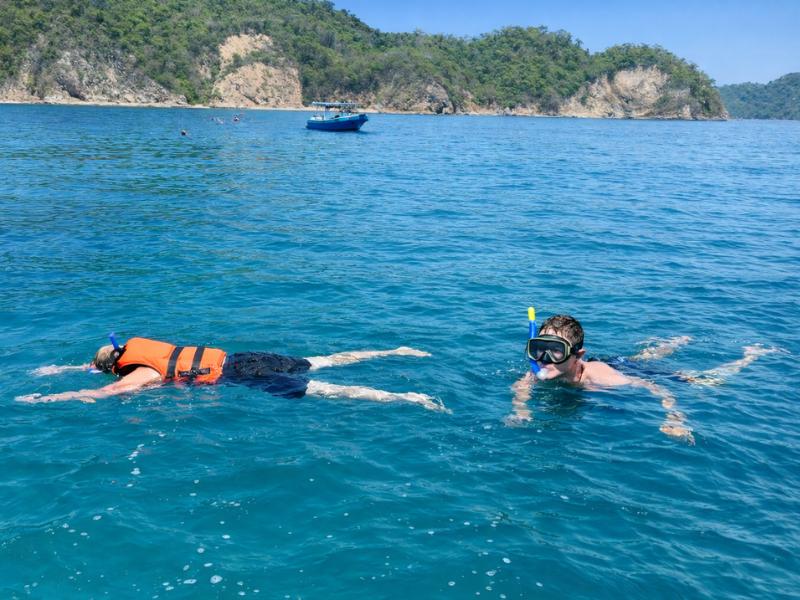
| Snorkel session | Around 45 to 60 minutes | Gear handed out on board. Reef fish, parrotfish, sea turtles when conditions allow. Weather dependent. |
| Lunch on the beach | Around 45 minutes | Full lunch with fresh seasonal fruit, iced tea, coffee and cookies. |
| Free time on Playa Tortuga | Up to 5 hours in total | Swimming, sunbathing, palm shade, optional beach chair rental. |
| Return crossing | About 1 hour | Afternoon light on the water, usually a calmer sea than the morning in dry season. |
| Showers and changing at the dock | 15 to 20 minutes | Included access. This is the detail returning guests mention most. |
Five hours of island time is a lot by the standards of this destination. Most Isla Tortuga tours give you three to four. If your idea of a good beach day is one where nobody hurries you back to a boat, that is the strongest argument for this particular departure.
What does the private option from Guima Frost include?
The private escape departs at 8:30 AM from Guima Frost marina, gives your group the whole boat, stops around 25 minutes at Negritos Island for spider monkeys, runs a guided hour of snorkelling on a volcanic reef, serves a BBQ lunch with a ceviche starter, and gets you back inside seven hours.
The 8:30 AM departure is the operational advantage. Arriving on the island in the middle of the morning, before the boats from other departure points converge, is the difference between a beach with a handful of people on it and a beach with four tour groups spread across it. The crowd curve on Isla Tortuga peaks between 11 AM and 2 PM, and an early private boat sits ahead of that wave.
| Included in the $125 | Not included, budget separately |
|---|---|
| Private beach spot in front of the water | Alcoholic drinks, available for purchase |
| Guided snorkel tour with equipment | Souvenirs from island vendors |
| Gourmet BBQ lunch, fish or chicken | Gratuities for the captain and crew |
| Ceviche starter, afternoon coffee and cookies | Professional photography service |
| Monkey and dolphin watching | Travel insurance |
| Stone arch viewpoint that group tours skip | Road transport to the marina |
Two honest limits on this option. First, a private boat is allocated to a date, so the week before you travel is late in dry season. Second, the seven-hour figure assumes you are already on the coast or driving yourself; add the San José road time on top if you are based in the capital.
Why does the 25-minute Negritos Island stop matter?
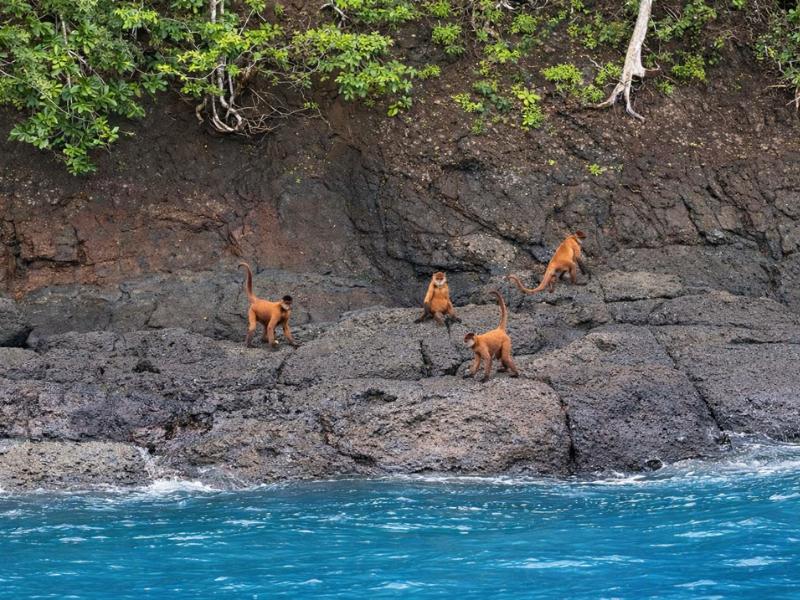
Negritos is part of the Islas Negritos Biological Reserve, the protected group that Isla Tortuga itself belongs to. The private charter pauses there for around 25 minutes on the outbound run, close enough to the shoreline that spider monkeys moving through the canopy are visible from the boat without anyone landing.
Nobody goes ashore, and that is the point. These are protected uninhabited islands managed under Costa Rica's protected-areas system, which you can read about at SINAC. The boat idles, the guide points, and the group watches. It is a quieter kind of wildlife viewing than the crocodile bridge that the Jacó departures build in, and it works because spider monkeys are large, dark and slow enough to track through foliage from a hundred metres out.
Sightings are not guaranteed and no honest operator will promise them. What is reliable is the seabird activity around the islets and the frequency of dolphin encounters on that stretch of water. Between July and November there is also a real chance of humpback whales, which migrate through the gulf during those months. The crew watch for them as a matter of routine rather than as a selling point.
If wildlife rather than beach time is your reason for the day, the stop is a genuine reason to pick the charter over the shared speedboat, which runs a more direct line to the island.
How do you get from San José to Puntarenas?
Puntarenas is roughly 90 minutes from San José by road on Route 27, the toll highway that runs from the Central Valley to the Pacific. Juan Santamaría International Airport sits on the San José side of that drive, which makes Puntarenas the closest island departure point to the country's main international gateway.
Getting there is the part that turns a seven-hour boat day into a twelve-hour one, so it deserves planning rather than improvisation. Four options cover almost everybody.
| Method | Allow roughly | Notes |
|---|---|---|
| Rental car from San José | 1.5 hours each way | Route 27 is fast and well surfaced. Tolls are cash or card. Parking is available near the tour docks. |
| Private transfer or taxi | 1.5 hours each way | Simplest for early departures. Agree a pickup time that gets you to the dock 20 minutes early. |
| Public bus from San José | 2 to 2.5 hours each way | Cheapest by a wide margin. Works only if the first departure aligns with your boat time. |
| Book the San José full-day tour instead | Handled for you | Pickup, road transfer, boat and lunch bundled into a single 18-hour package at $115. |
| Drive from Jacó or Herradura | About 1 hour each way | The shortest approach if you are already on the Central Pacific coast. |
If you are staying in the capital without a car, the bundled San José departure usually beats assembling the pieces yourself. If you have a car, the Puntarenas speedboat at $80 becomes the cheapest way to reach the island by a clear margin.
What is Puntarenas actually like as a staging town?
Puntarenas is a working port and a Costa Rican beach town rather than a resort. The spit carries a long waterfront promenade, a public beach, cruise berths, the Paquera ferry terminal, seafood sodas and ice cream stands. It is functional, faintly worn, genuinely lively at weekends, and not somewhere most visitors plan a second night.
Setting expectations correctly here saves disappointment. Travellers arriving from Manuel Antonio or Santa Teresa sometimes describe Puntarenas as underwhelming, which is fair if you were expecting a resort strip. Judged as what it is, a port town that Costa Ricans themselves use for beach weekends, it has real character: the Paseo de los Turistas along the water, churchill drinks sold from carts, and a fishing fleet that still fishes.
For an island day it does the job well. You can arrive the night before, sleep near the dock, and be on the water at first light without a pre-dawn drive. That single move fixes the biggest weakness of the mainland departures.
Should you sleep in Puntarenas the night before?
Check the departure and cancellation terms for your actual travel date before arranging connecting transport. The product listings do not establish a guaranteed early landing, a fixed island-wide boat cap or how often a departure sells out.
Where do you park, and what do you get on the way back?
Both Puntarenas departures work for self-drivers. The speedboat operator uses a private dock at Las Playitas with parking nearby, and the private charter leaves from a marina with its own on-site parking. The speedboat return also includes access to showers and changing rooms at the dock, which no other departure on this coast offers as standard.
The showers matter more than they sound. Seven to twelve hours of salt water, sunscreen and sand is a lot to carry into a rental car or a hotel lobby, and rinsing off before the drive back turns the last leg of the day from grim into pleasant.
- Parking. Available near the private dock at Las Playitas, and on site at the Guima Frost marina for the charter.
- Showers and changing rooms on return. Included with the speedboat tour at the dock. The marina has its own facilities for charter guests.
- Restroom on the island. Around $1 per use, cash only, on both departures.
- Beach chairs. An optional rental payable on the sand with the shared boat. The private charter includes a beach spot in front of the water.
- Luggage. There is no storage on shore. Whatever you bring travels with you on the boat and then sits on a beach all day.
That last point is the one people underestimate. Anything you take on the boat gets wet eventually. A dry bag for phones and documents is the single most useful thing you can add to what to pack for a boat tour, and it costs less than the beach chair.
What does a Puntarenas island day really cost once you add extras?
Take the headline price, then add road transport, a dollar or two for the island restroom, cash for a beach chair, tips for the crew and any drinks beyond the included soft drinks. On the shared speedboat a realistic all-in figure lands meaningfully above the $80 sticker once the drive is counted.
None of these are hidden charges. They are simply the things a boat ticket does not cover, and writing them down before you travel avoids the small irritations that dent an otherwise good day.
| Line item | Speedboat at $80 | Private charter at $125 |
|---|---|---|
| Tour price per person | $80 | $125 |
| Road transport to the dock | Not included, budget for fuel, tolls or a transfer | Not included |
| Lunch and soft drinks | Included | Included |
| Snorkel gear | Included | Included |
| Island restroom | Around $1 per use | Around $1 per use |
| Beach chair | Optional rental, cash on the beach | Private beach spot included |
| Alcohol | Sold separately | Sold separately |
| Crew tip | Discretionary, small notes appreciated | Discretionary |
For a group of four, the charter's per-head cost sits close enough to the shared boat that the private beach spot, the earlier start and the shorter day usually justify it. For one or two people the speedboat is the better value, and the money saved covers the drive.
Which months give the smoothest crossing out of Puntarenas?
Compare current quotes for the same date, party and inclusions. Add transport and optional extras to both totals before deciding whether private service is worth the difference. Weather can affect any departure. Related reading: Gulf of Nicoya
Because the Puntarenas crossing is open gulf water rather than a coastal hug, sea state affects it more than it affects the short peninsula runs. That makes the season choice more consequential from this departure point than from Montezuma. Costa Rica's national weather service, the Instituto Meteorológico Nacional, publishes the forecasts the crews actually watch.
| Window | Sea and visibility | Crowds | Booking pressure |
|---|---|---|---|
| December to February | Calm, clear, reliable | Busy, peaks at Christmas and New Year | High, book well ahead |
| March | The best of the year for flat water and clarity | Busy but below the holiday peaks | High |
| April | Still dry, warm water, Easter week is packed | Heavy around Semana Santa | High in Easter week |
| May to June | Mostly dry, occasional afternoon showers | Noticeably lighter | Moderate, good availability |
| July to August | Mixed, humpback whales possible in the gulf | A second smaller peak | Moderate to high |
| September to October | Wettest, murkier after rain, occasional rough days | Quietest of the year | Low, easiest to book late |
| November | Drying out, greenery at its best, whales tail off | Light | Low to moderate |
Whatever month you choose, take the earliest boat offered. The island at 9 AM and the island at noon are different places, and the price is the same.
Who should depart from Puntarenas, and who should not?
Puntarenas suits self-drivers, San José-based visitors, budget travellers and anyone who wants maximum beach hours. Skip it if you are already staying on the Nicoya Peninsula, if long open-water crossings make you queasy, or if you want the shortest possible boat ride to the island.
The honest comparison across departure points comes down to how much of your day you are willing to spend getting to the water, and where you happen to be sleeping. Nobody should reposition across the country to depart from Puntarenas, and nobody staying in Montezuma should drive to it.
| You are | Best Puntarenas fit | Or consider |
|---|---|---|
| Based in San José without a car | Neither, book the bundled full-day tour | The 18-hour San José departure at $115 |
| Based in San José with a rental car | The $80 speedboat | Drive down the night before |
| A family of four or more | The $125 private charter | Per-head cost closes fast with group size |
| Staying in Jacó or Herradura | Either, both are about an hour away | The Jacó departure with its crocodile bridge stop |
| Staying in Santa Teresa or Montezuma | Not Puntarenas | The 45-minute crossing from the peninsula side |
| Prone to seasickness | Private charter, earlier and calmer water | Dry season only, and take tablets before boarding |
| Wanting a night experience | Neither | The bioluminescence night tour from Curú |
Both Puntarenas boats land on the same beach, eat the same grilled lunch and snorkel the same reef. The choice is about how you want the hours around the island to feel, and how many of them you are prepared to spend on a road. Costa Rica's tourism board keeps regional planning information at Visit Costa Rica if you are still deciding where to base yourself.