Santa Teresa or Montezuma: Choosing a Nicoya Peninsula Base for Isla Tortuga
Most people meet Isla Tortuga on a long day out of San Jose. Sleep on the southern Nicoya Peninsula instead and the same island sits 45 minutes offshore, with the whole morning still ahead of you.
Booking Choice: A coastal boat ride from Montezuma, snorkeling equipment and a choice of island lunch. Explore Santa Teresa Island And Snorkel Day
Start: Santa Teresa. Confirm age rules and extras before booking.
Price note: fixed dollar amounts and totals in the editorial examples below are planning illustrations, not current quotes. Prices, child rates and private/shared options must be checked for your date and full party. The provider calendars and booking pages carry current offers.
Crossing times to Isla Tortuga by departure point
Crossing times are the figures published for each departure point on the tours we list: 15 minutes from Curu, about 45 minutes from Montezuma, and roughly 60 to 90 minutes from the mainland side of the Gulf of Nicoya.
Why does sleeping on the Nicoya Peninsula change an Isla Tortuga day?
Basing in Santa Teresa or Montezuma cuts the water crossing to roughly 45 minutes from Montezuma, against a crossing of about 90 minutes from the mainland side of the Gulf of Nicoya. It also removes the pre-dawn road transfer that defines the San Jose version of the trip, which runs up to 18 hours door to door.
Geography does the work here. Isla Tortuga sits off the southeastern tip of the Nicoya Peninsula, inside the Gulf of Nicoya. If you are standing in Montezuma, you are already on the correct side of that gulf. If you are standing in San Jose, you have a mountain range, a coastal highway and a port city between you and the boat.
The practical difference shows up in three places. Wake-up time, first. The San Jose full-day tour starts with a pickup somewhere between 4:00 and 6:00 in the morning, because the road transfer to the coast eats two hours before anyone touches salt water. From a peninsula base you leave your hotel after breakfast.
Check the departure and cancellation terms for your actual travel date before arranging connecting transport. The product listings do not establish a guaranteed early landing, a fixed island-wide boat cap or how often a departure sells out. Related reading: Tambor
The trade is real, though. Getting yourself onto the southern peninsula in the first place takes a ferry or a long drive around the top of the gulf, and the last hour of road on either approach is not smooth. You are moving the travel burden from the tour day to the arrival day. That works beautifully if you are giving the area several nights, and badly if you are not.
Santa Teresa or Montezuma: which base actually fits you?
Montezuma is small, walkable and closer to the boats, with a waterfall walk from the village and a bohemian, low-rise feel. Santa Teresa is a long strung-out surf town on a dirt main road, with better restaurants, better waves and a bigger accommodation range, but you will want wheels to move around it.
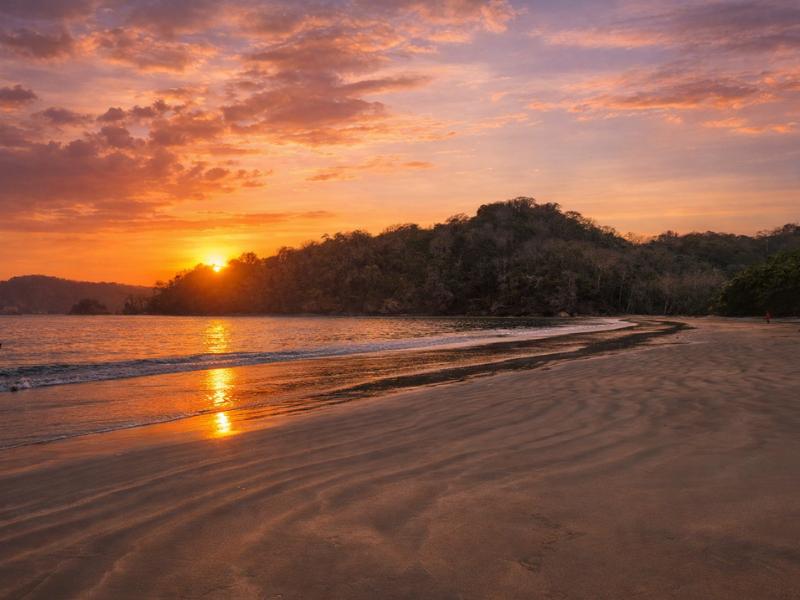
These two towns are about an hour apart by road across the southern tip of the peninsula, and they attract different travellers. Montezuma has a compact centre where you can park the car and forget it for three days. The beach in front of town is rocky in stretches, which annoys some visitors and delights others, and the walk to the waterfall starts a short distance from the last cafe. It is the base that puts you closest to the boat ramp.
Santa Teresa is the surf economy. It runs for kilometres along one unpaved road parallel to a long beach that gets consistent Pacific swell, and the town has the yoga studios, smoothie bowls and late dinners that come with that. What it does not have is walkability. Your hotel might be a 20-minute walk from the restaurant you wanted, along a dusty road with no pavement, in the dark. Quad bikes and scooters are the local answer, and they carry their own risk on loose gravel.
For an Isla Tortuga trip specifically, the deciding factor is usually the rest of your week. If you want to surf every morning and take one island day, Santa Teresa wins on the other six days. If the island, the wildlife and a slower pace are the point, Montezuma is the tighter fit.
| Factor | Santa Teresa | Montezuma |
|---|---|---|
| Town shape | Long ribbon along one dirt road, several kilometres end to end | Compact village centre, walkable in 10 minutes |
| Beach character | Long open sand, consistent surf, strong shore break | Smaller coves, rocky sections, calmer swimming pockets |
| Getting around | Scooter, quad or 4x4 effectively required | On foot for most of what you need |
| Road to the boat | About 45 minutes by van across to Montezuma | Boat leaves from the beach in town |
| Food and nightlife | Wide range, later hours, higher prices | Smaller, earlier, more local and budget options |
| Best for | Surfers, longer stays, groups wanting variety | Island days, wildlife, short stays, no rental car |
| Weak point | Dust in dry season, mud in green season, spread out | Limited dining variety, fills fast in peak weeks |
How long is the crossing from each departure point?
From Montezuma the run to Isla Tortuga takes about 45 minutes. From Curu the boat needs roughly 15 minutes. Mainland departures from the Puntarenas side generally run around 90 minutes, and the Negritos island stop sits about 25 minutes out from that side of the gulf.
Those numbers are the single strongest argument for a peninsula base, and they are worth laying out next to each other because the marketing on any given listing rarely does it. Note that the durations advertised on the tours themselves are door to door, not time on the water. The San Jose full-day tour is listed at 18 hours; almost none of that is sea. The Puntarenas speedboat tour is listed at 12 hours for the same reason.
| Departure point | Approx. water time each way | What it means for your day |
|---|---|---|
| Curu Wildlife Refuge | About 15 minutes | Short enough for an evening tour and a night return |
| Montezuma | About 45 minutes | Breakfast at your hotel, on the island mid-morning |
| Santa Teresa (via road to Montezuma) | 45 min van plus 45 min boat | Earlier pickup, same early arrival on the beach |
| Tambor / Paquera area | Roughly 30 to 45 minutes | Comparable to Montezuma, often quieter docks |
| Puntarenas and mainland side | Around 60 to 90 minutes | Longer open-water leg, earlier start, more chop risk |
| Jaco and Herradura | Longest, plus road transfer to the marina | Full 10-hour day, often with the Tarcoles crocodile stop |
One honest caveat. Shorter is not automatically better for everyone. The 90-minute crossings from the mainland pass through more of the gulf, and the longer Jaco itinerary bundles in the Tarcoles River bridge crocodile stop and a Negritos Island monkey stop that a direct Montezuma run does not include. If wildlife variety matters more than beach hours, the longer route earns some of its time back.
How does the Santa Teresa hotel pickup and van transfer work?
The Santa Teresa departure begins with a pickup at your hotel on the town's main road, followed by a roughly 45-minute transfer in a high-clearance van across the peninsula to Montezuma, where you board the boat. Total tour length runs about seven hours, and the listed price is around $152 per person.
The detail that catches people out is the words "main road". Santa Teresa's accommodation spreads well back from that road, up side tracks that a transfer van will not attempt with a full load. If your hotel sits up a steep unpaved spur, expect to walk down to the main road at pickup time with your dry bag, or to arrange a short lift from the property. Ask your hotel where the van actually stops when you book, not on the morning itself.
The van is high-riding for a reason. The route between Santa Teresa and Montezuma crosses the hilly interior of the southern peninsula, and in the green season parts of it turn to red mud. It is a scenic ride, and also a bumpy one. If anyone in your group is prone to motion sickness, take the tablet before the van, not before the boat, because the road is usually the rougher half.
What to have ready before pickup
- Swimwear already on, under dry clothes, since there is nowhere to change on the boat.
- Reef-safe high-SPF sunscreen applied before you leave, then a bottle for reapplication.
- Small US dollar or colon notes for the island restroom fee, which runs about $1 per use on some tours, plus crew tips.
- A dry bag or waterproof phone case; spray on the crossing is normal, not a sign of bad weather.
- Motion-sickness tablets taken 30 to 45 minutes before the van, if you need them.
On the water side, this departure sails the coast toward the island with a genuine wildlife chance built in. Dolphins are common enough that the captain scans for them, manta rays and turtles turn up, and humpback whales move through the gulf between July and November. Nobody can promise you a whale. The window is real, though, and it is a legitimate reason to book this crossing in that half of the year.
How do you get onto the southern peninsula in the first place?
The standard route is the Puntarenas to Paquera ferry, which takes roughly an hour and costs a few dollars per foot passenger plus a vehicle fee. From the Paquera dock it is another one to two hours by road to Montezuma or Santa Teresa, depending on which town and which vehicle.
The ferry is the pleasant part. It runs several times a day on a published timetable that shifts with season and demand, so check the operator's current schedule the week you travel rather than trusting a printout from last year. If you are driving, arrive at the Puntarenas terminal early in high season: vehicle capacity fills before foot-passenger capacity, and missing a sailing can cost you two hours.
The alternative is driving the long way around the top of the gulf through the Nicoya interior. It avoids ferry timetables entirely and it is the fallback when a sailing is cancelled, but it adds a substantial block of driving and most of that final approach is the same unpaved road either way.
| Route onto the peninsula | Rough time | Cost shape | Best for |
|---|---|---|---|
| Bus from San Jose to Paquera, then local bus or taxi | Allow 5 to 6 hours total | Cheapest, budget a small amount for each leg | Backpackers without a car |
| Drive to Puntarenas, ferry to Paquera, drive on | Roughly 4 to 5 hours from San Jose | Fuel plus ferry vehicle fee | Families and anyone with luggage |
| Drive the long way round the gulf | Longer again, no timetable risk | Fuel only | Late arrivals, cancelled sailings |
| Domestic flight to Tambor, then road | Shortest by far, small airstrip | Highest, book well ahead | Short trips where time beats budget |
| Shared shuttle from San Jose or Jaco | Half a day, door to door | Mid-range per person | Couples who want no logistics |
Whichever way you come, treat arrival day as a travel day. Do not book an island tour for the same afternoon you land at the ferry dock. The boats leave in the morning anyway, and the one thing you cannot buy back on this coast is a missed departure.
Do you need a 4x4 down here?
For the Isla Tortuga day itself, no: the tour van handles the road. For staying in Santa Teresa, a high-clearance vehicle is close to essential, and in the green season from May to November a true 4x4 is the sensible choice because of river crossings, mud and steep unpaved access tracks.
Two-wheel-drive rentals get down here in dry season and plenty of people do it. The failure modes are specific rather than constant: a steep gravel driveway you cannot climb with four adults aboard, a rutted section where a low bumper grounds out, and a shallow ford after rain that a sedan should not attempt. Rental companies in Costa Rica are strict about water damage, and a stalled crossing is an expensive lesson.
| Situation | Dry season, Dec to Apr | Green season, May to Nov |
|---|---|---|
| Paquera to Montezuma main route | Paved and unpaved mix, manageable | Manageable, expect potholes and mud patches |
| Montezuma to Santa Teresa interior road | Dusty, steep in places, high clearance helps | 4x4 strongly advised, ruts and slick clay |
| Hotel access tracks in Santa Teresa | Often steep gravel, clearance matters | Can become impassable in 2WD after heavy rain |
| River fords on secondary roads | Usually dry or ankle deep | Variable, never guess depth, ask locally |
| Scooters and quads | Popular, gravel and dust are the risk | Slippery, higher accident rate, think twice |
If you are basing in Montezuma and taking the boat from the village beach, you can genuinely skip the rental car. Shuttles, local buses and taxis cover the ferry connection, and the town is small enough to walk. That is a real budget saving, and it is one of the quiet arguments for Montezuma over Santa Teresa on a first visit.
How many days should you give the area?
Three nights is the working minimum for a peninsula base: one arrival day, one full island day and one day for the town itself. Four to five nights is the sweet spot, because it absorbs a weather cancellation on the boat and still leaves time for the waterfall, the surf and a slow morning.
Anything shorter and the ferry crossing starts to dominate the trip. Two nights means you arrive in the afternoon, take the boat the next morning, and leave the following day, which technically works but leaves no margin. Boats do get cancelled. Green-season swell, a bad forecast or a mechanical problem can move your departure by a day, and with a two-night stay there is no second day to move it to.
On the other side, the peninsula rewards a longer stay more than most Costa Rican beach towns. The waterfall walk in Montezuma, the Curu refuge trails, the surf lessons in Santa Teresa and one evening tour add up to a genuinely varied week without a single long drive. Travellers who plan two nights here often wish they had planned five.
Rough allocation by trip length
- Two nights: possible, but book the island day for your only full day and accept the cancellation risk.
- Three nights: island day, town day, travel days at each end. The standard shape.
- Four to five nights: add the bioluminescence evening, a waterfall morning and a proper surf session.
- A week: add day trips further up the coast and at least one deliberately empty day.
What does a worked five-day peninsula plan look like?
The plan that works best puts travel on day one, the island on day two while everyone is fresh and the sea is typically calmest early in a stay, the town on day three, the Curu bioluminescence evening on day four, and a slow departure on day five timed around a mid-morning ferry sailing.
The logic behind that order is weather margin. Booking the island early in your stay leaves later days free to reschedule if the boat cannot sail, which is the single most common way a peninsula trip goes wrong. If you book Isla Tortuga for your last morning and the sea is up, you lose it entirely.
| Day | Morning | Afternoon | Evening |
|---|---|---|---|
| Day 1 | Drive or shuttle to Puntarenas, ferry to Paquera | Road to Montezuma or Santa Teresa, check in | Dinner in town, confirm tomorrow's pickup point |
| Day 2 | Early pickup, boat to Isla Tortuga, snorkel the reef | Beach lunch, swim, kayak, return crossing | Early night, salt-tired |
| Day 3 | Montezuma waterfall walk or a Santa Teresa surf lesson | Beach time, slow lunch | Sunset drinks, town dinner |
| Day 4 | Free morning, market and cafes | Drive to Curu, wildlife walk on the refuge trails | Sunset boat, night swim in bioluminescent water |
| Day 5 | Slow breakfast, drive to Paquera | Mid-morning ferry, onward to San Jose or Jaco | Arrive with daylight to spare |
Two adjustments worth making. Surfers should flip days two and three so the island day lands on the smaller swell forecast. Families with young children should consider dropping the day-four evening tour and using that afternoon for a second, unhurried beach session instead, because a late night after a hot day rarely ends well.
Where does the Curu bioluminescence night tour fit?
The Curu evening tour is a separate product from the beach day, not a substitute. You arrive at the refuge in the early afternoon for wildlife, board a motorboat around 5pm for a 15-minute ride to a white-sand beach on the Tortuga islands, watch sunset, then swim in glowing water after dark. It runs around $60 and about 2½ hours for the evening tour.
The reason it slots so neatly into a peninsula itinerary is proximity. Curu sits between Paquera and Tambor, close enough to Montezuma that the drive is an afternoon errand rather than an expedition. Anyone based on the mainland side would need a whole additional travel day to reach the same starting point, which is exactly why day-trippers from San Jose rarely see this tour at all.
The refuge itself is part of the appeal. The trails hold monkeys, white-tailed deer, coatis and iguanas, and the walk before the boat is a real wildlife hour rather than filler. The tour has been family run since 2000 and is tied to conservation and responsible fishing work on that stretch of coast, which is a fair reason to prefer it over an anonymous boat.
On the glow itself, expectation management matters. Bioluminescence comes from plankton reacting to movement in the water, so it is brightest on dark nights with little moonlight and it varies with plankton density. A full moon washes it out. If you have any flexibility in your dates, aim the night tour at the darker half of the lunar month and treat a bright display as the good outcome rather than the guaranteed one.
What does the peninsula base actually cost compared with day-tripping?
Per person, the Santa Teresa boat day is the most expensive Isla Tortuga option on our list at around $152, against roughly $80 from Puntarenas and $115 from San Jose or Jaco. The peninsula still wins on value once you count the hours, because you are buying back most of a day.
Think of it as an hourly rate on your holiday. The San Jose tour costs $115 and consumes up to 18 hours door to door, most of it in a vehicle. The Santa Teresa version costs more per ticket but takes about seven hours and returns you to your hotel with an afternoon still usable. If your Costa Rica trip is ten days long, that difference compounds.
| Departure | Listed price | Listed duration | What the duration includes |
|---|---|---|---|
| From Santa Teresa, boat and snorkel | Around $152 | About 7 hours | Hotel pickup, 45-min van, 45-min crossing, island time |
| Private from Puntarenas, all inclusive | Around $125 | About 7 hours | 8:30am marina departure, Negritos stop, private boat |
| From Jaco, full-day adventure | Around $115 | About 10 hours | Tarcoles crocodile stop, road transfer, crossing, island |
| From San Jose, full day with lunch | Around $115 | Up to 18 hours | Pre-dawn pickup, two-hour road each way, island time |
| Puntarenas speedboat with lunch | Around $80 | About 12 hours | Private dock, gulf crossing, showers on return |
| Curu bioluminescence evening | Around $60 | About 2 hours on the water | Refuge walk, 15-min boat, sunset, night swim |
Prices move, so treat these as the shape of the market rather than a quote and check the live listing before you commit. What does not move is the relationship between them: the closer your bed is to the island, the less of your ticket price is buying road transfer.
When should you book, and how far ahead?
Check the departure and cancellation terms for your actual travel date before arranging connecting transport. The product listings do not establish a guaranteed early landing, a fixed island-wide boat cap or how often a departure sells out.
Check the departure and cancellation terms for your actual travel date before arranging connecting transport. The product listings do not establish a guaranteed early landing, a fixed island-wide boat cap or how often a departure sells out.
| Period | Sea and visibility | Crowds | Booking lead time |
|---|---|---|---|
| December to February | Calm, clear, breezy afternoons | High, holiday peaks | A week or more for early boats |
| March to April | Calmest and clearest of the year | High, Easter spikes | Several days to a week |
| May to June | Mostly good, afternoon showers begin | Moderate, easing | A few days is usually enough |
| July to August | Mixed, whale window opens | Moderate, family travel | Several days in whale season |
| September to October | Wettest, more sediment after rain | Lowest of the year | Often bookable a day or two ahead |
| November | Improving quickly, green landscape | Rising | A few days |
Costa Rica's national weather service, the Instituto Meteorologico Nacional, publishes the forecasts operators actually watch. Checking it the evening before is a better use of five minutes than reading another review.
What does the island itself give you once you land?
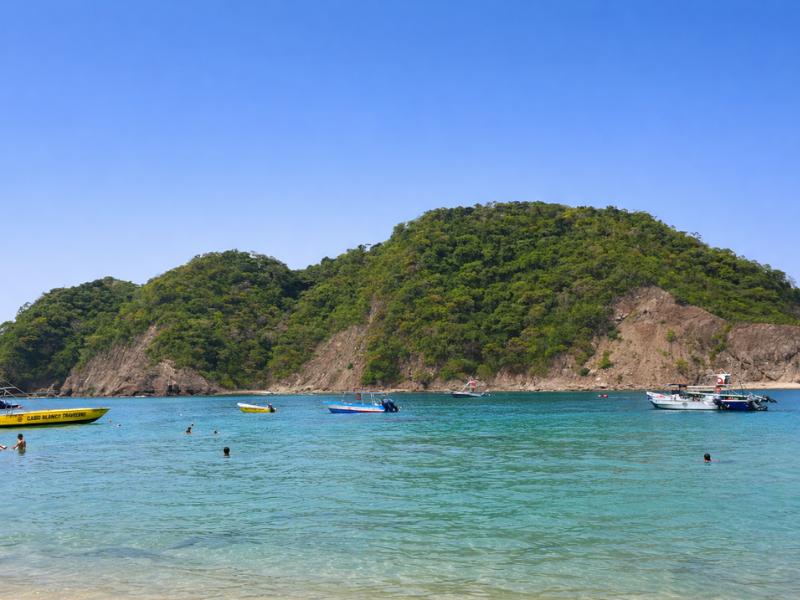
Playa Tortuga is powdery white sand backed by palms, with turquoise water calm enough for weak swimmers and a volcanic reef close by for snorkelling. The island is car-free and uninhabited, so the soundtrack is waves, seabirds and howler monkeys from the jungle edge. No one stays overnight.
Isla Tortuga and the Negritos islands are separate places in the Gulf of Nicoya. Some tours pass Negritos for wildlife viewing before visiting Tortuga. The excursions recommended here return the same day and do not include accommodation. Related reading: SINAC
In the water you can reasonably expect parrotfish and angelfish, moray eels tucked into the rock, eagle rays cruising the sand flats and, with luck, a turtle. Above water there are iguanas on the rocks, seabirds overhead and a stone arch viewpoint that some itineraries include and others skip. Ask which, if that matters to you.
Two practical notes people wish they had known. The restroom on the island carries a small fee, roughly a dollar a use on some tours, so carry small notes. And shade is finite: the palms and hammocks near the main landing go first, which is one more reason the early boat from the peninsula is worth its ticket.
Who should skip the peninsula base entirely?
If you have fewer than three nights to give the area, no interest in surf or slow beach towns, or a group that struggles with rough unpaved roads, day-tripping from Jaco, Puntarenas or San Jose is the better call. The peninsula rewards a stay, not a stopover.
Three profiles in particular are better served on the mainland. Travellers on a tight one-week Costa Rica loop that already includes Arenal and Manuel Antonio will lose a full day each way to the ferry and the road. Anyone with mobility limits should think hard about the unpaved access tracks and the beach-launch boarding some peninsula boats use. And cruise passengers docking at Puntarenas have no realistic option other than the mainland departure, which is exactly what the speedboat tour from the Las Playitas private dock exists for.
There is also a middle path that gets overlooked. Base in Jaco or Puntarenas, take the day trip to the island, and if you fall for the gulf, come back on a future trip and give the peninsula the four or five nights it needs. The island is not going anywhere, and it is protected precisely so that it will not.
For everyone else, the argument is straightforward: 45 minutes of water instead of 90, a boat that leaves after breakfast instead of before dawn, and an afternoon that still belongs to you. That is what you are buying when you sleep on this side of the Gulf of Nicoya.