Is Tortuga Island Worth Visiting? An Honest Assessment
Isla Tortuga is one of the most booked day trips on Costa Rica's Pacific coast, and it is also one of the easiest to book badly. Here is the case for it, the case against it, and how to tell which side you fall on.
Booking Choice: An island lunch, snorkeling equipment and a Negritos wildlife stop. Explore Puntarenas Island Day: Shared Or Private
Start: Puntarenas. Confirm age rules and extras before booking.
Price note: fixed dollar amounts and totals in the editorial examples below are planning illustrations, not current quotes. Prices, child rates and private/shared options must be checked for your date and full party. The provider calendars and booking pages carry current offers.
Day length by departure point
Bars compare the listed door-to-door duration of each Tortuga Island tour against its starting price, using the durations and rates published on the six live listings.
So is Tortuga Island worth visiting or not?
For most travellers already on Costa Rica's Pacific coast, yes. Isla Tortuga delivers a genuinely good beach, easy reef snorkelling and a lunch on the sand, with all logistics handled. Whether it is worth it from San Jose is a different question, because that version costs you an eighteen-hour day.
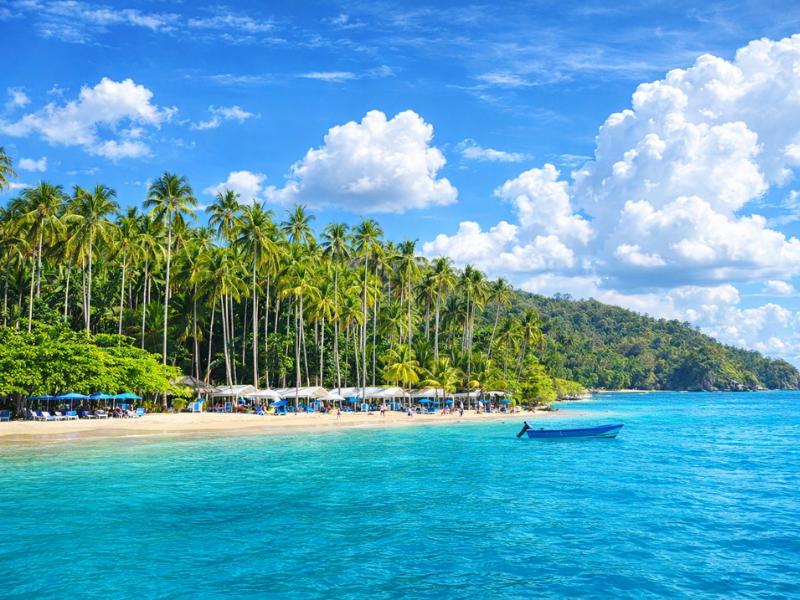
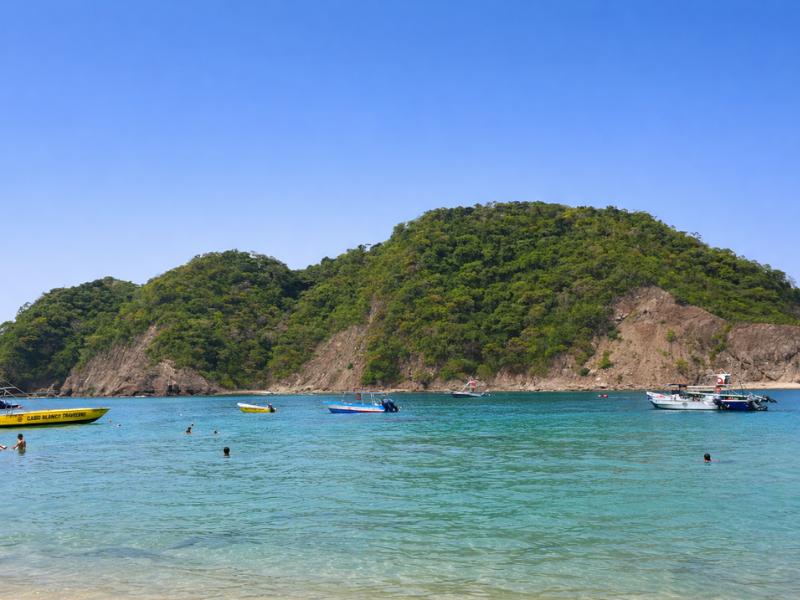
The reason this question gets asked so often is that Tortuga sells a photograph, and the photograph is accurate. Powdery white sand, water that goes turquoise in the shallows, palms leaning over the beach. What the photograph cannot tell you is how long you sat in a van to reach it, how many other boats landed at the same moment, and whether a beach day was what you wanted from a country better known for volcanoes and cloud forest.
So the useful answer is conditional. Below is the verdict split by traveller type, and the rest of this page works through both sides of the argument in detail rather than picking one.
| Traveller | Verdict | Why |
|---|---|---|
| Based in Santa Teresa, Montezuma or Tambor | Clearly worth it | 45-minute crossing, early landing, minimal dead time |
| Based in Puntarenas or the Central Pacific | Worth it | Direct dock access and the cheapest full-day option at $80 |
| Based in Jaco or Herradura | Worth it, with a caveat | Longer crossing, but the Tarcoles crocodile stop adds real value |
| Families with children under twelve | Clearly worth it | Calm shallow water, life jackets, child rates, simple lunch |
| Based in San Jose with several free days | Worth it if you want a beach day | Eighteen hours door to door, but no car or planning required |
| Based in San Jose with one free day | Probably not | A single free day spent mostly in a van is a poor trade |
| Certified divers chasing serious reef | Not really | Shallow, beginner-friendly reef rather than technical diving |
| Travellers who need constant activity | No | This is a beach day by design, with hours of deliberate nothing |
What actually makes the day good?
Snorkeling conditions and entry points vary. Boat-based reef stops involve open water; a life jacket does not replace swimming ability or individual supervision. Tell the operator about swimming confidence before booking, and choose beach time if the water activity is unsuitable.
Snorkeling conditions and entry points vary. Boat-based reef stops involve open water; a life jacket does not replace swimming ability or individual supervision. Tell the operator about swimming confidence before booking, and choose beach time if the water activity is unsuitable.
The guides in the water are a genuine differentiator on the better boats. Left alone, most first-time snorkellers swim over a flatfish, a small octopus tucked into a crevice, and a cleaning station without registering any of them. A guide pointing changes the session from pretty to interesting.
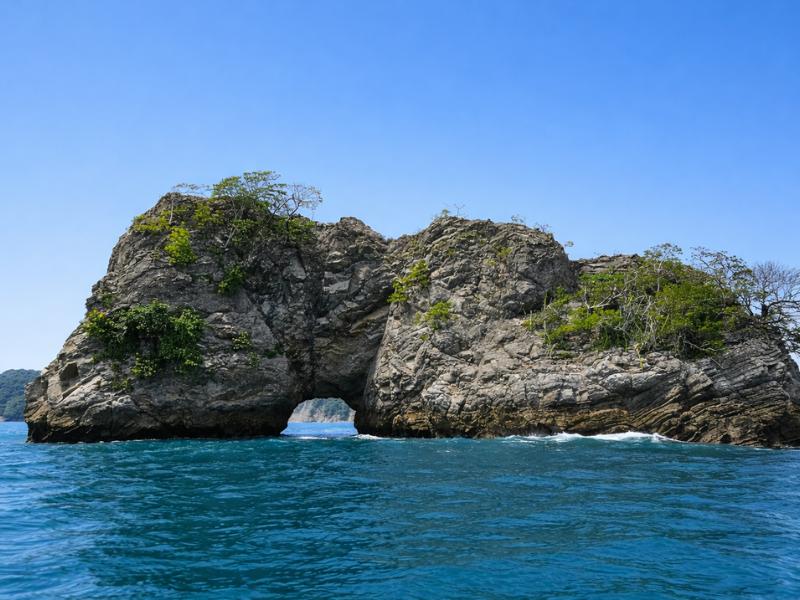
Then the beach itself. Playa Tortuga is long enough to absorb people, the sand is soft rather than shell-strewn, and the shade line under the palms is real shade. There are hammocks, kayaks and paddleboards typically at no extra charge, a banana boat for whoever wants it, and a stone arch viewpoint reachable on foot. Nobody organises you.
Lunch deserves its own sentence because it is better than the category usually manages. Grilled fish or chicken, rice, salad, plantains and tropical fruit, prepared by the boat crew and served at tables on the sand. It is a proper meal, not a lunchbox, and the crews tend to eat with the group.
Finally, the crossing. On the Santa Teresa and Montezuma route especially, the boat runs along the Nicoya coastline through water where dolphins are common and where humpback sightings between July and November are a real possibility rather than a marketing line. The operators worth booking are the ones who say clearly that they cannot promise it.
| What carries the day | How reliable it is | What can undercut it |
|---|---|---|
| Reef fish on the snorkel | Close to guaranteed on any session | Afternoon sessions in stirred-up shallows |
| Water clarity | Very good in dry season, among the best on this coast | Sediment for a while after heavy wet-season rain |
| Easy beach-entry snorkelling | Snorkeling conditions and entry points vary. Boat-based reef stops involve open water; a life jacket does not replace swimming ability or individual supervision. Tell the operator about swimming confidence before booking, and choose beach time if the water activity is unsuitable. | A rental mask that leaks, which ends sessions early |
| Lunch on the sand | Reliable on all full-day tours, cooked by the crew | Nothing much; the evening Curu tour serves snacks instead |
| Dolphins on the crossing | Common, captains scan and slow the boat | Wild animals, so never promised |
| Humpback whales | Genuinely possible July to November | Outside that window it does not happen at all |
| A quiet beach | Reliable before 10:30am and after 3pm | The 11am to 2pm convergence of several boats |
What is the honest case against Tortuga Island?
The case against is mostly about time and timing. Long transfer days from San Jose, a beach that fills between 11am and 2pm when several boats land at once, a pace that is deliberately slow, and a set of small on-island charges that surprise people, including a restroom fee of about a dollar a use.
None of these are dealbreakers on their own. Stacked together on the wrong booking, they produce the disappointed review you find on every platform.
| The friction | How bad it actually is | What removes it |
|---|---|---|
| Long transfer from San Jose | Real: 18 hours door to door, pickup between 4am and 6am, about four hours of road | Depart from Puntarenas, Jaco or the Nicoya Peninsula instead |
| Midday crowding | Moderate: 11am to 2pm, multiple boats on the same sand | Book the earliest departure and snorkel before lunch |
| Beach day, not adventure day | By design: hours of unstructured time after the snorkel | Pick a different tour if you want to be occupied all day |
| Restroom, WiFi and charging fees | Minor but irritating: around $1, $5 and $5 on some tours | Carry small notes; nobody expects to need cash on an island |
| Snorkel quality has a ceiling | Fair: good for beginners, not world-class reef | Set expectations, or book a discovery dive where offered |
| Weather risk in the wet season | Real: sediment after heavy rain, occasional rough crossings | Check the national forecast, take a morning departure, keep 24-hour cancellation terms |
| Two crossings in one day | Significant if you get seasick | Shortest crossing from Montezuma, medication before boarding |
There is one more thing worth naming, and it is not a flaw so much as a mismatch. Costa Rica is a country of volcanoes, cloud forest, whitewater and wildlife density that few places match. A day on a pretty island beach is a fine thing, but if it consumes one of five days in the country it is competing against Arenal, Monteverde and Manuel Antonio. That comparison is where a lot of the ambivalence about Tortuga actually comes from.
Is the eighteen-hour San Jose day trip worth it?
Only if you have days to spare and no rental car. The San Jose full-day tour is listed at 18 hours door to door, with pickup between 4am and 6am and roughly two hours of road each way. You get about five hours of beach time inside that. It is the site's most-booked tour by a wide margin, at around 6,090 bookings, so plenty of people find the trade acceptable.
Look at the ratio rather than the headline. The table below sets total listed day length against how much of it is actually spent on or around the island.
| Departure | Listed day length | Approximate transit share | Price from | Reasonable verdict |
|---|---|---|---|---|
| San Jose | 18 hours | Around four hours of road plus two crossings | $115 | Convenience purchase, not an efficiency purchase |
| Puntarenas, Las Playitas | 12 hours door to door | Two crossings of 60 to 90 minutes, no long road leg | $80 | Best value on the ladder |
| Jaco and Herradura | 10 hours | Two crossings of about 90 minutes plus the Tarcoles stop | $115 | Transit that is itself an attraction |
| Puntarenas private charter | 7 hours | Two crossings, 8:30am departure, no shared schedule | $125 | Best time efficiency for a group |
| Santa Teresa and Montezuma | 7 hours | Two 45-minute crossings | $152 | Highest island-time ratio, highest price |
The honest read: the San Jose tour is not badly designed, it is just geographically expensive. It exists because the capital is where a large share of visitors sleep, and because the alternative is renting a car and driving the same road yourself. The operator handles the bus, the boat connection, the island time, lunch and the return. If you have two or three nights in San Jose and want one beach day without organising anything, that is a fair exchange. If you have a single free day, spend it on something within an hour of where you are staying.
The Puntarenas speedboat at $80 is the option that quietly wins on value. The 12-hour label assumes you get yourself to the Las Playitas dock; the actual on-water and on-island portion is far shorter than that number suggests, and the return includes access to showers and changing rooms, which matters more than it sounds after six hours of salt.
How crowded does the beach really get?
Moderately, and on a predictable schedule. First boats land around 9 to 9:30am and the beach is close to empty. From 11am to 2pm boats from multiple departure points are on the sand at once, and arriving at 11am can mean four other tour boats are already there. After 3pm it thins out again.
Check the departure and cancellation terms for your actual travel date before arranging connecting transport. The product listings do not establish a guaranteed early landing, a fixed island-wide boat cap or how often a departure sells out. Related reading: Sistema Nacional de Areas de Conservacion
| Window | What the beach is like | Snorkel conditions |
|---|---|---|
| 9:00am to 10:30am | Near empty, first boats only | Best of the day: calm, clear, undisturbed sand |
| 10:30am to 11:00am | Filling steadily as later boats land | Still good |
| 11:00am to 2:00pm | Peak: multiple boats, towels along the main stretch | Stirred up near the entry point, busier in the water |
| 2:00pm to 3:00pm | Lunch service done, groups starting to board | Recovering |
| After 3:00pm | Thinning quickly, golden light | Quiet again, though most tours are leaving |
Season moves the ceiling but not the shape. December to April, and January to March in particular, puts the most boats on the water. May to June and September to October cut the count substantially, which is the main reason those months are worth considering even though the weather is less dependable. The clock stays the same either way.
Is the snorkelling good enough on its own to justify the trip?
For beginners and casual snorkellers, close to yes. For experienced divers, no. The reef around Isla Tortuga is shallow, calm and accessible from the beach, with a healthy fish population and good dry-season visibility. It is one of the better easy snorkel spots near the Nicoya mainland, not a world-class site.
The realistic comparison set is other easy Pacific-coast snorkelling in Costa Rica, and against that Tortuga does well. The water clarity around the island is consistently among the best on this coast, the entry is off sand rather than rock, and the fish are used to people. If you have never put a mask on before, this is a very good place to do it for the first time.
Against Caribbean or Indo-Pacific reef systems it does not compare, and the operators who claim otherwise are overselling. The coral is patchy rather than continuous, the depth is limited, and the species list is the standard tropical Pacific set rather than anything unusual. Some listings from the Santa Teresa side offer an optional discovery dive or scuba upgrade, which is the sensible route if you want more than a surface look.
Three factors move the quality of your specific session more than the site does:
- Time of day. Morning water is clearer and the fish are more active. After several groups have been through the shallows, visibility near the entry drops.
- Season. Dry-season visibility is materially better. Heavy rain puts sediment in suspension for a while afterwards.
- Whether a guide is in the water. The difference between a guided session and an unguided one is roughly the difference between seeing eight species and seeing twenty.
Gear is provided on all snorkel-focused tours and is basic but functional. If you own a mask you like the fit of, bring it. Rental masks that leak are the single most common reason people cut a session short.
Does the price hold up against other Costa Rica day trips?
Yes, at the lower end of the ladder. At $80 from Puntarenas, a full-day boat trip with snorkel gear, guide and a cooked lunch on a protected island is competitive with almost anything in Costa Rica. At $152 from Santa Teresa the value argument depends on how much you weight the shorter crossing.
The useful way to read the ladder is cost against what you actually receive, not cost against duration. A long listed duration is often transit, which is a cost rather than a benefit.
| Option | Price from | What the money buys beyond the boat | Rating |
|---|---|---|---|
| Puntarenas speedboat | $80 | Snorkel gear, full lunch, unlimited iced tea and coffee, showers and changing rooms at the dock | 4.5 |
| Jaco adventure day | $115 | Tarcoles crocodile bridge, Negritos monkey stop, secluded reef snorkel, local lunch | 4.5 |
| San Jose full day | $115 | Hotel pickup, all road and boat logistics handled, guided snorkel, buffet lunch | 4.5 |
| Puntarenas private charter | $125 | The whole boat, private beach spot, guided snorkel hour, gourmet barbecue, ceviche, stone arch stop | 4.8 |
| Santa Teresa full day | $152 | 45-minute crossing, whale corridor July to November, grilled lunch, optional discovery dive | 4.6 |
| Curu bioluminescence evening | $60 | Refuge wildlife walk, sunset on the island beach, night swim in glowing water | 4.3 |
The private charter is the entry that changes character with group size. At $125 per person it reads expensive next to the $80 speedboat, but you are buying an entire vessel, a guide focused only on your group, an 8:30am departure that lands ahead of the convergence, and access to the stone arch viewpoint that group tours often skip. For a family of four or five, that stops being a luxury and starts being the sensible booking.
The evening bioluminescence tour from Curu belongs in a different category entirely. It is not a beach day, it is a wildlife walk plus a sunset crossing plus a night swim, at $60 and about 2½ hours for the evening tour. For anyone who has already done a daytime island trip, it is the more interesting second visit.
Who should skip Tortuga Island?
Skip it if you have one free day in San Jose, if you get seriously seasick, if you are a certified diver expecting a dive site, if unstructured beach time bores you, or if what you actually wanted was turtle nesting and canal safaris, which is Tortuguero on the opposite coast.
Being specific about this is more useful than a general recommendation, so here is the list without hedging.
- You have a single free day and you are based in San Jose. Eighteen hours door to door, most of it in transit, for one beach. There are better uses of that day within an hour of the capital.
- You are prone to motion sickness and medication does not help you. Two crossings, and the return one is compulsory at the end of a hot day. From Puntarenas or Jaco that is roughly three hours on the water in total.
- You are a certified diver looking for depth, walls or big pelagics. This is a shallow beginner reef. Costa Rica has serious diving; it is not here.
- You cannot sit still. After the snorkel and lunch, the intended activity is a hammock. Operators say this openly, and the travellers who arrive calibrated for it have the best days.
- You want an island with a town on it. No village, no bar strip, no shops, no accommodation, no nightlife. The island empties every evening.
- You need guaranteed wildlife. Reef fish are close to certain. Turtles, rays, dolphins and whales are not, and no honest operator will tell you otherwise.
- You booked expecting Tortuguero. Different coast, different park, different trip. Cancel and rebook rather than trying to make one substitute for the other.
- Your dates land in the wettest stretch and your itinerary has no slack. September and October carry the highest chance of a rough crossing or a weather-affected day, and you want the flexibility to move it.
Who is Tortuga Island clearly worth it for?
It is clearly worth it if you are already on the Pacific coast or the southern Nicoya Peninsula, if you are travelling with children, if you want easy first-time snorkelling, if you have no car and want one organised beach day, or if you are a group large enough to fill a private boat.
The strongest case belongs to travellers based in Santa Teresa, Montezuma or Tambor. Forty-five minutes each way, an early landing, and a coastline route through good marine wildlife water. Almost none of the friction that generates negative reviews applies from that side of the gulf.
Families come second and it is not close. Shallow calm water, sand to occupy small children, mandatory child-sized life jackets on board, child rates on most listings, and a lunch that a fussy eater will find something in. The boat ride itself is usually a highlight for kids rather than a chore.
Then there is the group case. Four or more people booking the private charter out of Guima Frost marina get the whole vessel, an 8:30am departure ahead of the crowd, and a guide who is not managing thirty strangers. The 4.8 rating on that listing is what you would expect from a product where the main variable, other passengers, has been removed.
Cruise passengers and travellers with a single full day on the Central Pacific coast also do well here, because the Puntarenas departure is close and the day is self-contained. And anyone travelling without a rental car gets real value from having the entire chain handled, which is what the San Jose tour sells and why it carries the booking volume it does.
How do you make sure the day is worth it?
Four decisions carry almost all of the outcome: depart from the closest possible point, book the earliest boat, go in the morning half of the day for the snorkel, and bring small cash. Get those right and the common complaints mostly stop applying.
Work through the checklist below before you book rather than after.
| Decision | Get it right | What goes wrong otherwise |
|---|---|---|
| Departure point | Choose the closest one to where you sleep the night before | Hours of avoidable road time bolted onto a beach day |
| Departure time | Take the first sailing your operator offers | Landing at 11am into four boats worth of people |
| Snorkel timing | Go before lunch | Stirred-up water and the worst visibility of the day |
| Season | Dry season for conditions, shoulder for quiet and price | Sediment after rain, or a beach at its busiest |
| Booking lead time | Reserve days to a week ahead from January to March | Only the late departures left, or nothing at all |
| Cash | Small notes for restrooms, tips and extras | An awkward moment at the restroom block |
| Group size | Price the private charter at four or more people | Paying group rates for a worse version of the day |
If any of that raises a logistics question, the route-by-route breakdown of how to get to Tortuga Island covers every dock, crossing time and driving leg. For the wider picture on season, wildlife and what the day includes, the complete Tortuga Island travel guide has the full detail. And if the honest answer for your trip turns out to be that a beach day is not what you came for, that is a perfectly good outcome for a decision page to produce.