Isla Tortuga or Another Costa Rica Beach Day? How to Choose
Isla Tortuga is one of several ways to spend a beach day in Costa Rica, and it is not automatically the right one. Here is what it uniquely offers, what it cannot do, and how the alternatives really compare.
Booking Choice: An island lunch, snorkeling equipment and a Negritos wildlife stop. Explore Puntarenas Island Day: Shared Or Private
Start: Puntarenas. Confirm age rules and extras before booking.
Price note: fixed dollar amounts and totals in the editorial examples below are planning illustrations, not current quotes. Prices, child rates and private/shared options must be checked for your date and full party. The provider calendars and booking pages carry current offers.
What each beach day actually offers
The matrix compares structural features of each beach-day category, drawn from the Isla Tortuga tour itineraries on this site and from the general character of the mainland destinations rather than any single operator.
What is the one-line difference between these beach days?
Isla Tortuga is the only one of these options that is an uninhabited, car-free island reached by boat, visited on a fixed tour schedule, and left the same day. Every alternative is a mainland beach you can drive to, stay near, and leave when you like. That single structural difference drives almost everything else.
Travellers usually arrive at this question late, with a fixed number of days and one beach slot to fill. The mistake is comparing photographs. All of these places photograph well, because Costa Rica has a great deal of coastline and most of it looks good in the right light. The useful comparison is structural: who controls your schedule, whether there is a town, whether you can stay the night, and how much of the day is spent moving.
The honest framing for Isla Tortuga is that you are buying an island and a boat trip, not just a beach. If the boat and the island are what you want, nothing on the mainland substitutes. If what you actually want is a beach with a bar behind it and no departure time, you are paying a premium for constraints you did not need.
| Option | What it structurally is | Access | Who sets your schedule |
|---|---|---|---|
| Isla Tortuga | Uninhabited protected island, one visitor beach | Boat only, organised tour | The boat |
| Manuel Antonio | Beaches inside and beside a national park | Road, then park entry on foot | Park opening hours |
| Tamarindo and Guanacaste | Resort and surf beaches on the northern Pacific | Road, walk-on access | You |
| Jaco and the Central Pacific | Town beaches with a full service strip behind them | Road, walk-on access | You |
| Cahuita and Puerto Viejo | Caribbean beaches with reef and rainforest behind | Road, walk-on access | You |
What does Isla Tortuga uniquely give you?
Four things no mainland beach in Costa Rica can offer: an island you reach only by boat, no town or road behind the sand, a shallow reef inside a biological reserve within swimming distance of the beach, and a crossing through the Gulf of Nicoya where dolphins are routine and humpbacks pass between July and November.
Take those one at a time, because each is doing real work.
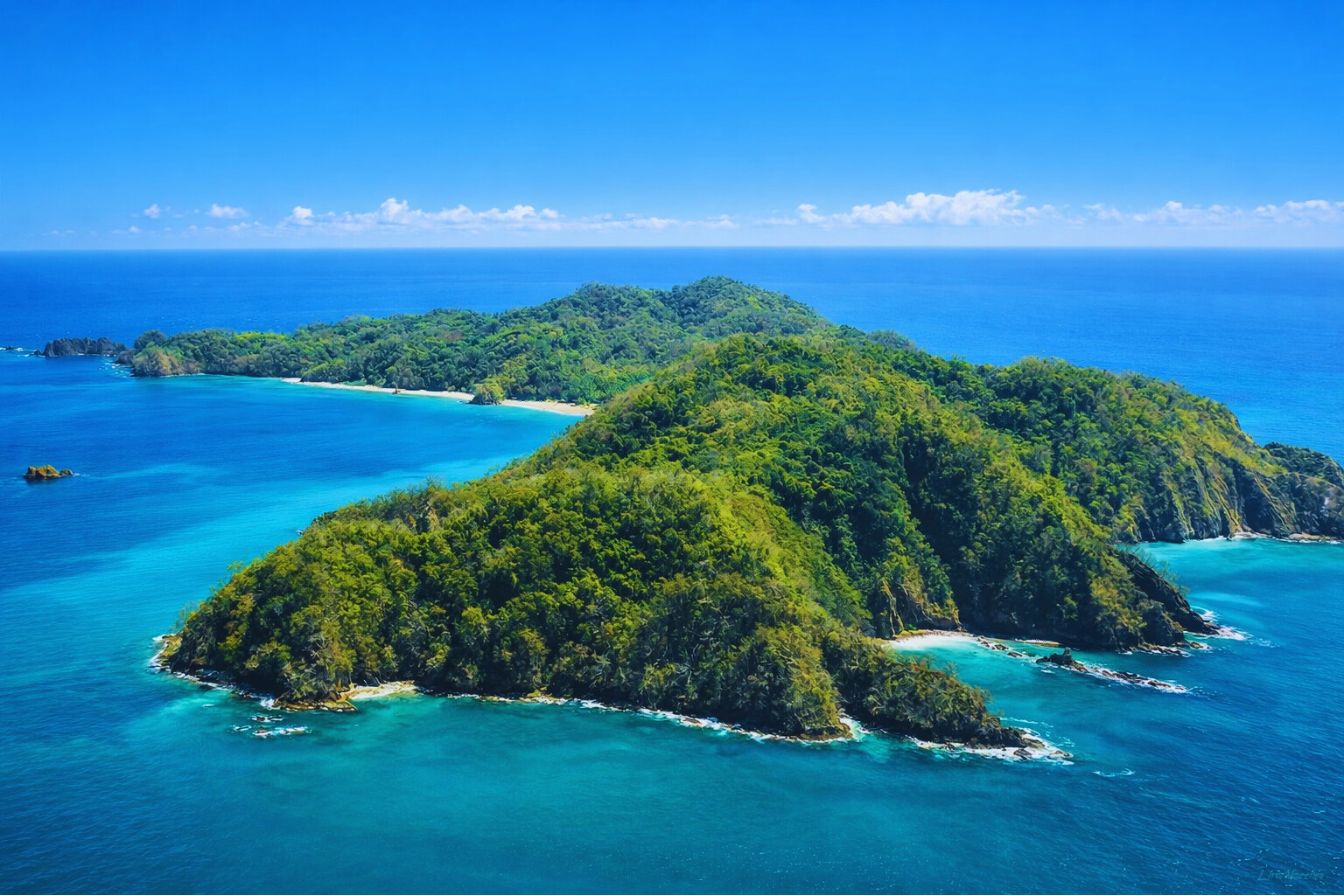
The arrival. A boat approach changes the psychology of a beach day. You watch a green hump with a white strip at its foot grow over 45 to 90 minutes, and by the time you step off into shin-deep water you have already had a morning. Driving to a beach, parking, and walking through a car park does not produce that, no matter how good the sand is at the other end.
The absence of a town. There is no road, no shop of consequence, no bar strip, no vendors working the sand in numbers, no hotel behind the palms. What that removes is noise and commerce. What it costs you is convenience, which is why the packing question for this trip is a real one rather than an afterthought.
The reef. A shallow volcanic rock reef with coral patches sits within swimming range of the beach, near the Islas Negritos Biological Reserve. Parrotfish, angelfish, sergeant majors, moray eels, eagle rays and green sea turtles turn up with enough regularity that operators build a guided snorkel session into the day. It is not a world-ranking dive site. For a warm, shallow, easy snorkel you can reach from sand, it is very good.
The crossing. The Gulf of Nicoya is productive water, and the boat trip is a wildlife activity in itself rather than dead transit. Dolphins are common enough that crews scan as routine. The Montezuma and Santa Teresa route runs through good whale water in the July to November window.
Check the departure and cancellation terms for your actual travel date before arranging connecting transport. The product listings do not establish a guaranteed early landing, a fixed island-wide boat cap or how often a departure sells out.
What does Isla Tortuga not give you?
No independent access, no overnight stay, no flexibility once the day starts, no town, and a long day if you are coming from San Jose. If any of those are deal-breakers, one of the mainland options will serve you better, and it is cheaper to work that out now than at 5am on a coach.
Being direct about the limits is worth more than another paragraph of turquoise adjectives.
- You cannot arrive on your own terms. There is no scheduled public boat service to the island. Independent arrangements from the peninsula exist but are informal, unregulated and unreliable to plan around from abroad. For practical purposes, a tour is the access route.
- Isla Tortuga and the Negritos islands are separate places in the Gulf of Nicoya. Some tours pass Negritos for wildlife viewing before visiting Tortuga. The excursions recommended here return the same day and do not include accommodation.
- You cannot change your mind. The boat departs and returns at fixed hours. If the snorkelling is exceptional and you want another hour, you do not get one. If you have had enough by two, you wait.
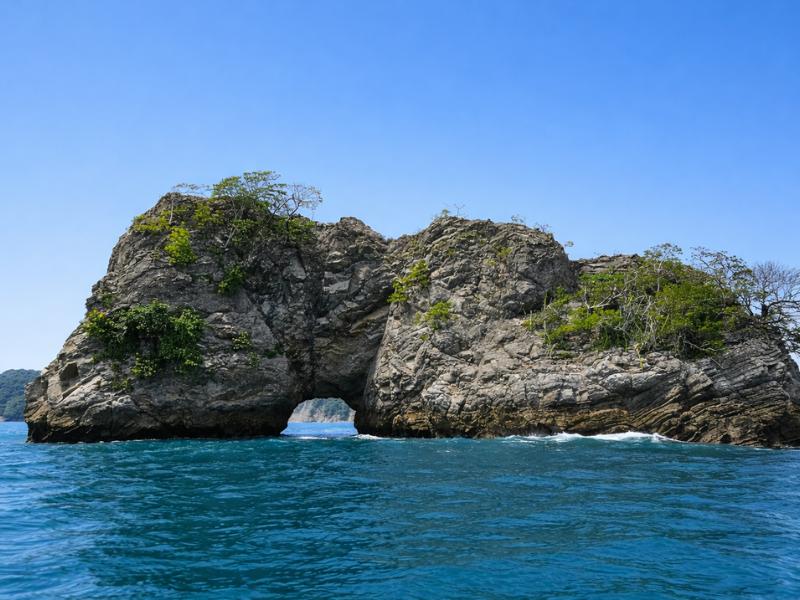
- There is nothing else to do. Beach, reef, short trails, the stone arch viewpoint, hammocks, lunch. That is the whole inventory. People who need constant activity find the afternoon long.
- The San Jose day is mostly road. The full-day tour from the capital is listed at 18 hours door to door, with a pickup between 4am and 6am and roughly two hours of driving each way. It is the most-booked option on this site for good reason, but the honest description is a long travel day around a good beach afternoon.
| Limitation | Why it exists | Which alternative solves it |
|---|---|---|
| No independent access | No road, no scheduled service, protected island | Any mainland beach, all of which you can drive to |
| No overnight stay | Biological reserve protection, no accommodation | Manuel Antonio, Tamarindo, Jaco, Puerto Viejo all have lodging |
| Fixed schedule | You are on a boat with other passengers | Any drive-to beach, or a private charter for a flexible group |
| No town, no services | Uninhabited island by design | Jaco or Tamarindo, which are the opposite of this |
| Long day from San Jose | Roughly two hours of road each way plus the crossing | Jaco, which is the closest coast to the capital |
| Limited land wildlife on the island | Monkeys are at the Negritos stop and Curu, not the beach | Manuel Antonio or the Caribbean side for reliable land wildlife |
Isla Tortuga or Manuel Antonio: beach plus park wildlife?
Manuel Antonio pairs beaches with a national park where sloths, monkeys and coatis are seen along accessible trails. It is the strongest alternative for anyone who wants land wildlife as the headline. Isla Tortuga wins on water: a boat crossing, a snorkel reef, and a beach with no road behind it.
These two get compared constantly because they occupy the same slot in an itinerary: one Pacific beach day, reachable from the Central Valley or the Central Pacific coast. They deliver almost opposite things.
Manuel Antonio's case is wildlife density on foot. Costa Rica's protected-areas system, administered by SINAC, includes a set of coastal parks, and this is the one where a visitor with no special skill walks a short trail and sees animals. That reliability is the product. The beaches inside and beside the park are genuinely good, the water is warm, and you can combine forest and sand in one morning.
Its costs are also real and worth stating. It is one of the busiest protected areas in the country, it operates on park hours with capacity management, the beaches have a town and a hotel strip behind them, and the snorkelling is not the reason anyone goes. Allow roughly three hours by road from San Jose, or a little over an hour from the Jaco area.
Isla Tortuga's case against it is structural. There is no road behind the sand, the reef is the point rather than an afterthought, and the crossing itself is part of the day. Its weakness against Manuel Antonio is equally clear: land wildlife on Isla Tortuga is limited to iguanas, seabirds and howler monkeys heard from the forest edge, with the monkey viewing happening at the Negritos stop from the boat, or on foot at Curu Wildlife Refuge on the evening departure.
Can you do both?
Yes, on separate days, and that is the usual answer for a two-week itinerary. They do not compete for the same base: Manuel Antonio works from Quepos or the Central Pacific, and Isla Tortuga works from Puntarenas, Jaco, San Jose or the southern peninsula. If you only have one beach day, choose on whether you want to be in the water or in the forest.
Isla Tortuga or Tamarindo and the Guanacaste beaches?
Guanacaste is the resort coast: long beaches, dependable dry-season sun, surf schools, and a full tourism infrastructure. If you are already staying there, a Tortuga day trip does not make sense geographically. If you are on the Central Pacific or in San Jose, Guanacaste is too far for a day.
This comparison is mostly settled by a map. Tamarindo and the Guanacaste beaches sit on the northern Pacific coast, well north of the Gulf of Nicoya, served by their own international gateway at Liberia. Allow roughly four to five hours by road from San Jose, or around an hour to an hour and a half from Liberia. Isla Tortuga tours depart from Puntarenas, Jaco, San Jose or the southern peninsula, which is a different part of the country.
What Guanacaste gives you is choice and comfort. Multiple beaches within short drives, a wide accommodation range, a reliable dry season, and a surf scene that caters to complete beginners. What it does not give you is an uninhabited island. The beaches have towns and resorts behind them; that is the model.
The honest recommendation is a base decision rather than a day decision. If your Costa Rica trip is centred on Guanacaste, build your beach days there and choose a different marine excursion from the local options rather than driving half the country for a boat. If your trip is centred on San Jose, Jaco or the Central Pacific, Isla Tortuga is the island day that is actually reachable from where you are.
| Factor | Isla Tortuga | Tamarindo and Guanacaste |
|---|---|---|
| Typical base | Puntarenas, Jaco, San Jose, southern Nicoya Peninsula | Tamarindo and the Guanacaste coast, via Liberia |
| Road time from San Jose | Around 1.5 to 2 hours to the departure port | Allow roughly 4 to 5 hours |
| Structure of the day | Fixed boat schedule, day trip only | Fully flexible, stay as long as you like |
| Overnight possible | No | Yes, extensive accommodation |
| Snorkelling | Reef within swimming distance of the beach | Varies by beach; generally a boat trip away |
| Surf | Not a surf destination | A primary reason people go |
| Crowd character | Check the departure and cancellation terms for your actual travel date before arranging connecting transport. The product listings do not establish a guaranteed early landing, a fixed island-wide boat cap or how often a departure sells out. | Town and resort crowds, uncapped |
Isla Tortuga or Jaco and the Central Pacific town beaches?
Jaco is the closest proper beach town to San Jose and the easiest beach day in the country logistically: allow roughly one and a half to two hours by road, park, and walk onto the sand. Isla Tortuga is what you do from Jaco when you want the day to be about water and an island rather than a town.
These two are not really rivals, because Jaco is one of the departure points for Isla Tortuga. The Jaco adventure tour runs a full day at around ten hours, starting with the Tarcoles River bridge crocodile stop, continuing to the Negritos islands for spider monkeys, then a snorkel at a secluded reef spot before the main beach.
The real comparison is between a day spent in Jaco and a day spent leaving Jaco. A Jaco beach day is easy, cheap and unstructured. There is a long grey-sand surf beach, a service strip of restaurants and bars, surf schools for beginners, and no schedule to keep. The water is not what you snorkel in; it is what you swim and surf in.
An Isla Tortuga day from Jaco costs you a full ten hours and gets you crocodiles, monkeys, a gulf crossing, a reef and a white-sand island. If you have several days on the Central Pacific, the sensible pattern is obvious: use a Jaco beach afternoon as the low-effort day and spend one full day on the island. If you have one day only and hate early starts, the town beach is the honest answer.
| Factor | Isla Tortuga from Jaco | A day on Jaco beach |
|---|---|---|
| Time commitment | Around 10 hours door to door, 7am pickup | As long or short as you want |
| Sand | White, powdery | Dark volcanic sand |
| Water activity | Guided reef snorkel, swimming, kayaks, banana boat | Swimming and surfing |
| Wildlife | Crocodiles at Tarcoles, spider monkeys at Negritos, dolphins on the crossing | Incidental |
| Food and drink | Lunch and soft drinks included; alcohol extra | Full town of restaurants and bars |
| Effort | Early start, long day, transfer to the dock may be extra | Walk out of your hotel |
One planning note specific to the Jaco departure: the Jaco to Puntarenas transport is listed as a separate charge of around $20 on that tour, so check the live inclusion list rather than assuming the transfer is bundled.
Isla Tortuga or Cahuita and Puerto Viejo on the Caribbean?
The southern Caribbean coast is a different country in feel: Afro-Caribbean culture, rainforest that reaches the sand, and Costa Rica's best-known fringing reef at Cahuita. It is the closest thing to a direct competitor on snorkelling, and it is on the opposite side of the country, allow roughly four hours by road from San Jose.
Start with the geography, because people confuse it with Isla Tortuga's name more often than you would expect. Cahuita and Puerto Viejo sit on the Caribbean coast in Limon province. Isla Tortuga is Pacific. Tortuguero, the Caribbean canal-and-turtle-nesting park, is a third and entirely separate destination further north on that same coast, reached by boat from Cariari or La Pavona and not related to Isla Tortuga in any way beyond the Spanish word for turtle.
On the merits, the Caribbean side's case is strong and different. The reef at Cahuita is a genuine fringing coral reef inside a national park, and it is snorkelled from shore or on a short boat trip. The beaches have rainforest directly behind them, with sloths and monkeys in the trees at the back of the sand. The food and music are unlike anywhere else in Costa Rica. You can stay for a week and never repeat a beach.
Its costs are distance and weather pattern. It is a long drive from the Central Valley and further still from the Pacific side, so it is a base rather than a day trip. The Caribbean rainfall pattern differs from the Pacific one, with September and October often the driest and sunniest window, which is the opposite of the Pacific dry season. Anyone planning a single itinerary across both coasts should look at that carefully.
Against Isla Tortuga, the honest summary is this: the Caribbean side wins if you want to base yourself somewhere for several days with reef, rainforest and culture in walking distance. Isla Tortuga wins if you want a single, structured, uninhabited-island day out from a Pacific base and have no intention of crossing the country. For general country-level orientation the Costa Rica entry covers the coastal geography.
How much of each day is actually travel?
This is the number most people fail to check, and it decides more beach days than sand quality does. The Isla Tortuga tour from San Jose is listed at 18 hours door to door, of which roughly four are road and around an hour and a half is water. From Jaco or Puntarenas the same island costs far less of your day.
The table below mixes two kinds of figure and it is important to know which is which. The Isla Tortuga rows are the tour operators' own published day lengths. The mainland alternatives are typical one-way driving allowances, not tour durations, and road conditions in Costa Rica vary enough that these are planning numbers rather than promises.
| Beach day | From San Jose | From the Central Pacific | What the figure includes |
|---|---|---|---|
| Isla Tortuga, San Jose tour | 18 hours door to door | Not applicable | Full tour: road, crossing, island, lunch, return |
| Isla Tortuga, Puntarenas speedboat | Drive about 1.5 hours to the dock | 12 hours door to door | Full tour from the Las Playitas dock |
| Isla Tortuga, Jaco adventure | Drive about 1.5 to 2 hours to Jaco | 10 hours door to door | Full tour including the Tarcoles stop |
| Isla Tortuga, Santa Teresa or Montezuma | Requires the ferry crossing; a base, not a day trip | 7 hours door to door | Full tour from the peninsula side |
| Manuel Antonio | Allow roughly 3 hours each way by road | Roughly 1 to 1.5 hours from Jaco | Driving allowance only, park time on top |
| Jaco beach | Allow roughly 1.5 to 2 hours each way | You are already there | Driving allowance only |
| Tamarindo and Guanacaste | Allow roughly 4 to 5 hours each way | Too far for a day trip | Driving allowance only; treat as a base |
| Cahuita and Puerto Viejo | Allow roughly 4 hours each way | Too far for a day trip | Driving allowance only; treat as a base |
Read that table as a filter rather than a ranking. Two of the four alternatives are not day trips from anywhere you would base yourself for an Isla Tortuga tour, which quietly removes them from the comparison for most itineraries. The real live choice for most visitors is Isla Tortuga against Manuel Antonio, or Isla Tortuga against simply staying put on a town beach.
Which one actually wins for snorkelling?
For a snorkel you can reach from a beach in warm, shallow, clear water, Isla Tortuga is the strongest of these Pacific options, and it is the only one where a guided reef session is built into the day at no extra charge. On the Caribbean side, Cahuita's fringing coral reef is the better reef in absolute terms.
The differences are worth being specific about, because snorkelling is the single activity where these places genuinely diverge.
Isla Tortuga's reef is volcanic rock with coral patches, sitting in shallow water within swimming distance of the sand. Visibility on a good dry-season morning is strong, the fish life is consistent, and the entry is easy enough that people who have never snorkelled before manage it on the first attempt. Gear is included on every snorkel-focused tour. The weakness is that it is a small site and it gets busy after eleven, which is another argument for the early boat.
Manuel Antonio has clear water and marine life but is not primarily a snorkel destination; people go for the park. Jaco's beach is surf and swim water rather than snorkel water. Guanacaste's snorkelling generally means a separate boat trip to an offshore site rather than a swim from the sand. Cahuita is the genuine reef, with the qualification that it sits on the far side of the country and its best water window is the reverse of the Pacific dry season.
| Destination | Reef type | Entry | Gear included | Best window |
|---|---|---|---|---|
| Isla Tortuga | Shallow volcanic rock with coral patches | Swim from the beach, guided session | Yes, on all snorkel tours | December to April, morning |
| Manuel Antonio | Rocky headlands, limited coral | From the beach, unguided | No | Dry season |
| Jaco | None to speak of | Not a snorkel beach | No | Not applicable |
| Guanacaste beaches | Rocky sites, usually offshore | Generally a separate boat trip | Depends on the operator | Dry season |
| Cahuita, Caribbean | Fringing coral reef in a national park | From shore or a short boat trip | Depends on the operator | Often September to October |
Which one wins for families with young children?
It depends on the age and the tolerance for a fixed schedule. Isla Tortuga works well for children who are comfortable on a boat: calm gulf water, life jackets provided, shallow swimming, a beach with nothing to fall off. It works badly for toddlers who nap on a schedule or anyone who cannot sit still on a 90-minute crossing.
The boat is the whole question. Tours to Isla Tortuga carry child-sized life jackets, the gulf is sheltered rather than open ocean, and once you are on the sand it is one of the safer beach environments in the country: no traffic, no vendors, no crowds to lose a child in, and shallow water at the swimming end. Families consistently do well on this trip.
What can go wrong is the shape of the day rather than the island. A 10 to 18 hour tour with an early pickup is a lot for a small child, and there is no way to leave early. The shorter departures fix most of this: the Santa Teresa and Montezuma route runs seven hours with a 45-minute crossing, and the private Puntarenas charter is also seven hours with the flexibility that comes from having your own boat. For a family that wants the island without the endurance test, one of those two is the answer rather than the San Jose day.
Against the alternatives: a town beach at Jaco or a Guanacaste resort beach is unquestionably easier with very young children, because you can leave when the day stops working. Manuel Antonio adds wildlife that children respond to strongly, with the trade-off of a walk in heat. Isla Tortuga trades flexibility for a genuinely memorable day, and for children old enough to snorkel, roughly from four to six upwards with a parent, that trade is usually worth it.
Who should skip Isla Tortuga entirely?
Skip it if you get badly seasick and cannot use medication, if you need a flexible schedule, if you are based in Guanacaste or on the Caribbean coast, if you have one day and want a lie-in, or if what you actually want is a bar, a surf lesson and a town behind the beach.
A guide that recommends everything to everyone is not much use, so here is the honest exclusion list.
- Severe motion sickness. The return crossing is not optional. If boats reliably ruin your day, the shortest crossing available is the 15-minute Curu evening departure, and the 45-minute Montezuma run is the shortest daytime option. If neither is workable, choose a mainland beach.
- Guanacaste or Caribbean bases. The geography does not work. You would spend most of a day driving to a boat.
- People who need to be busy. After the snorkel and lunch, the island is a beach. Hammocks, swimming, a short walk to the stone arch, kayaks and a banana boat. That is the full list, and the afternoon is long if that is not enough.
- Anyone hoping to stay overnight. Not possible, at any price, on any boat.
- Anyone booking it expecting Tortuguero. Different coast, different park, canal safaris and turtle nesting rather than a snorkel beach. If you booked one wanting the other, cancel and rebook.
- Very tight single-day itineraries out of San Jose. Eighteen hours door to door is a genuine commitment. If the day after is a flight or a long drive, think twice.
How does Isla Tortuga fit into a one or two week Costa Rica trip?
It slots in as one full day from a Central Pacific or Central Valley base, or as a short seven-hour day if you are already on the southern Nicoya Peninsula. The general rule is to attach it to where you already are rather than building an itinerary around it, and to book it early in the dry season.
Three patterns cover most trips.
The Central Valley base
You are in San Jose for the start or end of the trip and want one beach day without renting a car. The San Jose full-day tour handles the entire chain: pickup, road, boat, island, lunch, return. It carries close to 6,000 bookings and fills its December to April dates consistently. Accept that it is 18 hours door to door and treat the next morning as a slow one.
The Central Pacific base
You are in Jaco, Herradura or Puntarenas for a few nights. This is the most efficient position. The Puntarenas speedboat from the Las Playitas dock is the value option and returns you to showers and changing rooms; the Jaco adventure adds the crocodile bridge and the Negritos monkeys; the private Puntarenas charter from Guima Frost gives a group the whole boat with an 8:30am start. Pair the island day with a Manuel Antonio day and you have covered both halves of the Pacific coast experience.
The Nicoya Peninsula base
You are in Santa Teresa, Montezuma or Tambor, having taken the Puntarenas to Paquera ferry. From here the island is closest: a 45-minute crossing on a seven-hour day, through the water where humpbacks pass between July and November. Curu Wildlife Refuge is also on this side, which puts the bioluminescence night swim within reach as a second, entirely different island experience.
| Your base | Best Isla Tortuga option | Day length | Pair it with |
|---|---|---|---|
| San Jose or Central Valley | Full-day tour from San Jose | Up to 18 hours door to door | A rest day after |
| Puntarenas | Las Playitas speedboat, or the Guima Frost private charter | 12 hours, or 7 hours private | The Puntarenas waterfront in the evening |
| Jaco or Herradura | Jaco adventure full-day tour | Around 10 hours | A Manuel Antonio day, roughly 1 to 1.5 hours south |
| Santa Teresa, Montezuma or Tambor | Santa Teresa and Montezuma boat adventure | 7 hours | The Curu evening bioluminescence departure |
| Guanacaste | Not practical as a day trip | Not applicable | Local Guanacaste marine excursions instead |
| Caribbean coast | Not practical as a day trip | Not applicable | Cahuita reef and the Puerto Viejo beaches |
So which should you book?
Book Isla Tortuga if you want a boat crossing, a reef you can swim to, and a beach with no road behind it, and you are based on the Central Pacific, in San Jose or on the southern Nicoya Peninsula. Book a mainland beach day if you want flexibility, a town, an overnight, or reliable land wildlife on foot.
The comparison shopping usually ends in one of three places. If wildlife on foot is the priority, Manuel Antonio is the better single day and nobody should pretend otherwise. If ease is the priority and you are on the Central Pacific, a Jaco beach afternoon costs nothing and asks nothing. If the island itself is the appeal, and the idea of arriving somewhere by boat that has no road, no shop and no hotel is what you came to Costa Rica for, then nothing on this list substitutes for Isla Tortuga.
Check the departure and cancellation terms for your actual travel date before arranging connecting transport. The product listings do not establish a guaranteed early landing, a fixed island-wide boat cap or how often a departure sells out. Related reading: Costa Rica Tourism Board