Tortuga Island Tours from Jacó and Herradura
The Jaco version of a Tortuga day is not the shortest route to the island. It is the one that stops for crocodiles and spider monkeys on the way, and turns a transfer into the first half of the trip.
Booking Choice: A Tortuga reef session, lunch and wildlife stops on a day from Jacó. Explore Jacó Island Day And Wildlife Stops
Start: Jaco. Confirm age rules and extras before booking.
Price note: fixed dollar amounts and totals in the editorial examples below are planning illustrations, not current quotes. Prices, child rates and private/shared options must be checked for your date and full party. The provider calendars and booking pages carry current offers.
The Jacó day, hour by hour
Approximate minute allocation across the Jacó day, built from the published tour itinerary and the operators' typical hour-by-hour running order.
What does a Tortuga Island day from Jacó actually involve?
Pickup at your Jacó or Herradura hotel around 7 to 7:30am, a stop at the Tarcoles River bridge to look at wild American crocodiles, boarding for the Gulf of Nicoya crossing, a wildlife stop at Negritos Island for spider monkeys, a guided snorkel at a secluded reef, then beach time and a local lunch on Isla Tortuga. Back around 5:30 to 6pm.
Roughly ten hours door to door, of which the actual island block is about four. That ratio is the thing to understand before you book. This is not a route that minimises travel. It is a route that turns the travel into content, which is a genuine choice rather than a compromise, and it is why the Jacó departure earns bookings despite being further from the island than the peninsula ports.
| Time | What happens | Roughly how long | Worth knowing |
|---|---|---|---|
| 7:00 to 7:30am | Hotel pickup in Jacó or Herradura | 30 to 45 minutes on the road | Exact time depends on where your hotel sits on the pickup loop |
| Around 7:45am | Tarcoles River bridge, crocodile viewing | 15 to 20 minutes | Free to stand on the bridge; guides explain the delta ecology |
| 8:15am | Transfer onward to the departure marina | 20 to 30 minutes | Some departures board at Herradura, others continue to the Puntarenas dock |
| 8:30 to 9am | Boarding, safety briefing, gear allocation | 15 to 20 minutes | Sort your mask now rather than in the water |
| 9 to 10am | Crossing into the Gulf of Nicoya | About an hour | Dolphins are common; humpbacks possible July to November |
| Around 9:30am | Negritos Island stop, spider monkeys | 20 to 25 minutes | Boat slows offshore; this is a look-and-listen stop, no landing |
| 10:30am | Arrival at Isla Tortuga | Ahead of the midday convergence of other boats | |
| 10:45am to noon | Guided snorkel at a secluded reef | Roughly an hour in the water | Deliberately away from where the main tour boats concentrate |
| 12:30pm | Local lunch served on the beach | 45 to 60 minutes | Grilled fish or chicken, rice, salad, fresh fruit |
| 2 to 4pm | Free afternoon on the sand | About two hours | Swim, hammocks, kayaks, paddleboard, banana boat |
| 4pm | Board for the return crossing | 60 to 90 minutes | Coffee and snacks on the way back |
| 5:30 to 6pm | Marina, then road transfer to your hotel | 30 to 45 minutes | Plan a quiet evening; this is a long day in the sun |
Timings shift by twenty or thirty minutes depending on the pickup loop, the sea state and how the group moves. What does not shift is the shape: two wildlife stops before the island, one guided snorkel, one long lazy afternoon.
Why does the day start at a crocodile bridge?
Because the Tarcoles River sits directly on the road between Jacó and the Gulf of Nicoya, and it holds one of the highest concentrations of American crocodiles in Central America. You stand on the bridge and look down at animals in the water and on the banks, some of them exceeding four metres. It takes about fifteen minutes and costs nothing.
The stop works because it is honest. Nobody is feeding anything, there is no enclosure, and the crocodiles are simply there in a wild river delta doing what they do. Guides use the time to explain why the Tarcoles delta has become such a significant nesting area on the Pacific coast, which sets a tone for the day before the boat has even left.
Some practical notes on the stop:
- Bring a camera with reach. The animals are below you and a phone photo tends to render them as grey smudges on brown mud. Zoom helps.
- It is a road bridge. Traffic passes close. Keep children on the walkway side and hold onto anything you would hate to drop.
- Vendors work the parking area. Souvenirs and cold drinks. Small notes are useful; nothing here needs to be bought.
- Numbers vary. On a good morning there might be a dozen animals visible. At high water there may be two. It is a river, not a display.
- It is the only bathroom stop before the boat. Use it, because the next facilities are on the vessel and then a paid restroom on the island.
If wildlife is a large part of why you are in Costa Rica, this stop plus the Negritos monkeys is the substantive difference between the Jacó route and a straight boat transfer from a peninsula port. You are effectively getting two small wildlife encounters folded into a transfer you would have to make anyway.
What is the extra transport fee, and what does it cover?
The Jacó listing prices the boat day at around $115 and shows the Jacó to Puntarenas road transport as a separate charge of about $20 per person. That covers the ground leg between your hotel and the embarkation point, including the Tarcoles bridge stop. Budget for it rather than being surprised by it at pickup.
This is worth stating plainly because it is the most common point of confusion on this particular departure. The headline price is the island day. The road leg is the add-on. Add them together when you compare against a Puntarenas departure, because a Puntarenas boat has no road leg to price in and the raw comparison is misleading.
| Item | Typical cost | Included in the headline price? | Notes |
|---|---|---|---|
| Boat day, guiding, snorkel gear, lunch | From about $115 per person | Yes | Check the live listing for current pricing and any child rate |
| Jacó to Puntarenas road transport | About $20 per person | No, added separately | Covers the transfer plus the Tarcoles crocodile stop |
| Island restroom | Around $1 per use | No | Bring small notes or coins; there is no card facility on the island |
| Alcoholic drinks | Sold on board or on the beach | No | Soft drinks, coffee, tea and water are included through the day |
| Beach umbrella or chair rental | Optional, paid on the sand | No | Shade under the palms is free but goes early |
| Gratuities for the captain and crew | Your discretion, cash | No | Small US dollar or colón notes are the practical option |
| Travel insurance | Your own arrangement | No | Standard exclusion across every operator on this coast |
Realistically, allow around $150 per person for the day including the transfer, a couple of drinks, the restroom and a fair tip. That is a defensible planning figure rather than a quoted price, and it lets you compare the Jacó day honestly against the alternatives further down this page.
What actually happens at the Negritos Island stop?
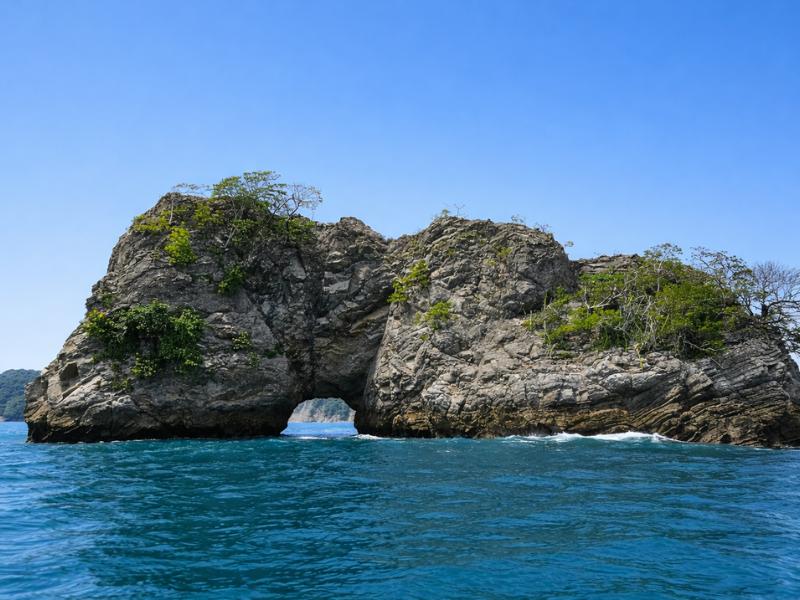
The boat slows off Negritos Island, part of the same protected reserve system as Isla Tortuga, and the guide finds the resident spider monkeys in the trees along the shoreline. Nobody lands. It runs twenty to twenty-five minutes and doubles as a dolphin-watching pause, since the crossing passes through water where pods are common.
Spider monkeys are the draw, and they are genuinely wild animals on a protected island rather than habituated beggars at a roadside. That cuts both ways: the encounter is authentic and it is not guaranteed. Some mornings the troop is visible along the water's edge and the whole boat gets a clear view. Other mornings you hear movement in the canopy and see very little.
The islands here fall near the Islas Negritos Biological Reserve, administered within Costa Rica's national protected-areas system, SINAC. That status is why boats stay offshore and why there is no landing, no trail and no feeding. If a tour anywhere on this coast offers to put food in front of a wild monkey for a photograph, that is the tour to avoid.
Two things improve your odds at this stop. First, go early, because primate activity along the shoreline drops as the day heats up. Second, listen rather than scan. Guides find monkeys by sound far more often than by sweeping the treeline with their eyes, and a boat full of talking passengers makes that harder for everyone.
What is the snorkel like on the Jacó tour specifically?
Gear is provided and the session runs at a secluded reef location chosen deliberately away from where the main tour boats concentrate. It is a boat-entry snorkel over volcanic rock rather than a shallow beach wade, roughly an hour in the water, and it happens before the midday crowd builds.
The reef around Isla Tortuga is volcanic structure colonised by coral, sponge and algae rather than a continuous coral garden, and the life concentrates on the rock. Parrotfish and angelfish are near-constants, morays sit in the crevices, and eagle rays cross the open water beyond the reef edge. Manta rays and sea turtles turn up occasionally. Visibility runs best on flat dry-season mornings.
Getting the most from this particular session
- Fit your mask on the crossing. A leaking rental mask is the most common reason people cut a session short, and the boat ride is dead time you can use to test the seal.
- Stay over the rock. Drifting out over sand is how people conclude there was nothing to see, ten metres from a wall covered in it.
- Snorkeling conditions and entry points vary. Boat-based reef stops involve open water; a life jacket does not replace swimming ability or individual supervision. Tell the operator about swimming confidence before booking, and choose beach time if the water activity is unsuitable.
- Put a rash guard on. An hour face-down at this latitude burns backs badly, and the cool water hides it happening.
- Go back in after lunch. The afternoon beach-entry swim is shallower, easier and free, and by then you know what you are looking for.
What is included, and what should you expect for lunch?
Lunch is a traditional local meal served on the island: grilled fish or chicken with rice, salad and fresh fruit. Snacks, unlimited fresh fruit, soft drinks, water, coffee and tea run through the day. Snorkel gear and guided wildlife viewing are included. Alcohol, the island restroom fee, tips and the road transfer are not.
| Included in the tour | Not included |
|---|---|
| Unlimited fresh fruit and non-alcoholic drinks | Jacó to Puntarenas road transport, about $20 extra |
| Professional snorkelling equipment | Alcoholic beverages, available to purchase |
| Traditional local lunch on the island | Gratuities for the captain and crew |
| Guided wildlife viewing, monkeys and dolphins | Beach umbrella and chair rental |
| Coffee, tea and snacks through the day | Island restroom fee, around $1 per use |
| Life jackets and onboard safety equipment | International travel insurance |
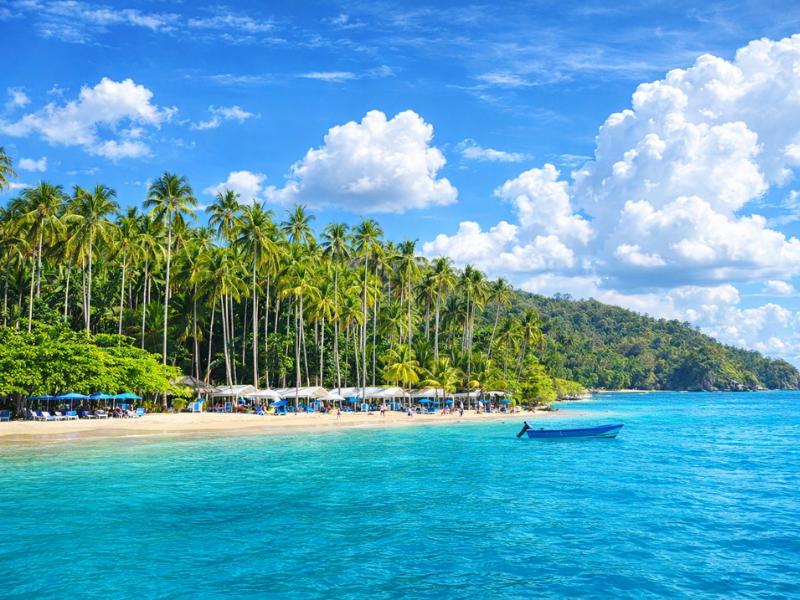
Lunch is served on the sand rather than at a restaurant, because there is no restaurant. The island is uninhabited, has no accommodation, no roads and no permanent facilities, and overnight stays are not permitted. Everything you eat arrived on a boat that morning, which is also why dietary requests need flagging at the time of booking rather than on the day.
The quality bar here is decent home cooking rather than fine dining, and most people rate it higher than they expected to. Eating grilled fish at a table on white sand with the boat anchored fifty metres away does a lot of work.
How does going from Jacó compare with going from Puntarenas?
Puntarenas is cheaper and more direct: a private dock, a straight crossing, no road leg to pay for. Jacó costs more once you add the transfer but folds in the crocodile bridge and the spider monkey stop. If you are already staying in Jacó or Herradura, the Jacó tour is the sensible choice. If you are driving anyway, Puntarenas wins on price.
| From Jacó or Herradura | From Puntarenas | |
|---|---|---|
| Headline price | From about $115, plus roughly $20 road transport | From about $80, the lowest full-day option |
| Door-to-door day | About 10 hours | About 12 hours including road connections |
| Wildlife on the way | Tarcoles crocodiles and Negritos spider monkeys | Dolphin watching on the gulf crossing |
| Departure point | Hotel pickup in Jacó and Herradura | Private dock in the Las Playitas neighbourhood |
| Facilities on return | Straight to the road transfer | Showers and changing rooms at the dock |
| Time on the island | About 4 hours after the snorkel | About 5 hours free on the beach |
| Best for | Jacó-based travellers who want wildlife layered in | Value seekers and anyone already on the central Pacific coast |
The wider point is that the island is identical from every boat. Same white sand, same volcanic reef, same grilled lunch. What you are choosing between is how much travel wraps around it and whether that travel is itself worth something to you. On the Jacó route it clearly is; on the Puntarenas route the answer is that you save both money and an hour.
Which departure point should a Jacó-based traveller actually use?
Stay in Jacó and take the Jacó tour. Moving your base to the Nicoya Peninsula for one day trip costs a ferry crossing, a night's accommodation and most of a travel day, which is a worse trade than accepting a longer boat ride. The peninsula ports are closer to the island but they are not closer to you.
| Departure | Getting there from Jacó | Crossing | From price | Verdict for a Jacó base |
|---|---|---|---|---|
| Jacó and Herradura | Hotel pickup, no travel needed | Road transfer plus the gulf crossing | $115 plus about $20 | The default. Wildlife stops included |
| Puntarenas | Roughly an hour by car or bus north | About 90 minutes across the gulf | $80 | Good if you have a car and want to save money |
| Private charter from Puntarenas | Same drive, 8:30am departure from Guima Frost | Direct, private vessel | $125 | Best for groups and anyone who wants the reef before the crowd |
| Santa Teresa or Montezuma | Ferry plus peninsula driving, an overnight in practice | 45 minutes, the shortest of the main routes | $152 | Only if you are already spending nights on the peninsula |
| San José | Wrong direction entirely from Jacó | Two hours by road each way, then the boat | $115 | For capital-based visitors, not for you |
| Curú refuge, evening | Ferry crossing required | 15 minutes to the island | $60 | A different product: sunset and a bioluminescent night swim |
The one scenario that changes this calculus is a multi-night Nicoya Peninsula leg already in your itinerary. If you are heading to Santa Teresa or Montezuma anyway, do the island from there instead: shorter crossing, earlier arrival, and the humpback corridor between July and November. Read more about how the departure points compare across the year before you commit hotel nights to it.
How does hotel pickup work in Jacó and Herradura?
Pickup runs as a loop through Jacó and Herradura between roughly 7 and 7:30am, with your exact time depending on where your hotel sits on that loop. You give your accommodation name at booking. If you are staying outside the standard zone, expect to be asked to meet at a central point instead.
| Where you are staying | Typical pickup | What to do |
|---|---|---|
| Central Jacó, on or near the main strip | Around 7 to 7:15am | Wait in the lobby or at the road entrance, not in your room |
| Herradura and Los Sueños area | Around 7:15 to 7:30am | Confirm the exact gate or reception the driver will use |
| Playa Hermosa, south of Jacó | Varies, sometimes a meeting point instead | Ask at booking whether your address is inside the pickup zone |
| Outside the standard zone | Meeting point in central Jacó | Arrange your own taxi to arrive fifteen minutes early |
| Arriving the night before from San José | Same loop as any Jacó hotel | Sleeping in Jacó rather than the capital saves several hours |
Three habits prevent almost every pickup problem. Be outside and visible five minutes early, because the driver has a schedule and a phone number that may not connect. Give a working local contact number at booking. And take a photo of your booking confirmation rather than relying on hotel WiFi to load an email at 7am.
Who is this day right for, and who should skip it?
It suits people based in Jacó or Herradura who want wildlife folded into their transfer and are happy with a long, gentle, sun-heavy day. It suits families. It does not suit anyone chasing maximum island time per hour spent, anyone prone to seasickness who dislikes long boat legs, or anyone expecting an adventure tour.
Book it if
- You are already in Jacó or Herradura. Hotel pickup removes the whole logistics question, and the day is built around your location rather than around a port you have to reach.
- You want wildlife, not just a beach. The crocodile bridge and the Negritos monkeys are two real encounters most island routes do not offer.
- You are travelling with children. Two stops before the boat break up the transfer, life jackets are carried for all ages, and the beach itself is shallow and calm.
- You want the reef before the crowd. A 10:30am arrival and a secluded snorkel spot both put you ahead of the 11am to 2pm convergence.
Skip it if
- You are staying on the Nicoya Peninsula. Montezuma and Santa Teresa are 45 minutes from the island. Do not cross the gulf twice to reach a boat.
- You get seasick easily. There is around two hours of boat time here. Take something before boarding rather than after you feel it.
- You want to be constantly active. This is a beach and ocean day with an unhurried middle. The hammocks are the point, not a consolation.
- You have one day and want maximum island time. The Puntarenas speedboat gives you around five hours on the sand for less money.
What should you bring for a ten-hour day?
Swimwear worn under your clothes, a rash guard, high-SPF reef-safe sunscreen applied before boarding, a hat and polarised sunglasses, a quick-dry towel, a dry bag for your phone, small cash notes, and motion-sickness tablets if you are prone. Everything else is provided or optional.
| Item | Why it matters on this route | Priority |
|---|---|---|
| Rash guard or long-sleeve swim top | An hour face-down snorkelling burns backs badly, and the water hides it | Essential |
| Reef-safe high-SPF sunscreen | Protected marine area; apply before boarding so it binds | Essential |
| Small cash notes | Restroom fee, tips, drinks, and the vendors at Tarcoles | Essential |
| Dry bag or waterproof phone case | Sea spray on the crossing plus a wet beach day | Essential |
| Motion-sickness tablets | Around two hours of boat time; take them before departure | High if you are prone |
| Hat and polarised sunglasses | Glare off the gulf is severe even under cloud | High |
| Quick-dry towel | Not provided; you will be wet more than once | High |
| Water shoes or secure sandals | Boat decks and beach rock are slippery; flip-flops slide | Medium |
| Your own snorkel mask | Fit is personal and a leaking rental cuts sessions short | Medium |
| Light rain layer | Green season showers plus wind on an open boat | Medium, May to November |
| Zoom camera or action camera | Crocodiles are far below, monkeys are high in the canopy | Optional but rewarding |
Pack light beyond that. Boat space is limited, you will be in and out of swimwear, and there is nowhere on the island to store anything. A single small dry bag plus a beach towel covers the whole day for most people.
What can go wrong, and what do you do about it?
The realistic problems are a missed pickup, seasickness on the crossing, sunburn, and a weather cancellation in September or October. All four are manageable and none of them are unusual. The one genuinely outside your control is the weather, which is why your island day should not be the morning before your flight home.
- Missed pickup. Be outside five minutes early with a working local number on the booking. If the van does not appear, call the operator before assuming it has gone.
- Seasickness. The crossing is inside the sheltered Gulf of Nicoya rather than open Pacific, so it is rarely rough, but it can be lively on a breezy green-season morning. Take tablets before boarding, sit mid-vessel, and look at the horizon rather than at your phone.
- Sunburn. The most common thing that actually spoils people's remaining holiday. Rash guard, reapply after the snorkel, and take the shade in the middle of the day.
- Weather cancellation. Uncommon outside the wettest weeks. Check the Instituto Meteorológico Nacional forecast a few days out, and keep a spare day if you are travelling in September or October.
- Wildlife no-shows. Crocodiles vary with the river level and monkeys vary with the morning. Guides do not stage either. Treat both stops as likely rather than certain.
- Running out of cash. There is no card facility on the island, and the restroom, the drinks and the tips all want notes. Sort this before pickup, not at the marina.
None of that should read as discouragement. The Jacó day works well and the ten hours pass faster than the number suggests, because the structure keeps changing: road, bridge, boat, island, water, food, hammock, boat, road. What people remember afterwards tends to be the two things that were not strictly necessary, the crocodiles under the bridge and the monkeys in the trees off Negritos, which is a fair verdict on why this particular route exists.
If you are still weighing the Jaco departure against the alternatives, two comparisons are worth making before you book. Tours from Puntarenas leave from closer to the island and cost less, while the Santa Teresa full day has the shortest crossing of any option. The full price breakdown across all six tours sits on its own page, and if you are travelling as a group, families with children often find the shorter peninsula departures easier than a ten-hour day built around a road transfer.