Best Time to Visit Tortuga Island (2026)
Two things decide how good your Tortuga Island day is: the month you pick and the hour your boat lands. Get both right and the beach is empty and the water is glass. Get either wrong and you queue.
Booking Choice: An island lunch, snorkeling equipment and a Negritos wildlife stop. Explore Puntarenas Island Day: Shared Or Private
Start: Puntarenas. Confirm age rules and extras before booking.
Price note: fixed dollar amounts and totals in the editorial examples below are planning illustrations, not current quotes. Prices, child rates and private/shared options must be checked for your date and full party. The provider calendars and booking pages carry current offers.
Tortuga Island conditions, month by month
Relative sea-calm and visibility scores by month, drawn from the dry and green season pattern in the Gulf of Nicoya and the July to November humpback window that operators work to.
When is the best time to visit Tortuga Island?
Compare current quotes for the same date, party and inclusions. Add transport and optional extras to both totals before deciding whether private service is worth the difference. Weather can affect any departure. Related reading: Gulf of Nicoya
Check the departure and cancellation terms for your actual travel date before arranging connecting transport. The product listings do not establish a guaranteed early landing, a fixed island-wide boat cap or how often a departure sells out.
So treat the calendar as two overlapping questions. The first is climate: sea state, rain, water clarity. The second is traffic: how many other boats are in the water with you, and how far ahead you need to commit to get on the early one. The dry season wins the first question and loses the second. Green season does the reverse. The table below is the short version.
| Season | Months | Sea and water | Crowds and availability | Book ahead |
|---|---|---|---|---|
| Dry season, peak | January to March | Flattest gulf of the year, visibility widely reported at 15 to 20 metres on good days, reliably sunny | Busiest. Multiple boats landing midday from four or five departure points | Several days to a week for the best boats and earliest departures |
| Dry season, edges | December and April | Still dry and calm, occasional building humidity late April | Christmas, New Year and Easter spike hard; the rest of both months is easier | Two to four days outside the holiday spikes |
| Green shoulder, early | May and June | Mostly bright mornings, showers building in the afternoon, sea still generally workable | Noticeably quieter, fewer boats per day, easier to get an early slot | One to three days is usually enough |
| Wet season with whales | July and August | More frequent showers, occasional choppier crossings, sediment after heavy rain | Quiet on the island, though this is a northern-hemisphere holiday period | Two to three days for whale-focused departures |
| Green shoulder, late | September and October | Wettest stretch of the year on the Pacific side, murkier water after downpours | Emptiest island of the year, lowest prices, some operators run reduced schedules | Often same week, but confirm the boat is running |
Costa Rica's tourism board keeps a general seasonal overview at visitcostarica.com, and the national weather service, the Instituto Meteorológico Nacional, publishes the actual forecasts and rainfall bulletins for the Pacific region. Check the IMN in the week before you travel rather than relying on a generic annual average, because the Pacific coast's rainy season does not start and stop on a fixed date.
What does the month-by-month scorecard actually say?
March is the standout: flattest water, best clarity, warmest sea. February and January sit just behind it with heavier demand. October is the weakest month for water clarity but the strongest for having the beach to yourself. September and October also carry the highest chance of a schedule change.
Read the table below as a planning tool, not a forecast. The sea-state and clarity columns describe what the gulf typically does across a whole month, and a single week can behave differently. What does not change month to month is the shape of the day: early boats get calm, clear water, and later boats get chop, company and stirred-up sand.
| Month | Sea state | Water clarity | Rain pattern | Island crowding | Verdict |
|---|---|---|---|---|---|
| January | Flat, steady offshore breeze | Excellent | Effectively none | High, peaks around New Year | Book early, take the first boat |
| February | Flat | Excellent | Effectively none | High and consistent all month | Best balance of conditions and reliability |
| March | Flattest of the year | Best of the year | Effectively none | High but no holiday spike | The month to aim for if you can choose |
| April | Calm, humidity building late month | Very good | First isolated afternoon showers late in the month | Very high in Holy Week, then falling | Excellent outside Semana Santa |
| May | Generally calm mornings | Good, occasional post-shower sediment | Bright mornings, afternoon showers | Dropping fast | Best value month of the year |
| June | Calm mornings, livelier afternoons | Good | Regular afternoon rain | Low | Quiet beach, still-warm water |
| July | Mixed, some choppier crossings | Variable | Short dry spell possible mid-month | Low to moderate | Humpback window opens |
| August | Mixed | Variable | Frequent showers | Low | Good whale odds, patchy snorkelling |
| September | Choppier, more weather days | Weakest of the year after rain | Heaviest rain on the Pacific side | Lowest of the year | Solitude and low prices, accept the risk |
| October | Choppier | Weak after heavy rain, fine on dry days | Heaviest rain on the Pacific side | Lowest of the year | Cheapest, emptiest, least dependable |
| November | Settling week by week | Improving through the month | Tapering | Still low, rising late | The insider month: whales, thin crowds, improving sea |
| December | Calm and drying out | Very good | Effectively none after the first week or two | Moderate, then very high from about the 20th | Early December is quietly excellent |
If you want one line to carry away: early December and late November are the most underrated fortnight on this island. The rain has usually stopped, the gulf has flattened, the whales have not entirely gone, and the Christmas surge has not started. Operators are running full schedules and their boats are not full.
Why does the dry season deliver such clear water?
Water clarity around Isla Tortuga is driven by runoff and swell, not by temperature. In dry months the rivers feeding the Gulf of Nicoya carry almost no sediment and the sea surface stays flat, so nothing lifts sand off the bottom. That combination is what produces the 15 to 20 metre visibility people photograph.
The Gulf of Nicoya is a large shallow estuary, and estuaries are sediment machines. Every river draining the central Pacific watershed empties into it. During the wet months that freight of silt and organic matter spreads out across the gulf, and even on a sunny day two days after a downpour the water carries a faint green haze. In February the same water reads as glass.
Swell matters just as much. Tortuga sits far enough inside the gulf to be sheltered from open-Pacific swell, which is why the crossing is comfortable most of the year. But wind chop still stirs the shallow sand shelf just off the beach, and that shelf is exactly where beach-entry snorkellers spend their time. On a flat February morning the sand stays where it is. On a breezy September afternoon it does not.
Three practical consequences follow from that:
- Rain two days ago still matters. Sediment does not clear the moment the sun comes out. If you are chasing clarity in green season, look for a dry run of three or four days, not just a dry morning.
- Morning beats afternoon in every month. Wind on the gulf typically builds through the day. Early water is calmer water, and calmer water is clearer water.
- The boat-based reef sessions hold up better than beach entry. The guided snorkel stops sit over volcanic rock in deeper water, away from the sand shelf, so they degrade less when conditions are marginal.
What do you genuinely gain by going in green season?
You gain space, price and flexibility. Fewer boats run, so the beach that holds several hundred people at a March midday might hold a few dozen. Operators discount. Early departures stop being contested. And you can often book two days out instead of a week, which suits itineraries that are still moving.
The trade is real, though, and pretending otherwise helps nobody. Green season on the Pacific side of Costa Rica means a wet afternoon most days, not a wet week. The classic pattern is a clear bright morning, cloud building from around midday, and a heavy burst of rain in the afternoon that clears by evening. Since a Tortuga day is built around a morning crossing and a midday beach block, that pattern is survivable. What is not survivable is a multi-day system sitting over the coast, and September and October are when those happen.
What green season actually changes about the day
- Lunch under cover. The beach lunch still happens; it just happens with more people crowded under the palapa or the boat's canopy while a shower passes.
- Shorter snorkel windows. Guides read the water. If clarity has collapsed after rain they will shorten the session or move it, which is the right call and worth respecting.
- Better wildlife on the crossing. Fewer boats churning the gulf means dolphins and rays behave more naturally. The humpback window overlaps most of the green season.
- Greener everything. The Nicoya coastline is brown and crisp by March. In October it is dense green forest running to the waterline, which changes what the crossing looks like.
One honest warning: in the deepest wet weeks, some operators reduce frequency. A tour that runs daily in February may run three or four days a week in October. That does not mean the tour is unavailable, it means the specific date you wanted may not have a departure. Confirm the sailing before you commit hotel nights around it.
When can you actually see humpback whales on the crossing?
The humpback window at Isla Tortuga runs July through November. Sightings happen on the crossing rather than at the island, which makes the longer routes from Santa Teresa and Montezuma the better bet, since they spend more time in the open gulf. No operator can promise a whale, and the honest ones do not.
Costa Rica's Pacific coast is unusual because it receives humpbacks from both hemispheres in different parts of the year, which stretches the total whale season far longer than most destinations manage. For Tortuga day trips specifically, the practical window that operators work to is July to November, and that overlaps neatly with the quietest months on the island. If wildlife rather than beach time is your priority, that overlap is the argument for skipping the dry season entirely.
Whales are not the only thing the calendar moves. Here is what the year does to the rest of the wildlife you might encounter on a Tortuga day.
| Species | Where you see it | Best months | Realistic odds |
|---|---|---|---|
| Humpback whale | Open gulf during the crossing | July to November | Possible, never guaranteed. Longer crossings improve the odds |
| Dolphins | Anywhere on the crossing | Year round | Common enough that captains routinely slow the boat for a pod |
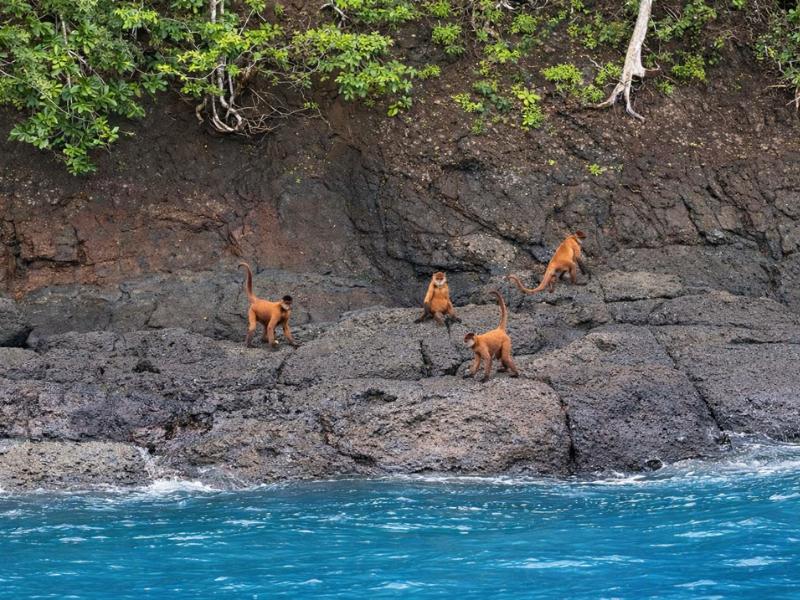
| Spider monkeys | Negritos Island stop | Year round | Good on tours that make the stop, better early morning |
| Sea turtles | Reef and shallows off the beach | Year round, best in clear water | Occasional, much better in dry-season visibility |
| Eagle and manta rays | Volcanic reef, boat-based snorkel | Year round | Occasional, favours the deeper guided sessions |
| Howler monkeys and iguanas | Jungle edge behind the beach, Curu refuge | Year round | Heard reliably, seen often at Curu, less often on the island itself |
The Islas Negritos Biological Reserve that protects these islands is administered within Costa Rica's national protected-areas system, SINAC. Landing rules and the number of authorised vessels exist because of that status, which is also why the island has no hotel, no road and no permanent population.
What time of day should you be standing on the beach?
Be on the sand by 9 or 9:30am. First boats leave Paquera, Montezuma and Tambor around 8 to 9am, and for roughly an hour the beach is close to empty. Crowds peak between 11am and 2pm as boats from four or five departure points converge. Arriving at 11am can mean four other tour boats have already landed.
This is the single highest-payoff decision in the whole article, and it costs nothing. The early slot is the same price as the late one on almost every operator. What changes is the product.
| Time on the island | Typical boats present | Water condition | What the day feels like |
|---|---|---|---|
| 8:30 to 9:30am | Zero to one | Calmest and clearest of the day, sand undisturbed | Near-solitude, soft light, best photographs, best snorkelling |
| 9:30 to 11am | One to three | Still good, light chop beginning | Comfortable. Shade and hammocks still available |
| 11am to 2pm | Four or more at peak | Sand stirred near shore, breeze up | The busy block. Snorkel zone shared, shade contested, queues for the restroom |
| 2 to 3:30pm | Thinning as morning groups leave | Choppiest of the day, clarity reduced | Beach reopens, but most tours are already boarding |
| After 4pm | Evening and sunset departures only | Not relevant, this is not a snorkel window | Golden light, the bioluminescence night tour territory |
Some tours build the early slot in structurally. The private charter from Puntarenas departs at 8:30am from Guima Frost marina, which lands you well before the group boats. Tours out of Montezuma and Santa Teresa have a 45-minute crossing rather than the roughly 90 minutes most mainland departures need, so an 8:30am departure from that side gets you on the sand while a Puntarenas boat is still mid-gulf.
The counter-intuitive one is the very long day from San Jose. It leaves between 4 and 6am, which sounds punishing, but the road transfer is the reason. That group is not first on the beach, because the road time eats the advantage. If early-and-empty is your goal, sleep on the coast rather than in the capital.
How far ahead do you need to book in each season?
Check the departure and cancellation terms for your actual travel date before arranging connecting transport. The product listings do not establish a guaranteed early landing, a fixed island-wide boat cap or how often a departure sells out.
Check the departure and cancellation terms for your actual travel date before arranging connecting transport. The product listings do not establish a guaranteed early landing, a fixed island-wide boat cap or how often a departure sells out.
| Period | Group day tour | Early departure specifically | Private charter | Bioluminescence evening |
|---|---|---|---|---|
| 20 Dec to 5 Jan | 1 to 2 weeks | 2 weeks | 3 weeks or more | 2 weeks or more |
| January to March | 4 to 7 days | 1 week | 2 weeks | 1 to 2 weeks |
| Semana Santa (Holy Week) | 2 weeks | 2 to 3 weeks | 3 weeks or more | 2 weeks or more |
| April outside Holy Week | 3 to 5 days | 5 days | 1 to 2 weeks | 1 week |
| May, June, September, October | 1 to 3 days | 2 to 3 days | 4 to 7 days | 3 to 5 days |
| July, August, November | 2 to 4 days | 3 to 5 days | 1 week | 5 to 7 days |
Demand is not spread evenly across the tour list either. The full-day trip from San Jose has close to 6,000 bookings behind it and fills its dry-season departures consistently from December through April, because San Jose is where the largest single pool of visitors sits. The private all-inclusive escape from Puntarenas cannot be assembled at the dock on the morning you want it, by definition: a private boat is committed to a date or it is not.
Which departure point suits which season?
Montezuma, Tambor and Paquera are the closest and stay comfortable in almost any month, because the 45-minute crossing spends less time in open water. Puntarenas and Jaco cross more exposed gulf, so a windy green-season morning is felt more. San Jose is a road-time question, not a sea question.
The Nicoya Peninsula side has the geographic advantage and the mainland side has the logistical one. Which matters more depends entirely on where you are sleeping, and moving your base for one day trip is usually a worse trade than accepting a longer crossing.
| Departure point | Crossing | Dry season | Green season | Best suited to |
|---|---|---|---|---|
| Montezuma or Santa Teresa | About 45 minutes | Excellent, arrives before the mainland boats | Excellent, the shortest exposure to chop | Anyone already on the southern peninsula |
| Tambor or Paquera | 30 to 45 minutes | Excellent, first boats out around 8am | Very good, calm bay water at the start | Families and anyone who dislikes long boat legs |
| Curu refuge | About 15 minutes | Shortest crossing of all, evening product | Fine, rain affects the night swim more than the boat | The bioluminescence night tour |
| Puntarenas | Roughly 90 minutes across the gulf | Very good, and the lowest-priced full day | Workable, but the exposed middle section can be lively | Central Pacific bases and anyone driving from San Jose |
| Jaco or Herradura | Road transfer plus the gulf crossing | Very good, wildlife stops built in | Fine, the road stops are rain-tolerant | Jaco-based travellers who want a wildlife-layered day |
| San Jose | Roughly 2 hours by road each way, then the boat | Reliable but long; a full 18-hour door-to-door day | Same length, more chance of a wet road stretch | Capital-based visitors with no rental car |
One note on the long-duration tours. The 18 hours quoted on the San Jose day and the 12 hours on the Puntarenas speedboat are door-to-door figures that include road transfer, hotel pickup and waiting time. Actual time on the water and on the island is a fraction of that. Nobody spends eighteen hours at Isla Tortuga, because overnight stays are not permitted anywhere on it.
What does a wet-season day on the island really feel like?
Usually it feels like a normal beach day with one interruption. Mornings in green season are frequently clear and calm, the crossing happens before the cloud builds, and the rain arrives in the afternoon as a heavy 30 to 60 minute burst. Then it stops and the light goes gold. What it does not feel like is a washout.
The failure mode is not drizzle, it is a frontal system. When a multi-day pattern parks over the Pacific coast in September or October, the gulf gets lumpy, visibility collapses, and operators start cancelling. That is when a tour gets moved or refunded, and it is why building your Tortuga day into the middle of a trip rather than the last morning is sensible planning in those months.
Practical adjustments for a green-season booking:
- Book the earliest departure available. The weather advantage of morning is larger in green season than in dry season, not smaller.
- Keep a spare day. If your tour is cancelled for weather you want a second shot, and that means not scheduling it for the day before your flight.
- Pack a light rain layer. Not for warmth. For the twenty minutes on an open boat when a shower passes and the wind chill on wet skin becomes genuinely unpleasant.
- Treat the snorkel as a bonus, not the point. If your whole reason for going is underwater clarity, September and October are the wrong months and no operator can fix that.
- Ask about the refund and reschedule policy before booking, not after. Most listings offer free cancellation 24 hours ahead, but weather cancellations are the operator's call and their policies differ.
How does the calendar change what you pay?
Headline tour prices move less than most travellers expect, because the biggest cost driver is the departure point, not the month. What green season really discounts is the surrounding trip: hotels, transfers and car hire. The tour ladder itself stays roughly stable, running from about $60 for the evening bioluminescence trip to about $152 from Santa Teresa.
Understanding why that ladder looks the way it does makes the seasonal question easier. You are not paying more for a better island. The island is identical from every boat. You are paying for how much travel is wrapped around it and whether that travel is itself an attraction.
| Tour | Departs from | Duration | From price | Strongest season for it |
|---|---|---|---|---|
| Bioluminescence evening from Curu | Curu Wildlife Refuge | About 2 hours on the water | $60 | Darkest nights, away from a full moon, year round |
| Puntarenas speedboat full day | Las Playitas private dock, Puntarenas | 12 hours door to door | $80 | Dry season, when the exposed gulf section is flat |
| Full day from San Jose | San Jose hotels | 18 hours door to door | $115 | Dry season, check your preferred date December to April |
| Isla Tortuga adventure from Jaco | Jaco and Herradura | 10 hours door to door | $115 | Any season; the wildlife stops are rain-tolerant |
| Private all-inclusive from Puntarenas | Guima Frost, 8:30am | 7 hours | $125 | Peak season, when avoiding the midday crowd is worth most |
| Full day from Santa Teresa | Santa Teresa and Montezuma | 7 hours | $152 | July to November for the humpback crossing |
Prices shown are the published from-rates on the live listings and can move, so check the current figure before you commit. The pattern that holds regardless: the closest departure points cost the most per person and give you the most island time, and the furthest cost the least per hour but spend that saving on road transfer.
Who should skip peak season entirely?
Skip December to April if your priority is solitude, photography without other groups in frame, wildlife behaviour, or budget. Skip it too if your dates are not fixed and you dislike booking a week ahead. The dry season buys clarity and reliability, and if those are not what you came for, you are paying a crowd premium for nothing.
Specific profiles who do better outside the peak:
- Whale watchers. The humpback window is July to November, which is the exact inverse of the dry season. This is not a compromise, it is the correct season for that goal.
- Photographers. Green season gives you dramatic sky, saturated forest on the Nicoya coastline and an empty beach. Dry season gives you flat blue sky and other people's umbrellas.
- Anyone with a flexible itinerary. If you can move your Tortuga day by 48 hours to chase a dry window, green season stops being a gamble and becomes a discount.
- Families with young children. Quieter boats and a quieter beach are worth more than perfect visibility when the snorkelling is going to be shallow and supervised anyway.
- Repeat visitors. If you have already had the postcard version, the version worth having next is the one where you can hear the howler monkeys over the jungle edge instead of four boats' worth of conversation.
The people who genuinely should hold out for dry season are those with a single fixed day, a strong snorkelling motivation, or a group that will not tolerate a weather cancellation. For them, February and March are worth planning the trip around.
What is the single best week to aim for?
The first two weeks of March, on a weekday, with an 8 to 9am departure from the Nicoya Peninsula side. That combination gives you the flattest gulf, the best visibility of the year, no holiday surge, and an arrival on the sand roughly ninety minutes before the midday convergence of boats.
If March does not fit your trip, the ranked fallbacks are straightforward. Late November is second, because the sea has settled, the whales have not entirely left and the island is still quiet. Early December is third for the same reasons minus the whales. Mid-May is fourth: bright mornings, real discounts, and the rain still politely waiting until afternoon.
The worst combination, for completeness, is a Saturday in late December or during Holy Week, booked the day before, on a midday departure from a mainland port. Every variable working against you at once. Everything above is really just a set of instructions for avoiding that.
Whichever month you land on, the two decisions that matter most are the same: commit to a boat early enough that you get the departure time you want, and pick a departure point whose crossing you will actually enjoy rather than endure. The island itself is generous. It rewards people who arrive before the crowd, in any month of the year.