Best Day Trips from San José: What Actually Fits in One Day
San José sits in a valley ringed by volcanoes, with two coasts a few hours away in opposite directions. That geography makes the day-trip list unusually long, and unusually easy to get wrong. Here is what genuinely fits in a day.
Booking Choice: Road transport, an island lunch and snorkeling when conditions allow. Explore San José To Isla Tortuga
Start: San Jose. Confirm age rules and extras before booking.
Price note: fixed dollar amounts and totals in the editorial examples below are planning illustrations, not current quotes. Prices, child rates and private/shared options must be checked for your date and full party. The provider calendars and booking pages carry current offers.
Day trips from San José at a glance
The bars show typical one-way travel allowances from San José by day-trip category, with the Isla Tortuga bar split into its road leg and its boat leg to show why the published day runs to 18 hours.
What makes a San José day trip work, and what makes it fail?
A San José day trip works when the road time is honest, the destination rewards a few hours rather than a few days, and the departure is early enough to beat both the traffic out of the Central Valley and the afternoon cloud that builds over the mountains. It fails when someone tries to reach a destination that needs an overnight.
The capital sits in the middle of the country at around 1,150 metres, in a valley ringed by mountains. Roads out of it run in four useful directions: up to the volcano rim, north into rainforest, west and southwest to the Pacific, and east toward the Caribbean slope. Every one of those roads starts with the same twenty to forty minutes of city traffic, which is why departure time matters more than distance.
The failure mode is predictable. Visitors look at a map of a country roughly the size of West Virginia, decide that everything is close, and book a day that spends nine hours in a vehicle for two hours of destination. Some of Costa Rica's best-known places, the Caribbean canals at Tortuguero above all, are simply not day trips from the capital under any arrangement.
The trips that do work share a shape: two to three hours of travel each way at most, a destination that gives you a solid block of time, and either a guide or a car so the logistics do not eat the day. Costa Rica's tourism board keeps regional orientation at Visit Costa Rica, and it is a useful sanity check on distances before you commit.
Which day trips are realistically within reach of San José?
Five categories cover almost everything worth doing in a day from the capital: Central Valley coffee estates, the volcano rim, rainforest and waterfall country on the northern slope, Central Pacific beach towns, and the Gulf of Nicoya island day to Isla Tortuga. Everything else is an overnight in disguise.
The table below sorts them by how much of your day disappears into a vehicle. Treat every figure as a planning allowance rather than a timetable, because traffic out of the Central Valley and weather on the mountain roads both move these numbers.
| Category | Allow one way | What the day gives you | Best for |
|---|---|---|---|
| Central Valley coffee estate | 30 to 60 minutes | A guided walk through planting, picking, processing and roasting, usually a half day | Half-day trips, rainy afternoons, first day after landing |
| Volcano rim, Poás or Irazú | 60 to 90 minutes | A crater viewpoint at altitude, cloud forest, a cool change from the valley heat | Early risers, photographers, anyone short on time |
| Rainforest and waterfall country | 90 minutes to 2 hours | Waterfalls, aerial trams and canopy walks, wildlife on the northern slope | Families, first-time visitors wanting green Costa Rica |
| Central Pacific beach towns | 90 minutes to 2.5 hours | Surf beaches, coastal towns, seafood lunch, sunset if you stay late | Beach fix without repacking your bags |
| Isla Tortuga island day | About 2 hours to the port, then the boat | Nearly 5 hours on white sand, snorkelling, buffet lunch, dolphins on the crossing | The one classic tropical island day the capital can reach |
| Arenal volcano area | Around 3 hours | Possible as a very long day, better as an overnight | Travellers with no other option and high tolerance for road time |
| Caribbean canals at Tortuguero | Not a day trip | Requires a boat connection and at least one night | Nobody, from San José |
That last row exists because of a genuinely common mix-up. Tortuguero on the Caribbean and Isla Tortuga on the Pacific sound alike and are nothing alike, and the difference between Tortuguero and Tortuga Island trips up a lot of first-time planners.
Why is Isla Tortuga the standout beach day from the capital?
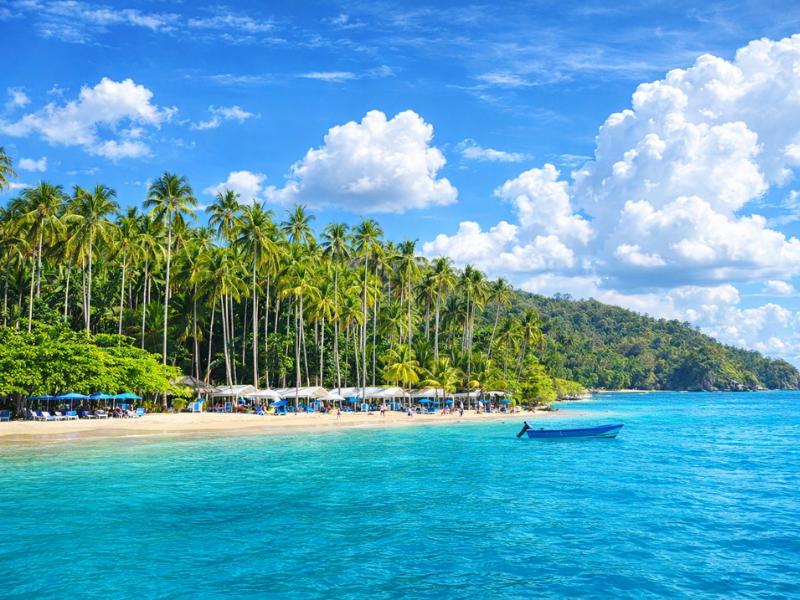
Isla Tortuga is an uninhabited protected island in the Gulf of Nicoya with powdery white sand, turquoise shallows and a reef close to shore. Nothing else within day-trip range of San José looks like it, and the organized full-day tour has taken more than 6,090 bookings at a 4.5 rating, more than four times the next Isla Tortuga departure.
Isla Tortuga and the Negritos islands are separate places in the Gulf of Nicoya. Some tours pass Negritos for wildlife viewing before visiting Tortuga. The excursions recommended here return the same day and do not include accommodation. Related reading: SINAC
What you get on the ground is roughly five hours of beach time on Playa Tortuga, a guided snorkel over reef holding parrotfish, angelfish, rays and sometimes sea turtles, and a buffet lunch served on the sand. The crossing itself is part of the appeal rather than dead time: the boat runs out through the gulf's volcanic islets, crews scan for dolphins as routine, and between July and November humpback whales move through those waters.
The booking pattern says something useful about who this tour is for. The largest single source of visitors to Isla Tortuga is not the nearby coastal towns. It is San José, because so many travellers base themselves in the capital for part of a trip and want one dedicated beach day without renting a car or shifting hotels.
How does the 18-hour Tortuga day break down, hour by hour?
Pickup runs between 4 and 6 AM depending on your hotel, followed by a two-hour drive to Puntarenas, a boat crossing of under an hour, a 45-minute guided snorkel, lunch and beach time on the island, then the same journey in reverse with coffee and cookies on the return boat.
Eighteen hours is the honest door-to-door figure, and the operator publishes it rather than hiding it. Set against that, nearly five of those hours are spent on the island itself, which is a strong return for a single-day format.
| Stage | Allow roughly | What is happening |
|---|---|---|
| Hotel pickup in San José | Between 4 and 6 AM | Air-conditioned transport, pickup point confirmed at booking. It is genuinely early. |
| Drive to Puntarenas | About 2 hours | Route 27 to the Pacific. A stop is made for inexpensive local breakfast, which is not included in the price. |
| Boarding at the port | 15 to 20 minutes | Life jackets, briefing, bags aboard. |
| Crossing the Gulf of Nicoya | Around 45 minutes | Dolphin and seabird watching. Humpbacks possible July to November. |
| Guided snorkel session | About 45 minutes | Equipment included. Reef fish, rays, occasional turtles. |
| Buffet lunch on the beach | 45 to 60 minutes | Fish, chicken or a vegetarian and vegan option, with fruit, soft drinks and iced tea. |
| Beach time on Playa Tortuga | Close to 5 hours in total | Swimming, palm shade, optional paid extras such as jet ski or banana boat. |
| Return crossing and drive | About 45 minutes plus 2 hours | Coffee and cookies on the boat, then the land leg back to the capital. |
At $115 per person the day covers round-trip transport, the boat, snorkel gear, lunch and drinks. Breakfast, gratuities, alcohol and optional island activities sit outside it.
Is 18 hours too long for a beach day, and who should skip it?
Yes for some people, and the site says so plainly. Roughly four hours of the day are spent in a vehicle and another hour and a half on boats. If your tolerance for early starts and road time is low, or you are travelling with a toddler, a different day trip will serve you better.
The honest framing matters because the tour is genuinely excellent for the people it fits and genuinely wearing for the people it does not. What tips the balance is usually not the beach, which everyone likes, but the 4 AM alarm and the return in the dark.
| Traveller | Verdict | Reasoning |
|---|---|---|
| Two or three nights in San José, no rental car | Strong fit | One organized day, no logistics, a real tropical beach and back to the same bed. |
| Comfortable with early starts | Strong fit | The early departure buys the beach hours. That is the whole trade. |
| Travelling with a toddler | Reconsider | A 4 AM start and four hours in a vehicle is a lot to ask. Older children handle it well. |
| Already heading to the Pacific coast | Book from the coast instead | The Puntarenas speedboat at $80 removes the San José road legs entirely. |
| Staying in Jacó or Herradura | Book locally | The Jacó departure adds a crocodile stop at the Tarcoles River bridge and cuts the drive. |
| Prone to seasickness | Take precautions | The gulf crossing is short but exposed. Tablets before boarding, seat towards the middle of the boat. |
| Only one free day and want green Costa Rica | Pick a different category | A volcano or rainforest day gives more variety for less total travel. |
Nobody should feel talked into this one. It is a beach and ocean day rather than an adventure day, and visitors who arrive calibrated for that tend to rate it as one of the best days of their trip.
What do the Central Valley volcano days involve?
The volcano rim above San José is the closest genuinely dramatic landscape to the city, with the main craters reachable in about an hour to 90 minutes by road. Expect altitude, cold wind, cloud forest on the approach and a viewpoint that either delivers spectacularly or shows you nothing but cloud.
Two volcanoes sit within easy reach of the capital: Poás to the northwest above Alajuela, and Irazú to the east above Cartago. Both are national parks with managed access, and both climb well above the valley floor, so the temperature drops sharply as you go up. People who set off in shorts on a warm San José morning regret it within the hour.
The single most important planning rule for a volcano day is to go early. Cloud builds over the summits through the morning and the crater views close in, often by mid-morning in the wetter months. A departure at first light is not a suggestion, it is the difference between a view and a white wall.
Access arrangements at active volcanoes change with conditions, sometimes at short notice, and visitor numbers at the crater viewpoints are managed. Check the current status through SINAC, the national protected-areas authority, before building a day around one.
What the day gives you: a crater, cool air, mountain agriculture on the drive, and often a coffee or strawberry stop on the way back down. It pairs well with a half-day activity because the volcano part is over by lunchtime.
What do coffee estate visits actually give you for the time spent?
The Central Valley around San José is coffee country, and estate visits sit 30 to 60 minutes from the city. A visit typically walks you through planting, picking, wet processing, drying, roasting and tasting, which takes a morning and explains a product most visitors drink daily without understanding.
This is the lowest-effort day trip on the list, and the most consistently underrated. The valley's altitude and volcanic soil are the reason Costa Rican coffee has the reputation it does, and standing in a plantation on a steep hillside makes that concrete in a way no café can.
It also happens to be the most weather-proof option. A cloudy day ruins a crater viewpoint and dulls a beach. It makes very little difference to a walk through coffee rows and a roasting room, which is why a coffee morning is a sensible thing to hold in reserve for the day the forecast turns.
Two practical notes. Harvest runs roughly from late in the year through the early months, so a visit outside that window shows you the process without the picking. And a coffee estate is a half day rather than a full one, which makes it the natural partner for a volcano morning or a city afternoon.
Which rainforest and waterfall days work from the capital?
The northern slope beyond the volcano rim drops into genuine rainforest, and the drive from San José runs 90 minutes to two hours. Waterfall gardens, aerial trams, canopy walkways and river country all sit in that band, and the change in vegetation from the valley is immediate and dramatic.
Once the road crosses the continental divide the climate changes character. Rainfall goes up, the forest closes in, and the birdlife shifts. This is where a lot of visitors get the Costa Rica they came for, without the long drive to the famous northern and southern reserves.
Typical ingredients of a rainforest day out of San José:
- Waterfall viewing, sometimes with built walkways and viewing platforms on steep ground.
- Canopy access, whether an aerial tram, a hanging-bridge walk or a zip line circuit.
- Guided wildlife walks, where a guide with a scope finds far more than you will alone.
- River activity in the lowlands, including calm-water wildlife floats and whitewater sections.
Bring rain gear regardless of the month. It is rainforest, and the definition is doing a lot of work in that word. Quick-dry clothing, closed shoes with grip and a dry bag for a camera cover most of what a day like this asks of you.
Can you reach a Pacific beach and back in a day?
Yes. The Central Pacific coast is the closest coastline to San José, with the main beach towns 90 minutes to two and a half hours away on the toll highway. Jacó and Herradura are the usual targets, with Puntarenas closer still and Manuel Antonio at the far edge of a sensible day.
Route 27 changed this equation. Before it, the coast was a mountain drive. Now the Central Pacific is genuinely a day trip, and the practical limit is not distance but what you want to do when you arrive.
Mainland Pacific beaches here are volcanic, which means dark grey to brown sand rather than white, and open ocean with real surf. That is a feature for surfers and a surprise for anyone expecting Caribbean postcard colour. The seafood is excellent, the sunsets are among the best in the country, and the towns have enough infrastructure to make an unplanned day work.
The trade against the island day is straightforward. A mainland beach run gives you flexibility, a shorter day and the option to leave whenever you like. The island gives you white sand, clear water and a reef, at the cost of a fixed schedule and a much earlier start. Both are legitimate. They are just different products.
How do the categories compare on road time versus payoff?
Coffee estates give the best payoff per hour travelled, volcano days the best scenery per hour, and the Isla Tortuga day the biggest single block of destination time despite having the longest total window. Rainforest days sit in the middle on both measures and suit first-time visitors best.
Scoring these things is inevitably rough, but the pattern below matches what people report after doing them.
| Day trip | Total day length | Time at the destination | Weather sensitivity | Physical demand |
|---|---|---|---|---|
| Coffee estate | Half day | 2 to 3 hours | Low | Easy walking |
| Volcano rim | Half to full day | 1 to 2 hours at the crater area | Very high, cloud closes views | Easy, but cold and at altitude |
| Rainforest and waterfalls | Full day | 3 to 5 hours | Moderate, rain is part of it | Moderate, stairs and trails |
| Central Pacific beach | Full day, flexible | 4 to 6 hours | Moderate | Low |
| Isla Tortuga island day | 18 hours door to door | Close to 5 hours on the island | Moderate, boats run year round | Low, plus swimming |
Read the last row against the others and the trade becomes clear. The Tortuga day is the longest total commitment on the list and also delivers the longest continuous stretch at a destination. You are not buying a short visit wrapped in a long drive. You are buying an entire beach day that happens to start before dawn.
Should you drive yourself, take a bus, or book the organized day?
Rent a car for coffee estates and beach towns, book organized for volcanoes and the island day, and use public buses only if you have time to spare and flexibility on schedule. The right answer changes by destination rather than by traveller type.
| Destination type | Self-drive | Organized day tour | Public bus |
|---|---|---|---|
| Coffee estate | Good, short and easy roads | Fine, often bundled with another stop | Workable to nearby towns |
| Volcano rim | Possible, but mountain fog and early starts are demanding | Best, guides know the cloud timing | Limited and slow |
| Rainforest and waterfalls | Good with a suitable vehicle | Best for wildlife, a guide finds what you cannot | Poor, connections eat the day |
| Central Pacific beach | Best, total flexibility on timing | Fine | Good, direct services run to the coast |
| Isla Tortuga | Only to reach the port, the boat must be booked | Best, the 18-hour package handles every leg | Possible to Puntarenas, then book the boat separately |
One route worth spelling out: if you have a rental car and want the island, driving yourself to Puntarenas and taking the $80 speedboat from the Las Playitas dock is the cheapest way onto Isla Tortuga from the Central Valley. Allow about 90 minutes each way on the highway, and check whether your departure includes return showers, because that detail improves the drive home considerably.
Which season suits which day trip, and how many can you fit?
December through April is the dry season, best for beaches, boats and crater views. May through November brings afternoon rain, greener landscapes, lower prices and thinner crowds, which favours rainforest and coffee days. Costa Rica's weather service publishes the forecasts operators actually watch.
Seasonality hits the categories unevenly, and planning around that is the single easiest way to improve a short stay. The Instituto Meteorológico Nacional is the primary source for conditions.
| Day trip | Dry season, December to April | Green season, May to November |
|---|---|---|
| Isla Tortuga | Calmest gulf, clearest water, book well ahead | More availability, choppier crossings, humpbacks July to November |
| Volcano rim | Best odds of a clear crater, go at first light | Cloud arrives earlier, views less reliable |
| Rainforest and waterfalls | Easier trails, lower water levels | Waterfalls at full force, greenest forest, wetter footing |
| Coffee estate | Harvest activity in the early months | Processing explained without the picking, rain barely matters |
| Central Pacific beach | Reliable sun, busiest weekends | Sunny mornings, rain often arrives after lunch |
On how many to attempt: pace matters more than ambition. The pattern below keeps travel time survivable.
| Nights in San José | Sensible plan | Why |
|---|---|---|
| One night | A coffee estate morning | Anything longer collides with your onward travel. |
| Two nights | One full-day trip, either the island or a rainforest day | A single big day plus a recovery evening in the city. |
| Three nights | The Isla Tortuga day, then a volcano or coffee half day | Put the 18-hour day first so the recovery day follows it. |
| Four nights or more | Island day, volcano day, rainforest day, one slow day | Alternate long and short days rather than stacking two big ones. |
Check the departure and cancellation terms for your actual travel date before arranging connecting transport. The product listings do not establish a guaranteed early landing, a fixed island-wide boat cap or how often a departure sells out.
Two practical follow-ups if the island day is the one you pick. The full price breakdown explains what the $115 actually covers and where the extra costs hide, and what to pack matters more on this trip than on a volcano or coffee day, because you are committed to a boat and a beach for most of it. Travellers who would rather not spend four hours on the road sometimes move their base instead: basing yourself on the peninsula turns the same island into a 45-minute crossing.
One last planning note. If the island day is the one you choose, the full price breakdown shows what each departure costs, and what to pack matters more here than on a land-based day trip. Travellers who find eighteen hours door to door too much sometimes reach the same island in forty-five minutes by basing themselves on the peninsula instead.