Tortuga Island Tours from Santa Teresa and Montezuma: the Short Crossing
From Santa Teresa you cross the peninsula by van, board at Montezuma, and reach Isla Tortuga in 45 minutes. It is the shortest ride to the island from any town with hotels, and the day is built around water rather than road.
Booking Choice: A coastal boat ride from Montezuma, snorkeling equipment and a choice of island lunch. Explore Santa Teresa Island And Snorkel Day
Start: Santa Teresa. Confirm age rules and extras before booking.
Price note: fixed dollar amounts and totals in the editorial examples below are planning illustrations, not current quotes. Prices, child rates and private/shared options must be checked for your date and full party. The provider calendars and booking pages carry current offers.
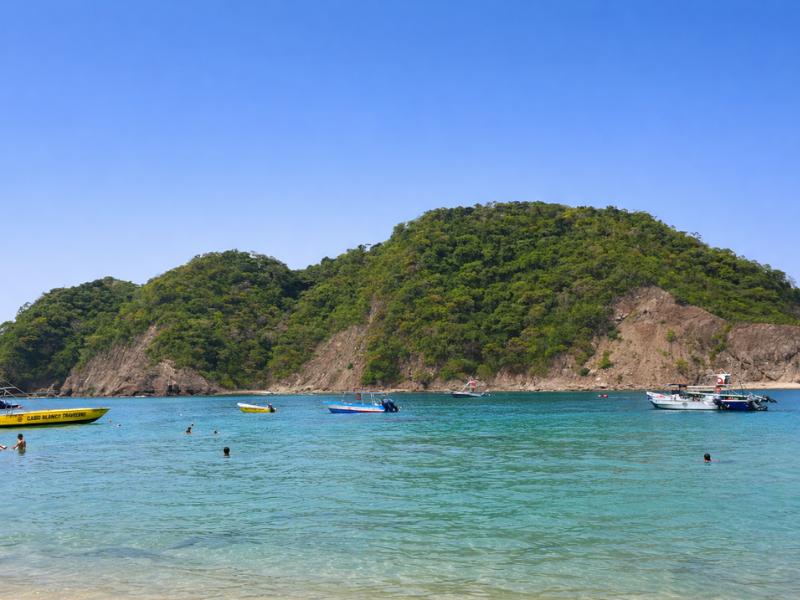
Crossing times to Isla Tortuga
The bars compare published boat crossing times to Isla Tortuga from four departure points, taken from the operators' own tour descriptions on the live listings.
Why is the crossing from Montezuma so much shorter than from the mainland?
Isla Tortuga sits just off the southeastern tip of the Nicoya Peninsula, and Montezuma sits on that same tip. The boat runs along the coast for about 45 minutes instead of crossing open gulf water for an hour and a half, which is why peninsula departures reach the island first and ride smoother doing it.
Geography does all the work here. Puntarenas is on the far side of the Gulf of Nicoya, so every mainland boat has to cross a wide stretch of exposed water. From Montezuma the island is close enough that the boat stays within sight of the peninsula shoreline for most of the run, tucked in behind headlands that knock the swell down.
Two things follow from that. The first is comfort: a 45-minute coastal run in moderate conditions is a different experience from 90 minutes of open water, particularly for anyone who gets queasy. The second is arrival time. Boats leaving the peninsula in the morning land on Playa Tortuga before the mainland groups converge, and the beach between 9 and 10 AM is a genuinely quieter place than the same beach at noon.
The catch is that Santa Teresa and Montezuma are not easy places to reach. You pay for the short crossing with a longer journey to the departure point, usually the Puntarenas to Paquera ferry followed by a road transfer. That is a trade worth making if you are already staying on the peninsula, and rarely worth making if you are not.
How does hotel pickup on the Santa Teresa main road work?
The tour collects you from your hotel on the main road through Santa Teresa. That single road runs the length of the town from Playa Carmen down through Santa Teresa and up towards Playa Hermosa, and almost every hotel, hostel and surf camp sits directly on it, which makes pickup straightforward.
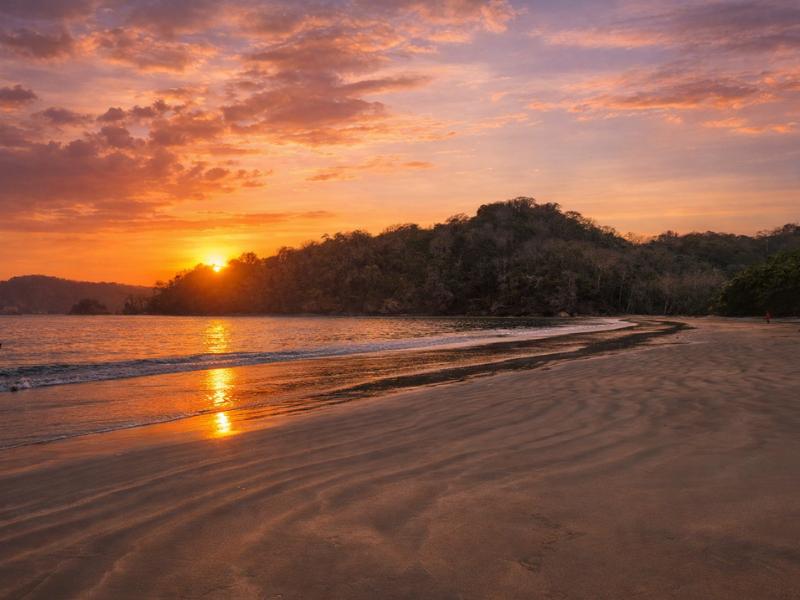
Santa Teresa has no bus station, no formal transport hub and, for long stretches, no pavement. What it has instead is one unpaved artery with everything strung along it. When the operator asks for your hotel name, they are really asking for a point on that line, and the van works its way along collecting people in order.
A few practical notes that repeat every morning:
- Be outside and visible at the road, not in your room. Vans stop briefly because the road is narrow and other traffic builds behind them.
- Confirm your exact accommodation name at booking, including which end of town it sits on. Several properties share similar names along the strip.
- If you are staying in Mal País or at the far northern end towards Playa Hermosa, flag it. Pickup order and time shift with position.
- Wear your swimsuit under your clothes and pack for a full day. You will not be back until the afternoon.
Pickup times are early because the crossing is timed to reach the island before the midday boats. That early start is the entire competitive advantage of this departure, so treat the stated time seriously.
What is the van transfer across the peninsula like?
A high-rise van carries the group from Santa Teresa across to Montezuma, allow around 45 minutes. The road climbs over the ridge that separates the surf coast from the gulf coast, and sections of it are unpaved, steep and rough enough that ordinary saloon cars struggle in the wet.
This is why the operator uses a lifted van rather than a minibus. The route between the two towns is short in distance and slow in practice, with switchbacks, loose surface and a few river crossings that swell after heavy rain. Visitors who try to self-drive the connection in a two-wheel-drive rental frequently regret it.
The upside is that the transfer is genuinely scenic. You climb out of the surf town, cross forested ridge country where howler monkeys are audible from the road, and drop down into Montezuma on the gulf side, a small town of cafés, waterfall trails and boats pulled up on the sand.
Boarding at Montezuma
Montezuma has no pier. Boats load from the beach, which means a short wade to the boat with your bag held up, and a crew member steadying you at the ladder. It sounds awkward and takes about twenty seconds. Wear sandals you can walk into the water in, keep your camera in a dry bag, and do not bring a wheeled suitcase.
How does the seven-hour day run, hour by hour?
Seven hours covers pickup, the peninsula transfer, the 45-minute crossing, an open-water reef snorkel, a grilled lunch on the sand, a free afternoon and the scenic return cruise to Montezuma. Roughly half the window is spent on or beside the island rather than in transit.
Exact timings move with sea state and pickup order, but the shape of the day is consistent.
| Stage | Allow roughly | What happens |
|---|---|---|
| Hotel pickup, Santa Teresa main road | Morning | Van collects along the strip in order. Round-trip transport is included in the price. |
| Transfer across the peninsula | About 45 minutes | High-rise van over the ridge road to Montezuma on the gulf coast. |
| Beach boarding at Montezuma | 10 to 15 minutes | Life jackets, safety brief, short wade to the boat. |
| Coastal crossing to Isla Tortuga | About 45 minutes | Nicoya coastline to starboard. Crew watch for dolphins, manta rays and turtles. |
| Open-water volcanic reef snorkel | Around an hour | Entry from the boat rather than the beach, guided, gear provided. |
| Arrival on Playa Tortuga | Late morning | Refreshments on the sand while the chef sets up lunch. |
| Grilled BBQ lunch | 45 to 60 minutes | Grilled fish or chicken, vegetables, potatoes and fresh fruit. |
| Free afternoon | Several hours | Swimming, kayaking, banana boat, beach time, shade under the palms. |
| Return cruise to Montezuma | About 45 minutes | Afternoon light along the peninsula coast, then the van back to Santa Teresa. |
Compare that with the twelve and eighteen-hour mainland packages and the appeal is obvious. You get the same island, the same reef and the same lunch, with several hours of road time removed from both ends.
What is the volcanic reef open-water snorkel actually like?
Unlike beach-entry snorkelling, this session drops you off the boat onto a volcanic rock reef in open water. You float above dark basalt structure rather than sand, and the fish life sits tighter to the rock: angelfish, moray eels, eagle rays and the parrotfish that graze the coral heads.
The difference between reef types is worth understanding before you book. A beach-entry snorkel over shallow sand and scattered coral is easy and forgiving, and it is what most Isla Tortuga tours offer. An open-water session over volcanic rock has more vertical structure, more shade, more crevices and consequently more of the shy species. It also demands slightly more of you, since there is no standing up and no walking back to your towel.
| Feature | Beach-entry snorkel, most tours | Open-water volcanic reef, this tour |
|---|---|---|
| How you get in | Wade from the sand | Off the side or ladder of the boat |
| Bottom type | Sand with scattered coral heads | Dark basalt structure with crevices and ledges |
| Depth under you | Shallow, standing depth close in | No seabed to stand on, flotation available |
| Typical fish | Sergeant majors, parrotfish, butterflyfish | Angelfish, moray eels, eagle rays, parrotfish |
| Skill needed | Any confidence level | Comfort floating away from shore |
| Session length | Usually 30 to 45 minutes | Around an hour, guided |
You do not need to be a strong swimmer for either format. Life jackets and flotation are available, the guide stays in the water with the group, and nobody is asked to free-dive or to hold their breath. What the open-water session does ask is basic comfort with your face in the water and a boat rather than a beach behind you, which most people find easier than they expected once the first two minutes are over.
Visibility follows the season. December through April delivers the clear water the photographs promise. After heavy rain in September and October, sediment washes out and the reef looks flatter, though the fish are still there. Morning sessions beat afternoon ones because the light angle is better and fewer groups have stirred up the bottom.
Peninsula side or mainland side: which departure actually wins?
The peninsula wins on crossing time, sea comfort and arrival hour. The mainland wins on price and on how easy the departure point is to reach. If you are already sleeping in Santa Teresa, Montezuma or Tambor, the peninsula is the obvious answer. If you are anywhere else in Costa Rica, it usually is not.
| Factor | Santa Teresa and Montezuma | Puntarenas and San José |
|---|---|---|
| Crossing to the island | About 45 minutes, coastal | Roughly 60 to 90 minutes, open gulf |
| Published day length | 7 hours | 12 hours from Puntarenas, 18 hours from San José |
| Price per person | $152 | $80 from Puntarenas, $115 from San José |
| Rating and volume | 4.6, 985+ booked | 4.5, 1,669+ and 6,090+ booked |
| Getting to the departure point | Ferry plus rough road, or a domestic flight to Tambor | 90 minutes on paved highway from San José |
| Sea comfort | Sheltered coastal run | Exposed crossing, choppier in green season |
| Whale window | July to November, on a genuine migration corridor | Possible, less of a feature of the route |
| Arrival on the beach | Ahead of the midday convergence | Depends on departure time, often mid-morning |
The $152 price is the highest on this site and the reason is not the island. It is the cost of running a van over ridge roads and a boat out of a beach town with no pier, for a smaller group, in a place where everything arrives by ferry. You are paying peninsula prices for peninsula logistics.
What is included in the Santa Teresa trip, and what costs extra?
The price covers round-trip transport from your Santa Teresa hotel, professional snorkel equipment, a grilled BBQ lunch with fruit, a bilingual guide and captain, and whale or dolphin watching in season. It does not cover the island restroom, WiFi, device charging, tips or insurance.
The extras on this particular island are small in money and large in irritation if nobody warns you, so here they are in plain figures.
| Included | Not included |
|---|---|
| Round-trip transportation from Santa Teresa | Island restrooms, around $1 per use |
| Professional snorkelling equipment | WiFi password access, around $5 |
| Grilled BBQ lunch and fresh fruit | Device charging, around $5 |
| Bilingual guide and captain | Gratuities for the crew |
| Whale and dolphin watching, July to November | International travel insurance |
| Kayaking and beach time in the free afternoon | Alcoholic drinks |
A dollar for the restroom sounds petty until you have been on a beach for four hours. Five dollars for WiFi and another five to charge a phone sound worse, and they are the two most common complaints from visitors who arrived expecting an all-inclusive resort. They exist because Isla Tortuga is an uninhabited protected island with no grid power and no water mains, and everything on it runs off generators and boats.
The practical fix costs nothing. Carry a few small dollar bills, arrive with a full battery, bring a power bank, and treat the day as a disconnected one. Almost nobody who plans for that mentions the fees afterwards.
When can you see humpback whales on this crossing?
Humpback whales move through the Gulf of Nicoya between July and November, and the peninsula route runs along a genuine part of that corridor. Sightings are real rather than promotional, but no honest operator guarantees them. Dolphins, manta rays and sea turtles are more frequent year round.
The gulf receives humpbacks from two separate populations at different points in the year, which is why the Costa Rican Pacific has an unusually long whale window compared with most destinations. Crews scan as a matter of routine on this crossing and slow the boat when something surfaces.
| Window | Humpback chance | Other marine life | Water clarity |
|---|---|---|---|
| December to April | Low, outside the main window | Dolphins, turtles, rays, strong reef fish activity | Best of the year |
| May to June | Low, building at the end of June | Dolphins common, quiet beaches | Good, occasional showers |
| July to August | Good | Dolphins, manta rays, turtles | Variable |
| September to October | Good, the wettest months | Fewest boats on the island all year | Weakest after heavy rain |
| November | Tailing off | Dolphins, greenest landscape of the year | Improving week by week |
If whales are your reason for booking, take a July to November departure and accept that the beach day is the guaranteed part and the whale is the bonus. If clear water and calm seas matter more, come in the dry season and treat any dolphin pod as the wildlife highlight.
Is the optional scuba or discovery dive worth adding?
A scuba or discovery dive is available as an optional add-on on this departure, arranged with the operator rather than bought on the beach. It suits certified divers who want depth on the volcanic reef, and complete beginners who want a supervised first breath underwater without committing to a course.
The case for adding it depends on what you want from the day. The snorkel session already shows you the reef top, the fish and the structure. A dive takes you down the side of it, where the visibility is more consistent and the larger animals hold. For a certified diver on the peninsula with limited days, that is a meaningful upgrade over a second snorkel.
The case against is simple. A dive eats a chunk of your free afternoon, and the free afternoon is the reason many people pick this tour in the first place. Kayaking, the banana boat, a long swim and a hammock are all sitting there, and they are the difference between an active day and a holiday day.
Arrange it when you book rather than on the boat. Tanks, weights and a divemaster do not appear on request in the middle of the Gulf of Nicoya, and the operator needs the numbers before the boat leaves the beach at Montezuma.
A scuba upgrade is not established in the current verified snorkeling listings. No dive booking is recommended here; confirm a separate dive product before planning one.
What does the free afternoon on Playa Tortuga actually give you?
After lunch the day opens up. Kayaks and the banana boat run from the beach, the water is calm and shallow close in, and there is enough palm shade to sit out the strongest part of the afternoon. Nobody herds you, and the boat leaves when the day is genuinely finished.
Playa Tortuga is a powdery white curve backed by palms, with turquoise water that stays shallow far enough out to be comfortable for weak swimmers and children. There are no roads on the island and no vehicles, so the sound is waves, seabirds and the occasional howler monkey chorus from the treeline.
What people actually do with the hours, roughly in order of popularity:
- Swim and float. The water temperature sits in the high twenties Celsius for most of the year.
- Kayak along the shoreline, which gives you a view back at the island that the boat does not.
- Take the banana boat, which is loud, brief and reliably funny.
- Walk the beach away from the landing point, where the crowd density drops off quickly.
- Sit in the shade and do nothing. This is the correct answer more often than people expect.
The island is located near the Islas Negritos Biological Reserve, managed within Costa Rica's protected-areas system at SINAC. No overnight stays are permitted, which is exactly why the beach empties every evening and looks untouched every morning.
How do you actually reach Santa Teresa in the first place?
Santa Teresa sits at the far southwestern tip of the Nicoya Peninsula, and every route to it involves either a ferry or a small plane. From San José, allow most of a day by road and ferry, or around half an hour in the air to Tambor followed by a road transfer.
This is the part that decides whether the peninsula departure makes sense for you. Nobody should cross the country to catch a 45-minute boat ride. Everybody already on this coast should.
| Route | Allow roughly | Notes |
|---|---|---|
| San José to Puntarenas by road, then the Paquera ferry | Most of a travel day | Drive or bus to Puntarenas, ferry across the gulf, then road to Santa Teresa. The classic route. |
| Domestic flight to Tambor, then transfer | Around half an hour flying plus road time | Fastest option from the capital. Small aircraft, tight baggage limits. |
| Shared shuttle from San José or Jacó | A long half day | Door to door, ferry included, no driving on peninsula roads. |
| Self-drive with four-wheel drive | Depends on ferry timing | Peninsula roads are unpaved in places and rough in green season. A two-wheel-drive car is a bad idea. |
| Already in Montezuma or Mal País | Under an hour | You are effectively at the departure point. This is when the peninsula tour makes most sense. |
Check ferry timetables before committing to a plan built around them, since sailings are spaced through the day rather than continuous. Costa Rica's tourism board keeps regional orientation at Visit Costa Rica.
Who should book from Santa Teresa, and who should not?
Book this if you are staying anywhere on the southern Nicoya Peninsula, want the shortest crossing, care about the open-water reef snorkel, or are travelling in the July to November whale window. Skip it if you are based in San José, on a tight budget, or want the most beach hours per dollar.
| You are | Verdict | Why |
|---|---|---|
| Staying in Santa Teresa, Mal País or Montezuma | Book it | Hotel pickup on the main road, 45-minute crossing, seven-hour day. |
| Based in San José with no car | Skip it | Reaching the peninsula costs more time than the tour saves. Take the bundled full-day tour instead. |
| Travelling on a budget | Skip it | $152 against $80 from Puntarenas for the same island and the same lunch. |
| Prone to seasickness | Book it | Sheltered coastal run rather than an exposed gulf crossing. |
| A certified diver | Book it | Optional scuba on a volcanic reef, arranged in advance. |
| Chasing humpbacks | Book it, July to November | The route runs a real migration corridor and the crew watch for them. |
| Wanting maximum beach hours | Compare first | The Puntarenas speedboat gives up to five hours on the sand for a longer total day. |
| Looking for something after dark | Consider the alternative | The bioluminescence night tour from Curú is a separate evening experience. |
The short version: this is the best-designed Isla Tortuga day on the peninsula and the wrong one to travel across Costa Rica for. Match the departure point to where you are already sleeping and the decision makes itself.