Can You Enjoy Isla Tortuga If You Cannot Swim?
Plenty of people book a Tortuga Island day trip without being able to swim a length. The day still works, but only if you pick the right departure and say so out loud before you board.
Booking Choice: An island lunch, snorkeling equipment and a Negritos wildlife stop. Explore Puntarenas Island Day: Shared Or Private
Start: Puntarenas. Confirm age rules and extras before booking.
Price note: fixed dollar amounts and totals in the editorial examples below are planning illustrations, not current quotes. Prices, child rates and private/shared options must be checked for your date and full party. The provider calendars and booking pages carry current offers.
What works at each confidence level
Activities available on a Tortuga Island day trip sorted by the swimming confidence each one actually requires, based on the inclusions published for the tours listed on this site.
Can you enjoy Isla Tortuga if you cannot swim?
Yes. Most of what makes the day good happens in waist-deep water or on the sand: the beach, the shallows, lunch, hammocks, the boat ride and the wildlife stops. Life jackets are on every boat and free to use. What you should skip, or attempt only with a guide holding you, is the open-water reef snorkel.
The mistake non-swimmers make is assuming the whole tour is a swimming tour and either cancelling or bluffing. Neither is necessary. Around half the value of a Tortuga day is on land, and a large chunk of the water time is standing depth. The reef sections vary a lot between operators, and the difference between a shallow beach-entry snorkel and an open-water session off the boat is the single most important thing to understand before booking.
What follows separates the activities that genuinely require swimming from the ones that only require being comfortable getting wet. They are not the same category, and the second one is much bigger than people expect.
What is the water actually like at Playa Tortuga?
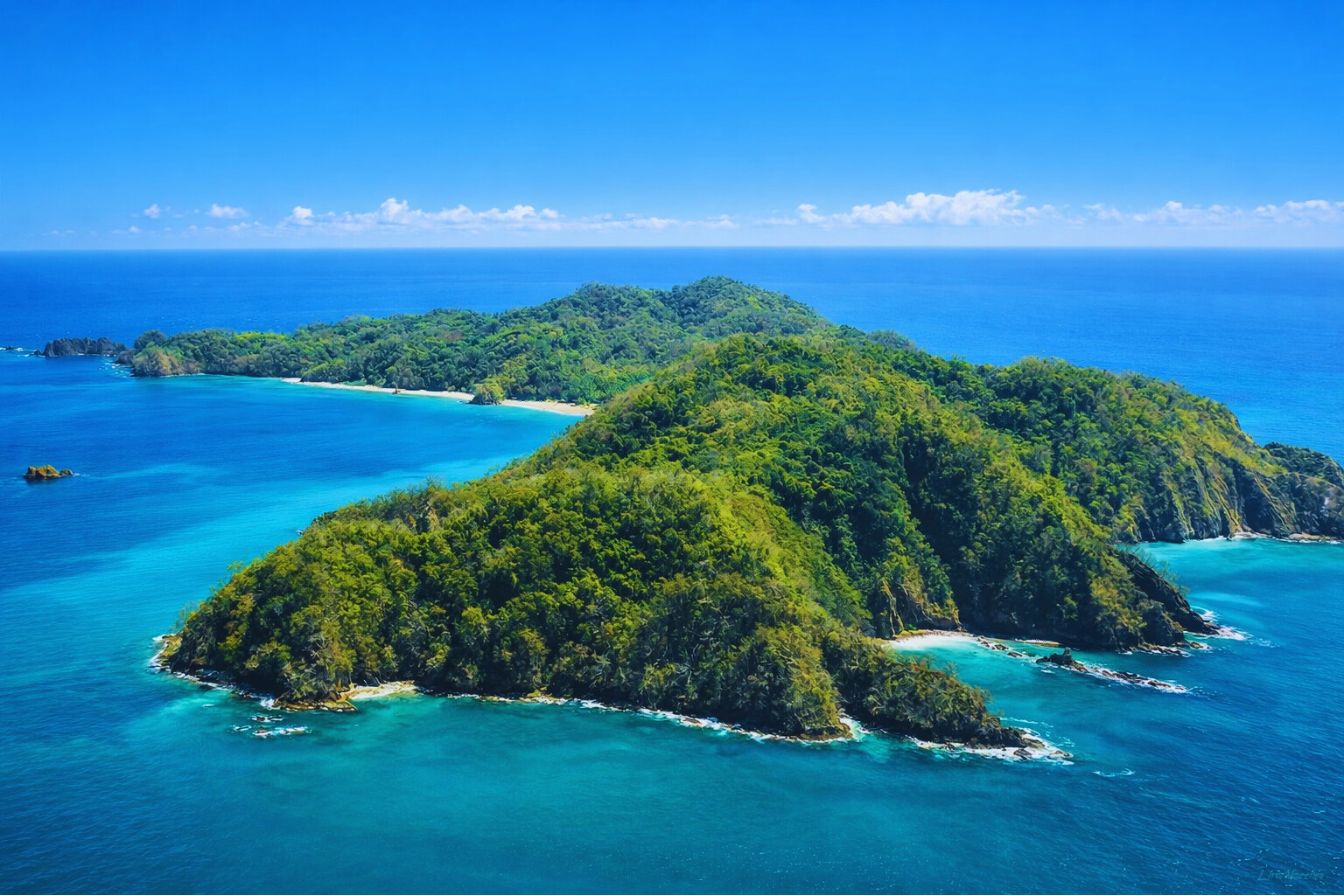
Playa Tortuga has a gentle gradient, soft sand and no dumping shorebreak. You can wade a long way out and still stand. Compared with the surf beaches on the mainland Pacific coast, it is a swimming pool, which is precisely why the island became a day-trip destination in the first place.
The beach shelves gradually rather than dropping away. On a normal day the water off the main swimming area is flat enough that children play in it unsupervised by anything other than a parent standing knee-deep. Visibility is good, so you can see the bottom, and you can see where the sand gives way to rock. The mainland beaches around Jacó have real rip currents and real surf; Tortuga does not behave that way.
That said, this is open ocean, not a lagoon. There is no lifeguard on an uninhabited island and no rope marking a safe zone. Depth increases as you move out toward the reef and the boat anchorage. The comfortable rule for a non-swimmer is simple and rigid: stay where your feet touch, and if you want to go further out, put a life jacket on and take someone with you.
Conditions are calmest and clearest in the morning, before several boats have landed and stirred sand into the water column. Dry season, December to April, gives the flattest gulf overall. If your confidence in water is low, an early dry-season departure gives you the friendliest version of the same beach.
What flotation do the boats provide?
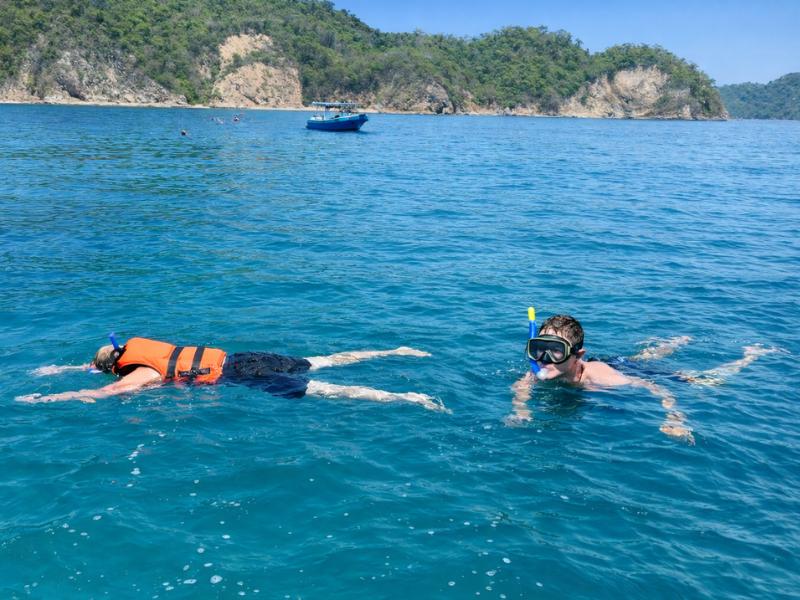
Every tour boat carries life jackets for all passengers, in adult and child sizes, and crews hand them out freely for snorkelling as well as for the crossing. Snorkel gear, mask, snorkel and fins, is included on the snorkel-focused tours. Nobody charges you for a life jacket and nobody treats asking for one as unusual.
A life jacket changes the whole experience for a non-swimmer. It holds you face-up and high in the water with no effort, which means you can put a mask in and look down at the reef without treading water at all. Guides use this constantly with nervous guests; it is the standard solution, not a special accommodation. Some crews also carry pool noodles or foam floats, which are easier to hold onto while looking down than a bulky vest.
The one thing flotation does not give you is propulsion or the ability to handle a current. That is what the guide is for. On guided snorkel sessions, a guide can and routinely does tow a guest by the hand or by a float, and will position themselves between you and open water. Ask for that specifically. Guides who know a guest is not a swimmer plan the session around it; guides who find out mid-session have to improvise.
Beach-entry snorkelling or open-water reef: which is which?
Beach-entry snorkelling means walking into shallow water from the sand and floating over the near-shore reef with your feet a metre from the bottom. Open-water reef snorkelling means jumping off the side of a boat over a volcanic rock reef in water too deep to stand, with a swim back to the ladder. They are different activities.
Both exist on Tortuga itineraries and the listings do not always spell out which you are getting. Some departures make a point of the volcanic reef session and describe it as being unlike a beach-entry snorkel, which is an honest signal that it is genuinely open water. Others put the guided snorkel close to the beach in shallow, calm water where basic comfort is enough and swimming ability is not really tested.
If you cannot swim, the beach-entry version is your session and the open-water version is the one to sit out or attempt only with a guide physically alongside you and a jacket on. There is no shame in staying on the boat for 45 minutes with a coffee and a view. There is a genuine problem in getting into deep water off a boat ladder and discovering, 20 metres from the hull, that you cannot get back.
| Activity | Non-swimmer | Weak or nervous swimmer | Confident swimmer |
|---|---|---|---|
| Boat crossing and wildlife spotting | Fine, life jacket on | Fine | Fine |
| Wading and standing in the shallows | Fine, stay foot-deep | Fine | Fine |
| Beach-entry snorkel over near-shore reef | With a life jacket and a guide | Yes, with flotation | Yes |
| Open-water reef snorkel off the boat | Skip it, or guide-assisted only | Only with a jacket and guide nearby | Yes, the best reef of the day |
| Kayak, seated with a jacket | Yes, close to shore | Yes | Yes |
| Stand-up paddleboard | Kneel or sit, jacket on, shallow water only | Yes, expect to fall in | Yes |
| Banana boat | Not recommended, you will end up in deep water | Jacket on, be ready to fall | Yes |
| Optional discovery scuba dive | No | No | Yes, if offered on your departure |
Which of the six tours suit a nervous swimmer best?
The private full-day escape from Puntarenas is the strongest choice, because a private boat means the guide's attention and the pace are yours. After that, the Puntarenas speedboat and the San José full day both give long stretches of unstructured beach time where nobody is pushing you into deep water.
The private Puntarenas charter runs at $125 with a 4.8 rating, departs at 8:30 AM from Guima Frost marina, and includes a guided snorkel with equipment plus a private beach spot at the water's edge. The value for a non-swimmer is control: you can ask the captain for shallow water, you are not one of 40 people, and the guided snorkel can be run at your speed.
The Puntarenas speedboat at $80 gives roughly five hours of free time on the island with the snorkel offered rather than compulsory, plus showers and changing rooms back at the Las Playitas dock. The San José full day at $115 is built around about five hours of beach time and a 45-minute guided snorkel session you can opt out of.
The Santa Teresa departure at $152 is the outlier here. It is a good tour, but its selling point is an open-water session on a volcanic rock reef, explicitly described as unlike a beach-entry snorkel. If reef quality is what you are paying for and you cannot swim, you are paying for the part you will sit out.
| Tour | Price | Snorkel format | Fit for a non-swimmer |
|---|---|---|---|
| Private Isla Tortuga escape from Puntarenas | $125 | Guided, private boat, pace is yours | Best. Ask for shallow water and one-to-one attention |
| Puntarenas full-day speedboat | $80 | Optional, weather permitting | Strong. Five hours of beach time, snorkel is not compulsory |
| Tortuga Island full day from San José | $115 | 45-minute guided session | Strong on beach time, though the day itself runs long |
| Isla Tortuga adventure from Jacó | $115 | Guided snorkel at a secluded spot | Workable. The crocodile bridge and monkey stops are dry-land value |
| Santa Teresa boat adventure and snorkel | $152 | Open-water volcanic reef session | Weakest fit. You would skip the headline activity |
| Bioluminescence tour from Curú | $60 | Night swim in glowing water | Only with a jacket, in the shallows, beside the guide |
Are kayaks, paddleboards and the banana boat non-swimmer friendly?
A sit-on-top kayak with a life jacket, kept parallel to the beach in shallow water, is the safest of the three and genuinely enjoyable. A paddleboard works if you kneel or sit rather than stand. The banana boat is designed to throw you into deep water, which makes it the one to skip.
Kayaks are available on most island stops and often at no extra charge. The technique matters less than the discipline: stay in water shallow enough that falling out means standing up. Paddleboards are harder than they look in any breeze, and standing on one guarantees you will end up in the water eventually. Kneeling on the board lowers your centre of gravity and turns it into a floating platform rather than a balance test.
The banana boat is a towed inflatable whose entire purpose is the moment everyone falls off. That happens out in deeper water, at speed, with several people landing near each other. With a life jacket you will float, but you will also be bobbing in open water waiting to be collected, which is not where a non-swimmer wants their first experience of being out of their depth.
The alternatives are not consolation prizes. Hammocks between the palms, a walk to the stone arch viewpoint, beach volleyball, iguanas on the rocks and howler monkeys calling from the jungle edge fill an afternoon perfectly well. Several of the departures also build in wildlife stops that involve no water at all: spider monkeys at Negritos Island, crocodiles at the Tarcoles River bridge on the Jacó run, and monkeys, deer and coatis at the Curú refuge.
What should you tell the crew before boarding?
Say the words out loud: "I cannot swim." Say it to the guide at the meeting point, before the boat leaves, not when the snorkel gear comes out. Crews plan around it easily when they know, and cannot plan around it at all when they find out in the water.
Three sentences cover everything a guide needs. First, that you are not a swimmer or are a weak one. Second, whether you still want to try the snorkel with support, or would rather stay in the shallows. Third, any medical detail that matters, an inhaler in the bag, a bad ear, a shoulder that will not tolerate being towed.
Ask specific questions back. Is the snorkel session beach-entry or off the boat? How deep is the water where we anchor? Can I use a life jacket while snorkelling? Will a guide stay with me? Every one of those has a straightforward answer, and asking at the dock lets you adjust before you have committed to a boat schedule you cannot change.
Sit near the crew on the crossing rather than at the bow. Put the life jacket on properly at the start, adjusted and buckled, instead of holding it loosely. And if the conditions on the day look bouncier than you expected, tell the guide you want the shallow option. Nobody on a Costa Rican tour boat is judging you for it, and the crew would far rather manage a stated limitation than a surprise.
What does a good non-swimmer day at Tortuga look like?
Board early, wear the jacket on the crossing, take the shallow snorkel and skip the deep one, eat lunch on the sand, kayak along the shoreline in the afternoon, and spend the rest of it in shade watching the water. That is a full day, and it is the same day most confident swimmers are having anyway.
The rhythm of these tours helps you. First boats leave around 8 to 9 AM from the peninsula side, and arriving early means the water is calmest and clearest, before the 11 AM to 2 PM window when several boats land at once. Morning is when the shallows look their best and when a guide has the most time for individual attention.
Lunch is served on the beach: grilled fish or chicken, rice, salad and fresh fruit, with soft drinks, coffee and cookies included on most departures. That anchors the middle of the day on land. The afternoon then belongs to whatever you want it to be, which for a non-swimmer usually means shoreline kayaking, the walk to the arch and a hammock.
One last practical note: bring your own mask if you own one that fits. Learning to breathe through a snorkel in standing depth is far less stressful when the mask is not leaking, and standing in a metre of water with your face in it is a legitimate way to see parrotfish without swimming a stroke. Plenty of people discover the reef that way and never go deeper.