The Best Beaches Near Jacó: Where to Swim, Surf and Stay Out of the Rip
The beaches around Jacó are long, warm and easy to reach, and several of them are genuinely dangerous to swim at. Here is what each one is good for, and where to go when you want calm, clear water instead.
Booking Choice: A Tortuga reef session, lunch and wildlife stops on a day from Jacó. Explore Jacó Island Day And Wildlife Stops
Start: Jaco. Confirm age rules and extras before booking.
Price note: fixed dollar amounts and totals in the editorial examples below are planning illustrations, not current quotes. Prices, child rates and private/shared options must be checked for your date and full party. The provider calendars and booking pages carry current offers.
Beaches near Jacó at a glance
The ranking reflects wave exposure and rip-current risk reported for each beach: exposed Central Pacific sand at Hermosa and Jaco, sheltered bays at Herradura, Mantas and Blanca, and the offshore island beach at Playa Tortuga.
Which beaches near Jacó are actually worth your time?
Six stretches of coast cover almost everything a visitor to Jacó needs: Playa Jacó for convenience and surf lessons, Herradura for calmer bay swimming, Playa Hermosa for serious surf, Playa Blanca and Playa Mantas around Punta Leona for clearer water, and the boat trip to Playa Tortuga for white sand.
Jacó sits on Costa Rica's Central Pacific coast, roughly 90 minutes to two hours by road from Juan Santamaria airport depending on traffic. Everything listed here falls within about a 30-minute drive of the town, which is the main reason people base here in the first place. The area is not a single beach with one character. It is a run of very different beaches that happen to share a road.
The honest headline is that most of them are grey or dark sand rather than white, because this coast is volcanic in origin and fed by rivers coming out of the mountains behind it. That sand gets hot underfoot in the middle of the day and it reduces the postcard quality of the water. What the area does offer is reliable surf, warm water year round, easy access and a lot of choice within a short drive.
The other honest headline is safety. Several of these beaches have strong rip currents and no lifeguard cover for most of their length. That is not a reason to avoid the coast. It is a reason to pick your beach for the day you are having, and to know how a rip works before you get in.
| Beach | Sand colour | Swimming | Surf | Crowds | Facilities |
|---|---|---|---|---|---|
| Playa Jacó | Grey to dark grey | Caution, rip currents common | Beginner to intermediate beach break | Busiest in the area | Excellent: town, food, rentals, showers |
| Playa Herradura | Dark grey, softer | Best local option, calmer bay | Small and inconsistent | Moderate, local families | Good: sodas, parking, marina nearby |
| Playa Hermosa | Dark, near black | Not recommended for casual swimming | Powerful, experienced surfers | Low, surfers and spectators | Basic: a few restaurants and hotels |
| Playa Blanca (Punta Leona) | Pale, closest to white on this coast | Generally calm, sheltered | Minimal | Low, access controlled | Resort facilities, access rules apply |
| Playa Mantas | Light grey to tan | Calm bay, good for families | Minimal | Low to moderate | Limited, plan to bring supplies |
| Playa Tortuga (island) | Powdery white | Calm and clear, snorkel friendly | None to speak of | Quiet early, busy 11am to 2pm | Tour provided, small restroom fee |
What is Playa Jacó itself actually like?
Playa Jacó is a long crescent of grey volcanic sand backed directly by the town, which makes it the most convenient beach on this coast and the least scenic. The waves are consistent and forgiving enough for surf lessons, the sunsets are excellent, and the rip currents are a genuine hazard rather than a theoretical one.
Convenience is the whole pitch. You can walk out of a hotel, cross a street and be on the sand, with a board rental, a cold drink and a bathroom within a hundred metres. For a first afternoon in Costa Rica after a long flight, that is worth a lot. The town runs the length of the beach, so there is no wrong end to stay at, though the northern end tends to be quieter and the southern end livelier.
The water is warm, usually somewhere in the high twenties Celsius, and murky more often than not. River outflow and constant wave action keep sediment suspended, so do not expect to see your feet. The colour in photographs is brown-green rather than turquoise. That is normal here and it is not pollution in any dramatic sense, it is a river coast doing what river coasts do.
What Playa Jacó is good for
- Learning to surf, with several schools operating right off the sand.
- Sunset walks, when the tide is out and the beach widens considerably.
- Long runs and dog walks in the early morning before the heat.
- Beach volleyball, football and the general social scene at the southern end.
- Convenience swimming, in waist depth, with an eye on where the water is pulling.
What it is not good for is snorkelling, calm-water floating, or the white-sand photograph most people arrive expecting. Those are all available in the region, just not from this particular stretch of sand.
How dangerous are the rip currents, and what do you do about them?
Rip currents are the main water hazard on the Central Pacific coast and they are strongest around low tide and after big swell. They pull outward, not under. If you are caught, do not swim against it: float, signal, and swim parallel to the beach until you are out of the channel, then come in on the breaking waves.
Costa Rica's Pacific beaches produce rips because water pushed onto the sand by breaking waves has to escape somewhere, and it escapes through channels. On a long straight beach like Jacó or Hermosa, those channels move around and are not obvious to an untrained eye. The tell-tale signs are a gap in the breaking waves, a stretch of choppier or discoloured water heading offshore, and foam or debris moving out rather than in.
Lifeguard cover on this coast is patchy and seasonal. Assume there is nobody watching unless you can see a tower with a person in it. That single assumption changes behaviour in the right direction: swim with someone else, stay where you can stand, and keep children within arm's reach rather than eyesight.
| Beach | Rip risk | Worst conditions | Sensible approach |
|---|---|---|---|
| Playa Jacó | High | Big swell, outgoing tide, river mouth ends | Stay waist deep, mid-beach, away from the river mouths |
| Playa Hermosa | Very high | Any decent swell, which is most of the year | Watch from the sand unless you are a strong surfer |
| Playa Herradura | Moderate | Storm swell wrapping into the bay | The most forgiving mainland option nearby |
| Playa Mantas | Low to moderate | Rare, sheltered bay | Good family swimming, still supervise |
| Playa Blanca | Low | Rare, protected by the point | Calmest mainland water in the area |
| Playa Tortuga (island) | Low | Rare, sheltered island beach | Calm enough for weak swimmers with a vest |
Two things worth adding. Alcohol and rips are a bad pairing, and the combination accounts for a meaningful share of trouble on tourist beaches everywhere. And a surfboard or a bodyboard is a flotation device: if you are caught while surfing, stay with the board and signal, because the board will keep you up far longer than your arms will.
Is Playa Herradura the better swimming option?
Yes, for mainland swimming near Jacó, Herradura is the most forgiving choice. It is a horseshoe bay a short drive north of town, sheltered enough that the surf usually stays small, with dark soft sand, a line of local sodas and the Los Suenos marina at the northern end.
Allow roughly 10 to 15 minutes by car from central Jacó. The bay shape is the whole point: the headlands at either end absorb most of the swell, so the water inside is generally flatter than at Jacó and considerably flatter than at Hermosa. Local families use it at weekends, which is usually a good sign about a beach.
The marina end changes the character. There are yachts, sportfishing boats and a more polished resort feel, and some Isla Tortuga departures from the Jacó area board here rather than in Jacó itself. If your island tour lists a Herradura marina boarding point, this is where you are going, and the drive from a Jacó hotel is short.
Herradura's weaknesses are honest ones. The sand is dark and coarse in places, the water clarity is no better than Jacó's, and after heavy rain the run-off from the surrounding hills reaches the bay. Shade is limited outside the tree line at the back of the beach. Bring an umbrella if you plan to stay past 11am.
Should you swim at Playa Hermosa?
No, not casually. Playa Hermosa sits a short drive south of Jacó and is one of the most consistent and powerful beach breaks in the country, with a heavy shore break, strong rips and no sheltered corner. It is a superb surf beach and a poor swimming beach, and the two facts are the same fact.
The wave that makes Hermosa famous is the same wave that makes it hazardous. It breaks hard and close to shore over a steep sand bank, which means the energy hits you in shallow water rather than dissipating over a reef. Experienced surfers travel here on purpose. Swimmers who wandered down from Jacó because the beach looked emptier are the ones who get into trouble.
Go anyway, but go to watch. Late afternoon from one of the beachfront restaurants is one of the better ways to spend an evening in the area, particularly during competition weekends when the standard in the water is high. The sand here is dark, almost black, and it holds heat, so footwear matters more than you would think.
Part of this coastline is protected as a national wildlife refuge, and sections of the beach see sea turtle nesting activity at certain times of year under that protection. Costa Rica's protected-areas authority, SINAC, oversees those designations. Respect any signage, keep off marked nesting areas, and never use white light on the sand at night.
What about Playa Blanca and the Punta Leona area?
Playa Blanca, on the Punta Leona headland north of Herradura, has the palest sand and the calmest, clearest water on this stretch of mainland coast. The catch is access: the beach sits within a large private resort and club property, and getting to it usually means going through their entry system.
Costa Rican law keeps beaches themselves public, but the land you cross to reach them may not be. In practice that means visitors reach Playa Blanca either as guests of the resort, as day visitors under whatever day-pass arrangement is operating, or by walking in along the coast where that is possible. Rules and pricing change, so check current arrangements before you plan a day around it rather than turning up and hoping.
Once you are there, it is the closest thing to a picture-postcard beach on the mainland Central Pacific. The point shelters it, the sand is pale, and on a calm dry-season morning the water can actually look blue rather than brown. There is snorkelling potential around the rocky edges when conditions cooperate, though it remains modest by Caribbean or island standards.
The area also holds one of the region's better bits of wildlife watching. The forest around the headland is home to scarlet macaws, and hearing a pair fly over the beach is a routine event rather than a lucky one. That combination of calm water and forest edge is what makes Punta Leona worth the drive from Jacó, which takes roughly 20 to 30 minutes.
Is Playa Mantas the calm-water family option?
Playa Mantas is a small sheltered cove in the same Punta Leona area, with light grey to tan sand, gentle water and enough tree cover to sit out the middle of the day. It is the beach to pick when the group includes small children and nobody wants to think about rip currents.
The cove shape does the work. Waves arriving here have already lost most of their energy on the headlands, so what reaches the sand is closer to a lapping than a break. Water clarity is better than Jacó on a calm day, though still not clear enough for real snorkelling most of the time.
Facilities are thin. There is limited food and drink compared to Jacó or Herradura, so the practical approach is to bring a cooler, water, snacks and shade. Parking arrangements vary with the season and with access rules on the surrounding property, which is the single thing to check before you drive out.
| Beach | Under-5s | Ages 6 to 12 | Teens | Main reason |
|---|---|---|---|---|
| Playa Mantas | Best choice | Good | May find it dull | Sheltered cove, gentle water |
| Playa Blanca | Very good | Very good | Good | Calm, pale sand, resort facilities |
| Playa Herradura | Good with supervision | Good | Good | Bay shelter plus food nearby |
| Playa Jacó | Paddling only | Waist deep only | Excellent for surf lessons | Convenience, activity, rip risk |
| Playa Hermosa | Sand play only | Sand play only | Watching, not swimming | Heavy shore break |
| Playa Tortuga (island) | Very good with a vest | Excellent | Excellent | Calm clear water, snorkelling, boat day |
Surf or swim: how do you pick a beach for the day you are having?
Match the beach to the swell and the tide rather than to the guidebook. Small swell and a mid to high tide make Jacó a reasonable swim. Big swell pushes swimmers to Herradura, Mantas or Blanca and pushes surfers to Hermosa. Low tide on a big day is the combination to sit out entirely.
Surf forecasts for this coast are easy to find and worth two minutes each morning. What you are looking for is swell height, period and direction. A long-period swell, meaning waves arriving further apart, carries far more energy than the same height at a short period, and it is what turns Hermosa from difficult into serious.
| Conditions | Best for swimming | Best for surfing | Avoid |
|---|---|---|---|
| Small swell, high tide | Playa Jacó, Herradura | Jacó for beginners | Nothing in particular |
| Small swell, low tide | Mantas, Blanca | Hermosa, cleaner shape | Deep water at Jacó |
| Medium swell | Mantas, Blanca, Herradura | Jacó intermediate, Hermosa | Casual swimming at Jacó |
| Big swell | Sheltered coves only | Hermosa for experienced surfers | Swimming anywhere exposed |
| Heavy rain the day before | Island trip if the boat sails | Anywhere away from river mouths | Water near river outflows |
Costa Rica's national weather service, the Instituto Meteorologico Nacional, is the source most local operators check for rainfall and coastal conditions. In green season, the pattern is often bright mornings and afternoon storms, which is another argument for doing water activities early.
What facilities can you actually expect at each beach?
Only Playa Jacó has full town facilities directly on the sand. Herradura has parking, sodas and toilets in places. Hermosa has a handful of restaurants and hotels. Mantas and Blanca sit behind resort or private access with limited public services, so bring what you need.
The mistake visitors make is assuming that a beach in a tourist region comes with infrastructure. It often does not. Shade in particular is scarce: the tree line sits well back from the high-water mark on most of these beaches, and by mid-morning the grey sand is hot enough to be genuinely uncomfortable barefoot.
| Beach | Parking | Food and drink | Toilets and showers | Shade | Rentals |
|---|---|---|---|---|---|
| Playa Jacó | Street parking, paid lots | Extensive, all budgets | Widely available | Limited, some palms | Boards, chairs, umbrellas |
| Playa Herradura | Informal lots, small fee | Sodas and beach bars | Some, variable | Tree line at the back | Limited |
| Playa Hermosa | Roadside and hotel lots | Several restaurants | Via restaurants | Minimal on the sand | Surfboards |
| Playa Blanca | Within resort property | Resort facilities | Resort facilities | Good, forest edge | Resort managed |
| Playa Mantas | Limited, check access | Very limited | Very limited | Decent tree cover | None reliably |
| Playa Tortuga (island) | Not applicable | Lunch included on tours | Small fee, around $1 per use | Palms and hammocks | Kayak, paddleboard on tours |
Why is Playa Tortuga the white-sand counterpoint the mainland cannot match?
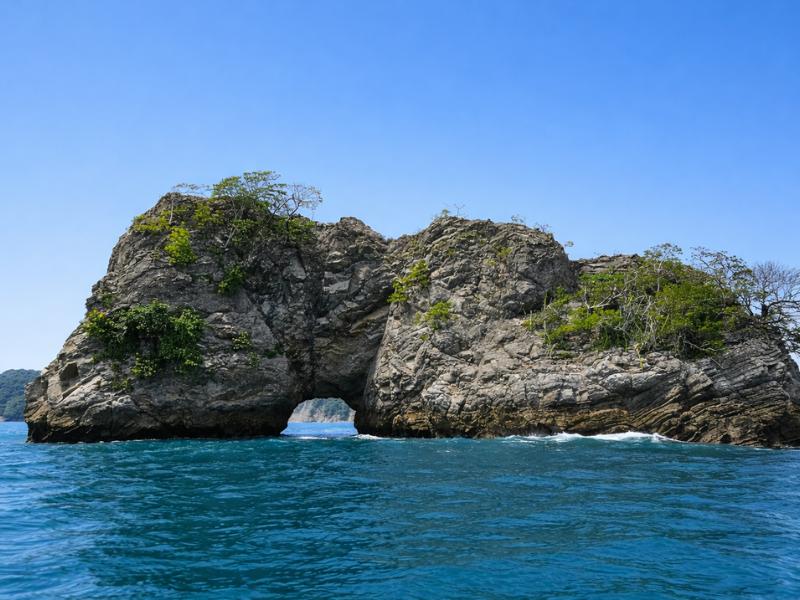
Playa Tortuga on Isla Tortuga is powdery white sand with turquoise water calm enough to float in and clear enough to snorkel a volcanic reef. No river drains into it, no town backs onto it, and no cars reach it. It is a boat day from Jacó, not a drive, and that is precisely why it looks different.
The mechanism is simple. The mainland beaches near Jacó sit at the receiving end of rivers coming off the mountains, carrying sediment and dark volcanic material into the surf zone. Isla Tortuga sits offshore in the Gulf of Nicoya, away from river outflow, sheltered from the direct Pacific swell, with coral and shell material in its sand rather than river silt.
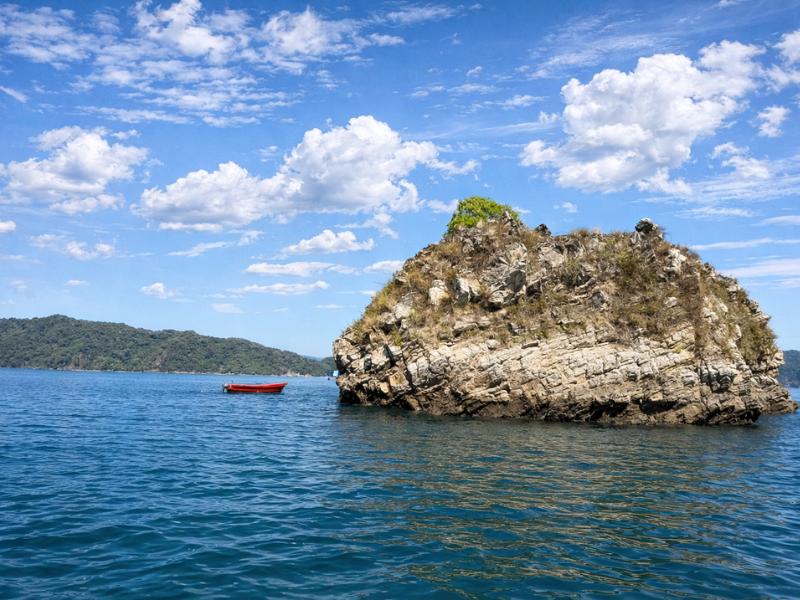
Isla Tortuga and the Negritos islands are separate places in the Gulf of Nicoya. Some tours pass Negritos for wildlife viewing before visiting Tortuga. The excursions recommended here return the same day and do not include accommodation.
What the island day gives you that a Jacó beach cannot
- White sand and water clear enough to see fish from the surface.
- A reef with parrotfish, angelfish, morays, eagle rays and the occasional turtle.
- Calm water suitable for weak swimmers and children in vests.
- Wildlife on the way: dolphins are common, humpback whales pass between July and November.
- A grilled fish or chicken lunch on the sand, included on most full-day tours.
The Jacó departure runs about ten hours door to door and usually starts with the Tarcoles River bridge crocodile stop, which is a genuinely good 15 minutes of wildlife on the way to the boat. Expect a listed price around $115 and check the live listing before booking. From Puntarenas the speedboat option runs closer to $80 with a longer overall day.
Check the departure and cancellation terms for your actual travel date before arranging connecting transport. The product listings do not establish a guaranteed early landing, a fixed island-wide boat cap or how often a departure sells out.
How should you sequence a beach week based in Jacó?
Alternate high-effort and low-effort days, put the island trip early in the week so weather leaves you a spare day, and treat the middle of the day as indoor or shaded time rather than beach time. Sun on this coast between 11am and 2pm is stronger than most visitors calibrate for.
| Day | Plan | Why this order |
|---|---|---|
| Day 1 | Arrive, Playa Jacó sunset walk, surf shop reconnaissance | Zero logistics after a travel day |
| Day 2 | Isla Tortuga boat day from Jacó or Herradura | Early in the week leaves room to reschedule |
| Day 3 | Morning surf lesson at Jacó, shaded afternoon | Recovery day after a long boat day |
| Day 4 | Punta Leona area: Playa Blanca or Playa Mantas | Calm water and a change of scenery |
| Day 5 | Herradura swim, marina lunch, Hermosa sunset session watching | Two beaches, minimal driving |
| Day 6 | Rainforest or waterfall inland, or a second island day | Breaks up a week of salt and sun |
One last piece of practical advice that applies to every beach on this list. Do not leave anything in a parked car, on any of these beaches, at any time of day. Take the minimum to the sand, keep it in one bag, and keep the bag where you can see it from the water. That single habit removes the most common way a good beach day goes wrong on this coast, and it holds just as true at the quiet coves as at busy Playa Jacó.
Two things worth reading alongside this list. The mainland beaches here are not snorkelling water, and where else to snorkel on this coast explains why the river outflow and the groundswell work against you, which is the honest reason the boat day exists. And if the white sand and calm water are what you are actually after, the full Tortuga Island travel guide covers how the day works, what to pack, and what a tour costs from each departure point.
Finally, if a boat day appeals, the Jaco departure adds the Tarcoles crocodile bridge on the way to the water, and the full price breakdown compares it against the cheaper Puntarenas options. Check what to pack before you go: the sun on an open deck is a different problem from the sun on a town beach.