Is Puntarenas, Costa Rica Worth Visiting? An Honest Look
Puntarenas gets written off in a sentence by half the guidebooks and defended fiercely by the people who actually use it. Both camps have a point. Here is what the port city is genuinely good for.
Booking Choice: An island lunch, snorkeling equipment and a Negritos wildlife stop. Explore Puntarenas Island Day: Shared Or Private
Start: Puntarenas. Confirm age rules and extras before booking.
Price note: fixed dollar amounts and totals in the editorial examples below are planning illustrations, not current quotes. Prices, child rates and private/shared options must be checked for your date and full party. The provider calendars and booking pages carry current offers.

Puntarenas at a glance
Journey times for the legs that matter when you plan a Puntarenas departure, drawn from the crossing times quoted by the operators listed on this site.
Is Puntarenas worth visiting on its own, or only as a launch point?
Puntarenas is a working Pacific port and a Costa Rican beach town, not a resort destination. Judged as a holiday base it underwhelms most foreign visitors. Judged as the most convenient jumping-off point for Gulf of Nicoya boat trips and the Nicoya Peninsula ferry, it is genuinely useful and hard to replace.
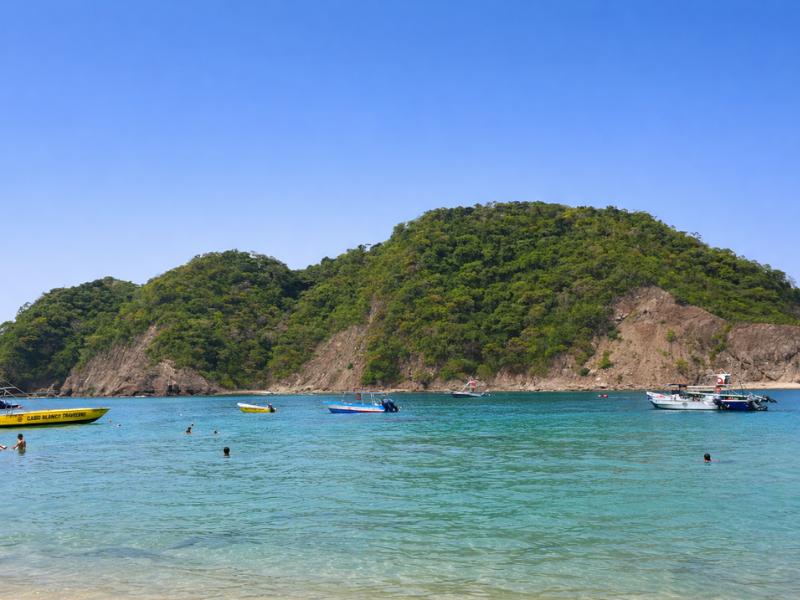
The city sits on a long, narrow sand spit that pushes several kilometres out into the Gulf of Nicoya, with the open gulf on one side and a mangrove estuary on the other. That geography is the whole story. It made Puntarenas Costa Rica's main Pacific port for a century, it gave the city water on both sides of a street grid barely a few blocks wide, and it explains why almost every boat heading to the islands in the gulf leaves from here.
Travellers who arrive expecting Tamarindo or Manuel Antonio leave disappointed within an hour. Travellers who arrive understanding that this is a real city where Costa Ricans live, work, load containers and eat ceviche on a Sunday tend to enjoy the afternoon a great deal more. The mismatch is almost always about expectation, not about the place.
There is also the simple matter of position. Puntarenas sits roughly 1.5 hours by road from Juan Santamaria Airport and San Jose, which puts a Pacific boat departure within a comfortable morning drive of the capital. Nowhere else on this coast combines that access with a ferry terminal, a cruise berth and multiple private tour docks.
What is the Paseo de los Turistas actually like?
The Paseo de los Turistas is a wide seafront promenade running along the gulf-facing side of the spit, lined with food stalls, benches, souvenir kiosks and small restaurants. It is pleasant, unpolished and busiest at weekends when Costa Rican families drive down from the Central Valley. It is not a manicured tourist boardwalk.
Walk it late in the afternoon and the character is obvious. Vendors sell shaved ice and fried snacks, teenagers play football on the sand, pelicans work the shallows, and the light across the gulf towards the Nicoya Peninsula turns genuinely beautiful for about forty minutes before sunset. Cruise-ship days bring a burst of activity around the pier and then the street empties again.
The promenade is the single best reason to spend an unhurried hour or two in Puntarenas. It costs nothing, it is flat and easy to walk with children, and it gives you an accurate read on the city within about fifteen minutes. If the Paseo appeals to you, the rest of Puntarenas probably will too. If it does not, you have your answer early and cheaply.
What should you expect from the beach?
Puntarenas beach is grey to light brown volcanic sand, not the postcard white of the islands offshore. The water is warm, calm and often murky, because the spit sits where river sediment meets the gulf. It is fine for a paddle and a sunset walk. It is not why you came to Costa Rica.
This is where the disappointment usually lands. Photographs of Playa Tortuga, the powdery white beach on the island itself, sit right next to photographs of Puntarenas in search results, and the two look nothing alike. The island is a 90-minute crossing away and sits in clear water off the Nicoya Peninsula. The city beach is estuary-adjacent, working-port water.
Set expectations accordingly and the beach becomes perfectly enjoyable on its own terms. Locals swim here. The sand is wide at low tide. Sunsets across the gulf are excellent because you are looking west over open water at the peninsula. Just do not plan a snorkelling afternoon from the city shoreline, and do not judge the region's water clarity by what you see from the Paseo.
Where do the ferries, cruise ships and tour boats actually dock?
Puntarenas has several separate water access points and they are not interchangeable. The Naviera ferry terminal serves vehicle and foot passengers to the Nicoya Peninsula. The cruise pier sits near the Paseo. Tour boats use their own docks, including a private dock in the Las Playitas neighbourhood and a marina berth at Guima Frost.
Turning up at the wrong one is the most common logistical error visitors make here, and it is an expensive one when a boat leaves at 8:30 in the morning. Always read the meeting-point line on your booking rather than assuming the ferry terminal is the default.
| Access point | What uses it | Who needs it | Practical note |
|---|---|---|---|
| Naviera ferry terminal | Vehicle and passenger ferry to Paquera on the Nicoya Peninsula | Independent travellers crossing to Montezuma, Santa Teresa, Tambor | Crossing takes roughly an hour; check the current sailing timetable before committing to a plan |
| Cruise pier | Cruise-ship calls | Cruise passengers on a port day | Shore excursions form up here; the Paseo is a short walk away |
| Las Playitas private dock | Speedboat departures to Isla Tortuga | Guests on the Puntarenas speedboat day trip | This dock has showers and changing rooms available on return, which the public terminal does not |
| Guima Frost marina | Private charter departures | Groups on a private all-inclusive island day | Private Puntarenas charters depart at 8:30 AM from here |
| Fishing and cargo berths | Commercial traffic | Nobody on a tour | Interesting to look at, not a passenger facility |
If you are booked on an organised island day, the operator will name the dock and often collect you from a hotel or a central meeting point instead. That removes the problem entirely, which is a large part of why guided departures dominate here despite the independent ferry route being cheaper.
Is the food scene a reason to stop?
For seafood on a budget, yes. Puntarenas is a fishing port, and ceviche, whole fried fish, shrimp and arroz con camarones turn up at prices well below the Pacific resort towns. The city is also the home of the churchill, a shaved-ice dessert that Costa Ricans specifically drive here to eat.
The churchill is a real local institution rather than a marketing invention: shaved ice, powdered milk, syrup, condensed milk and usually a scoop of ice cream, sold from stands along the Paseo. Ordering one is the cheapest possible way to understand why Costa Rican families treat Puntarenas as a weekend outing rather than a place to avoid.
The seafood sodas and marisquerias around the promenade and the market area do the heavy lifting for lunch. Portions are large, prices are local rather than tourist, and the fish came off a boat nearby. Budget around ten to fifteen dollars for a proper sit-down seafood plate and considerably less at a stall, though menu prices move, so treat that as an allowance rather than a quote.
What you will not find is a dense restaurant scene aimed at foreign palates. There are a handful of decent places and a great deal of ordinary ones. Eat what the port is good at and you will do well.
How safe is Puntarenas, and does that change after dark?
Daytime Puntarenas, particularly the Paseo, the ferry area and the main commercial streets, is ordinary and busy with families. Like most working ports, it warrants more care after dark, away from the promenade and around the market and back streets. The sensible approach is normal city caution rather than avoidance.
Concretely: keep phones and cameras out of sight when you are not using them, do not leave bags on the sand while you swim, use taxis or a ride app at night rather than walking unfamiliar blocks, and treat the areas away from the seafront after dark the way you would in any port city anywhere. Petty theft is the realistic risk, not anything dramatic.
Visitors on a guided island day are barely exposed to any of this. You arrive in the morning, you board, you return in the afternoon and you leave. The safety question really only becomes relevant if you are staying overnight or walking the city independently in the evening. The Costa Rica Tourism Board publishes current visitor guidance at visitcostarica.com, which is a better source than travel forums for anything official.
Should you stay overnight or just pass through?
Most visitors should pass through. Stay overnight only if you have an early boat, a dawn ferry, a very long drive behind you, or a genuine interest in Costa Rican port-city life. The city is 1.5 hours from San Jose and about an hour from Jaco, which makes a same-day arrival and departure realistic.
The argument for one night is entirely practical. An 8:00 or 8:30 AM departure from a Puntarenas dock means leaving San Jose somewhere around 5:00 to 6:00 AM if you drive in on the morning. Sleeping locally converts a punishing start into a civilised one, and it lets you take the earliest boat, which is the one that reaches the island before the midday crowd.
| Your situation | Overnight in Puntarenas? | Why |
|---|---|---|
| Booked on an early Puntarenas boat departure | Worth considering | Removes a pre-dawn drive and secures the quiet morning slot on the island |
| Taking the vehicle ferry to the peninsula | Sometimes | Useful if you want a morning sailing without a very early start from the Central Valley |
| Doing the organised full day from San Jose | No | Transport is built into the tour; you never need a Puntarenas bed |
| Based in Jaco or Herradura | No | You are close enough to travel in on the day |
| Looking for a beach holiday base | No | The peninsula and central Pacific beaches do this far better |
| Interested in Costa Rican port life and food | Yes, one night | Evening on the Paseo is the city at its most characterful |
So who is Puntarenas worth it for, and who should skip it?
Puntarenas rewards travellers who want cheap seafood, a real Costa Rican town and a boat out to the gulf islands. It frustrates travellers who came for white sand, clear water and a polished resort strip. Neither reaction is wrong. They are answers to different questions.
| Worth it for | Not worth it for |
|---|---|
| Anyone catching a boat to Isla Tortuga or the gulf islands | Travellers wanting a white-sand swimming beach at their doorstep |
| Foot or vehicle passengers taking the Nicoya Peninsula ferry | Anyone with only one beach day in Costa Rica |
| Budget seafood eaters and food-curious travellers | Visitors expecting a developed restaurant and nightlife scene |
| Cruise passengers with a half day ashore | Snorkellers hoping to swim from the city shoreline |
| Photographers who like sunsets over open water | People uncomfortable in ordinary working cities |
| Drivers breaking a long Pacific coast route | Families wanting a multi-day resort base |
The honest summary is that Puntarenas is a means far more often than an end. Its value to a visitor is measured in what it connects to: the ferry, the gulf, the islands, the peninsula beyond. Spend an afternoon there deliberately and you will find it more interesting than its reputation suggests. Build a week around it and you will wish you had gone across the water instead.
For most people reading this, the practical decision is simple. Use Puntarenas as the departure point it is very good at being, give it two or three hours of genuine attention while you are there, eat something that came out of the gulf, and spend the rest of your time where the water runs clear. More background on the city and its unusual sand-spit geography sits on its Wikipedia entry.
If you are using the city as a launch point rather than a destination, two pages here are the practical follow-up. Tours departing from Puntarenas covers both docks and what each departure includes, and the full price breakdown explains where the $80 speedboat sits against the other five options. Travellers deciding between the mainland and the peninsula should also look at whether basing yourself on the peninsula suits the trip better.